Crossroads field guides · Three ranges · Peaks and glaciers
Three great mountain ranges meet in northern Pakistan: the Karakoram, the Himalaya and the Hindu Kush. Beyond their meeting landscape near Gilgit lie five eight-thousanders, remarkable seven-thousand-metre peaks and thousands of glaciers. This guide connects that extraordinary geography with meaningful, realistic mountain journeys.
By Sultan Uddin · Crossroads Adventure · Editorial review: 6 October 2026
Where three great mountain ranges meet
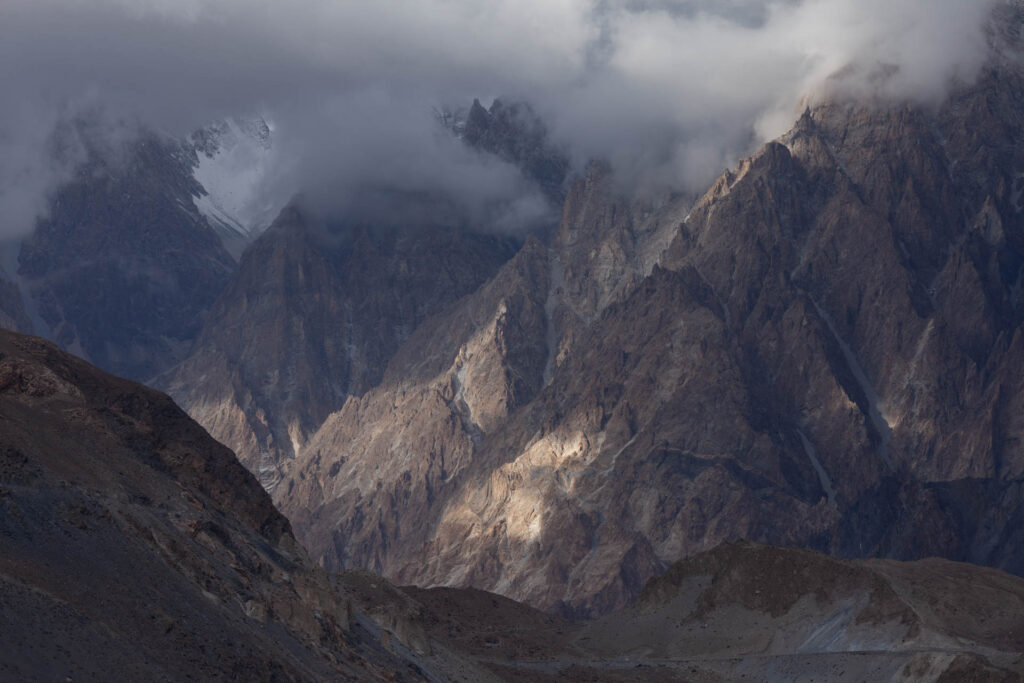
The three mountain ranges in Pakistan most associated with its northern landscapes are the Karakoram, the Himalaya and the Hindu Kush. Their meeting area is commonly identified near Jaglot and Bunji, south of Gilgit, around the confluence of the Gilgit and Indus rivers. The roadside interpretation point makes an unusually useful introduction to the region: mountains, rivers and routes can be understood together before you continue towards Hunza, Baltistan or the Nanga Parbat approaches.
The Gilgit-Baltistan Tourism destination entry identifies the three-range meeting landscape. Look at the shape of the valleys and the river junction rather than expecting three coloured lines on the ground. Mountain ranges are geographical divisions; their mapped boundaries do not always coincide with the geological units beneath them. A scientific review of northern Pakistan’s glaciations explicitly notes this distinction.
This is a roadside geographic stop, not a viewpoint from which every famous summit is visible. K2 lies deep in the central Karakoram; Tirich Mir belongs to the Chitral landscape; Nanga Parbat has its own approaches and viewpoints. A guide who can orient the river valleys adds more to the visit than a photograph beside the sign alone.
Allow time for a safe stop when your route passes the area. Confirm the stopping place and road conditions locally, stay clear of moving traffic and avoid walking down unstable slopes towards the rivers. Morning or evening light can reveal the folds of the terrain, while haze can flatten a midday view. The junction is especially meaningful at the beginning of a longer northern journey, when it gives context to the landscapes that follow.
A landscape shaped by collision, ice and rivers
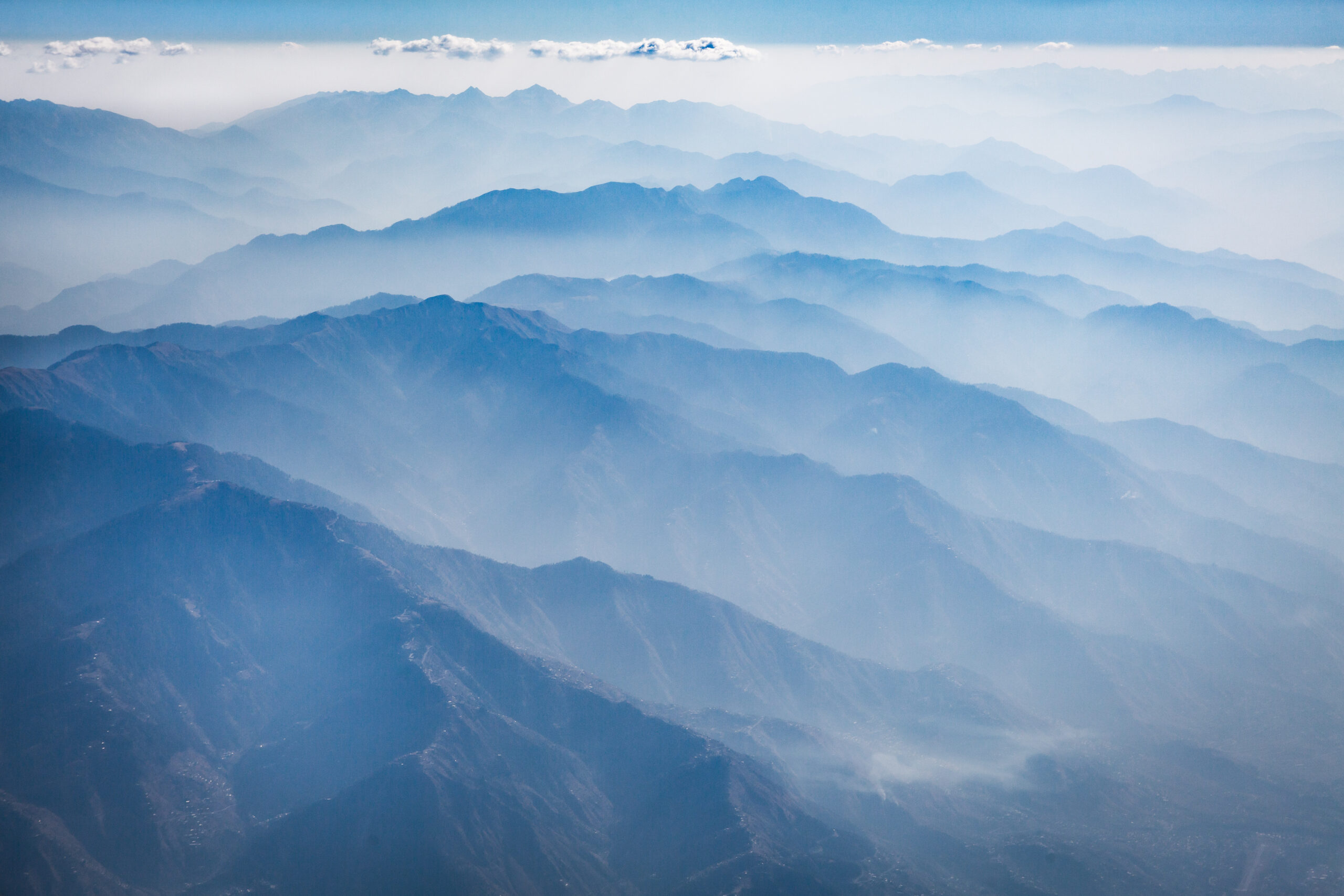
These mountains form part of the broad collision zone between the Indian and Eurasian plates. Over geological time, compression, uplift, faulting and erosion have produced enormous relief. Yet “the three ranges meet here” should not be interpreted as three tectonic plates colliding at a roadside marker. The geography is more intricate, with rock belts and structures crossing familiar travel-region names.
Glaciers occupy the high valleys, while rivers carry water and sediment into the inhabited valleys below. A snow-covered summit, a debris-covered glacier and an orchard beside an irrigation channel can therefore be parts of the same connected landscape. The mountain experience becomes richer when you notice the entire system instead of only collecting peak names.
The contrasts can be striking within one day. A dry valley floor may sit beneath ice-covered mountains; cultivated terraces may end abruptly against a steep scree slope; a river gorge may connect places whose languages, food and architecture differ. Height, aspect and access to water matter as much as latitude. “Northern Pakistan” describes a broad destination, but it does not describe one uniform climate or culture.
| Range | Highest summit | Useful journey gateways | Typical landscape focus |
|---|---|---|---|
| Karakoram | K2, 8,611 m | Skardu; Gilgit, Hunza and Nagar | Great glacier valleys, steep peaks and remote trekking routes |
| Himalaya | Everest globally; Nanga Parbat, 8,126 m, in Pakistan | Raikot-side access; Astore and the Rupal Valley | Nanga Parbat’s contrasting faces, forests and alpine meadows |
| Hindu Kush | Tirich Mir, 7,708 m | Chitral and its upper valleys | High ridges, glaciated headwaters and inhabited valley routes |
The gateways are starting points for planning, not promises of direct summit views from each town. Road travel, an approach walk and a high expedition occupy very different levels of commitment.
The Karakoram: K2, Baltistan, Hunza and Nagar
The Karakoram holds four of Pakistan’s five eight-thousanders and much of its best-known glacier trekking terrain. Its reputation rests on the concentration of high peaks and the scale of its ice systems, but visitors can experience it at many levels. A journey through Hunza and Nagar offers roadside views and village walks; a Baltoro expedition enters a remote environment where days of walking separate camps from permanent settlements.
Baltistan and the central Karakoram
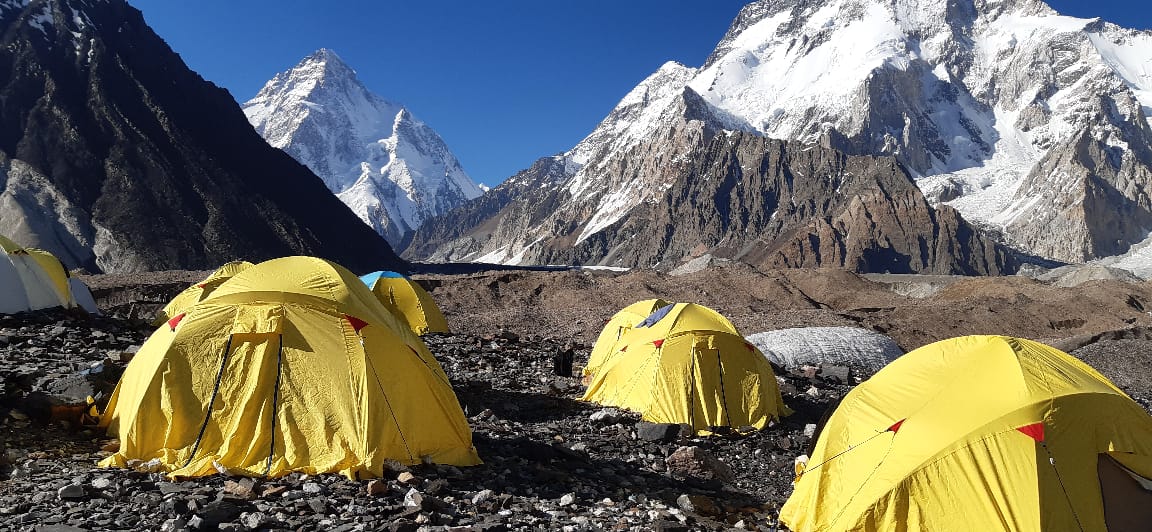
Skardu is the principal planning gateway for the Baltoro approach. The journey into the mountains involves additional road travel and a sustained trek, with conditions changing as the route reaches moraine and ice. Concordia, where major glacier branches meet, is celebrated for its surrounding peaks. Continuing towards K2 Base Camp is an extension of that trekking landscape, not an ascent of K2 itself.
A map helps explain why K2, Broad Peak and the Gasherbrums appear together in expedition discussions. They belong to the same broad central Karakoram region, yet their approaches and viewpoints are distinct. Do not assume that one photograph at Concordia will contain all four eight-thousanders. The Gasherbrum group lies beyond a different part of the upper Baltoro system, and any extra objective must be included deliberately in the route.
Hunza, Nagar and Upper Hunza
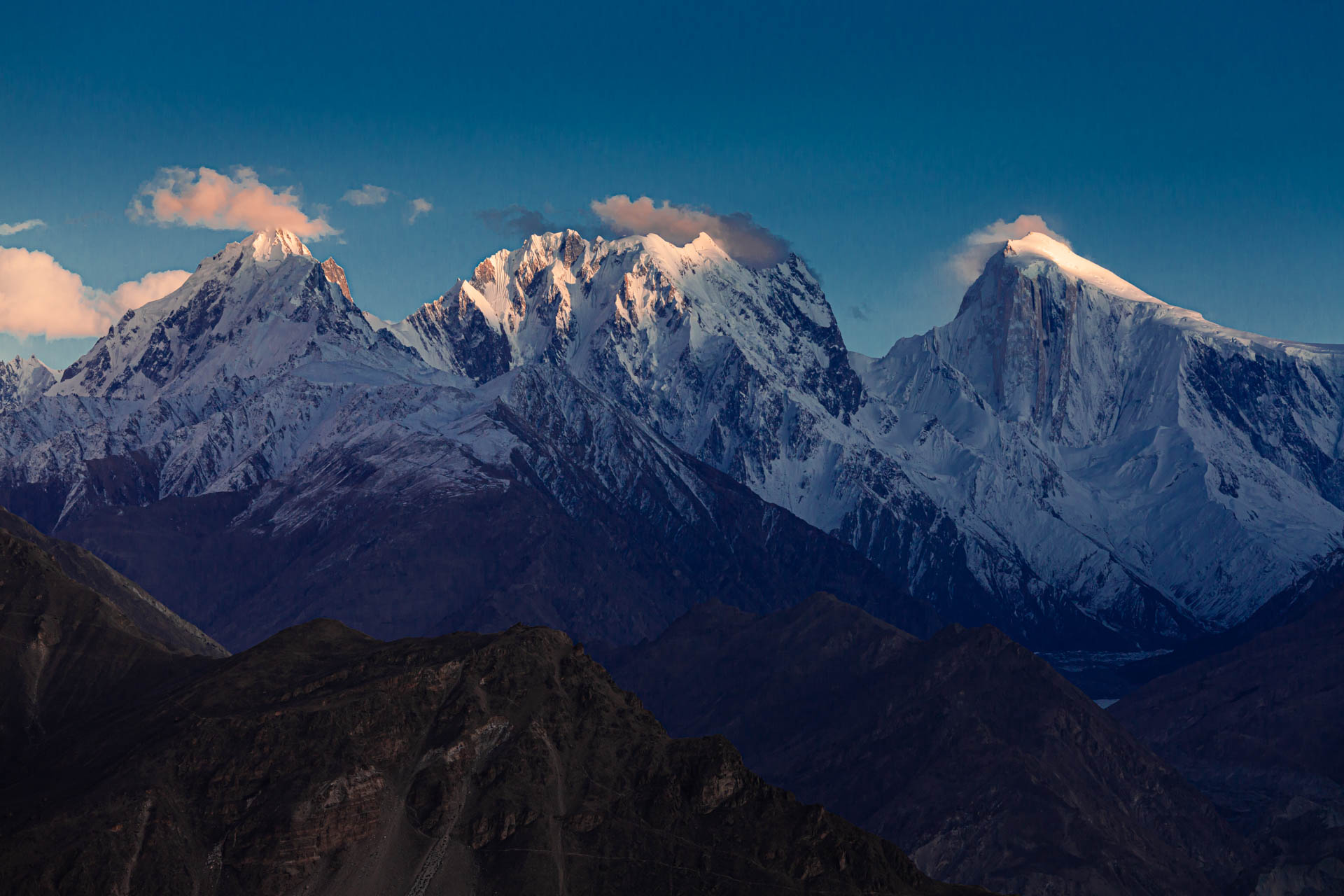
Farther west, the Karakoram Highway gives travellers access to a different mountain experience. Rakaposhi dominates important viewpoints in the Hunza–Nagar landscape. The official Rakaposhi entry gives its height as 7,788 metres. Viewing it from the road, walking towards a meadow and undertaking a base-camp trek are separate activities.
Upper Hunza introduces the Batura and Passu landscapes, while side valleys lead towards places such as Shimshal. These are inhabited regions with farms, schools, historic settlements and working mountain communities. Include time for the valley itself: a rushed drive between viewpoints can miss the human landscape that gives the mountains meaning.
For a walking journey, compare our short treks in Hunza and Nagar and Shimshal Valley trekking guide. A shorter route can still involve steep ground, exposed paths or glacier crossings. Duration alone is a poor measure of difficulty.
The Himalaya: Nanga Parbat and its different faces
Nanga Parbat is Pakistan’s Himalayan eight-thousander. Its separation from the Baltoro group matters when planning: a K2 approach and a Nanga Parbat approach cannot be treated as neighbouring day excursions. The mountain’s different sides also provide distinct experiences rather than interchangeable versions of one trek.
The Raikot-side landscape is associated with Fairy Meadows and views towards the mountain’s north-facing glaciers and walls. The Rupal side, reached through the Astore region, brings a different valley setting and perspective on the massif. Choose a side according to your available time, walking ability, interests and current access. A scenic meadow stay is not automatically a complete base-camp itinerary.
Nanga Parbat also illustrates why altitude and relief are different ideas. The height of the summit is one figure; the vertical rise above nearby valleys is another. For a traveller, the important figures are the elevation of the accommodation, the highest point reached on foot, and the amount of ascent and descent during the day.
Forest, grassland, cultivated land and glacial terrain can all appear along an approach, but conditions change sharply with elevation and season. A comfortable afternoon in a meadow does not predict the temperature higher on the route or after sunset. Build a journey around realistic stages, suitable clothing and enough time to respond to changing weather.
The Hindu Kush: Chitral beyond the summit skyline
The Hindu Kush shapes much of Chitral’s high mountain identity. Tirich Mir, commonly given as 7,708 metres, is the range’s highest mountain. The elevation appears in a World Bank environmental assessment for Khyber Pakhtunkhwa. It belongs to a region where substantial seven-thousand-metre mountains stand above valleys with long histories of settlement and travel.
A Chitral journey can focus on valley landscapes, local heritage and selected walks without becoming a climbing expedition. Remote approaches towards the highest mountains require a different plan, including experienced local support and current permission checks. The mountain name on an itinerary should explain what you will actually do: see it from a suitable viewpoint, approach its valley or enter a specialist climbing route.
Chitral also offers a meaningful cultural dimension. Conversations with local hosts, village architecture, agricultural seasons and regional music can occupy as much of a journey as mountain photography. Communities should be approached on their own terms, with consent for portraits and respect for private and ceremonial spaces.
If travelling between Chitral and Gilgit-Baltistan, avoid treating a high pass as a guaranteed shortcut. Access is seasonal and conditions must be checked. Our Shandur guide explains the festival landscape and its practical planning considerations. Combining several regions works best when travel days and contingency time are visible in the itinerary.
Pakistan’s five eight-thousanders
An eight-thousander is a mountain whose summit rises above 8,000 metres. In the conventional list of fourteen such mountains worldwide, five are in Pakistan or on its borders. Four belong to the Karakoram and one to the Himalaya. The UIAA’s discussion of 8,000-metre peaks also explains why main mountains and subsidiary summits should not be counted indiscriminately.
| Mountain | Elevation | World rank | Range | Visitor context |
|---|---|---|---|---|
| K2 | 8,611 m | 2 | Karakoram | Baltoro, Concordia and the K2 Base Camp approach |
| Nanga Parbat | 8,126 m | 9 | Himalaya | Raikot and Rupal approaches offer different perspectives |
| Gasherbrum I | 8,080 m | 11 | Karakoram | Upper Baltoro expedition terrain |
| Broad Peak | 8,051 m | 12 | Karakoram | Part of the Concordia–Godwin Austen glacier landscape |
| Gasherbrum II | 8,035 m | 13 | Karakoram | Gasherbrum glacier approach; specialist expedition planning |
The figures above follow the mountain table reproduced in COMSATS’ Pakistan destination reference. Older publications sometimes list slightly different heights for Gasherbrum I and Broad Peak. Such variation should be acknowledged rather than mixed silently within one table.
All five are serious mountaineering objectives. Their presence enriches a trekking or photography journey, but their summit heights do not describe a visitor’s route. A K2 Base Camp trek does not reach 8,611 metres, and a photograph of Nanga Parbat does not require climbing to 8,126 metres. Ask for daily walking distances, sleeping elevations, terrain and evacuation arrangements separately.
A summit expedition involves technical experience, acclimatisation, specialised equipment, permits and a much larger logistical commitment than a base-camp trek. No eight-thousander should be described as an easy introductory climb. A sensible first mountain journey chooses the experience that matches the traveller, rather than choosing solely by the prestige of the summit name.
The seven-thousanders: much more than supporting scenery
Pakistan’s mountain story extends far beyond the five highest summits. Mountains between 7,000 and 7,999 metres include some of the region’s most distinctive skyline features and challenging climbing objectives. For many visitors, Rakaposhi, Diran or Ultar Sar becomes more personally memorable than a distant eight-thousander because it dominates the valley where they spend time.
| Mountain | Approximate elevation | Range and regional context |
|---|---|---|
| Distaghil Sar | 7,885 m | Karakoram; Hispar Muztagh |
| Masherbrum | 7,821 m | Karakoram; Baltistan |
| Rakaposhi | 7,788 m | Karakoram; Nagar |
| Tirich Mir | 7,708 m | Hindu Kush; Chitral |
| Passu Sar | 7,478 m | Karakoram; Upper Hunza |
| Ultar Sar | 7,388 m | Karakoram; Hunza |
| Diran | 7,266 m | Karakoram; Nagar–Bagrot mountain landscape |
| Spantik | 7,027 m | Karakoram; Baltistan |
These heights are documented across official destination material and mountaineering records, including the American Alpine Journal’s Distaghil Sar regional account, its Masherbrum reference, its Passu Sar regional report and the Himalayan Journal’s Diran expedition account. Survey and naming differences can produce small variations.
Why avoid a single dramatic total for Pakistan’s seven-thousanders? Lists do not always use the same definition of a mountain. Some count independent summits with a specified prominence; others include named tops along a ridge or subsidiary summits of a larger massif. A number without its inventory and counting method is difficult to verify. The table is more useful for travellers because it connects recognizable mountains with their regions.
A height below 8,000 metres does not make a mountain straightforward. Route steepness, ice conditions, avalanche exposure, weather and remoteness can matter more than the final elevation. Even a base-camp approach needs its own assessment. The value of these mountains for a visitor often lies in a well-chosen viewpoint, a valley walk or a supported trek rather than a summit attempt.
Thousands of glaciers: understanding the latest inventory
Pakistan’s high mountains contain thousands of glaciers, from small ice bodies in sheltered basins to extensive valley systems. A national inventory presented in 2024 mapped 13,032 glaciers. The Italian Agency for Development Cooperation’s announcement describes the Glaciers and Students project, involving remote sensing, fieldwork and university collaboration.
The University of Milan research group reports a mapped area of approximately 13,547 square kilometres. These are inventory figures with a publication date and a mapping method, rather than a real-time count of every ice body on the day you travel.
You may still encounter older descriptions saying “more than 7,000 glaciers” or quoting 7,253. Different inventories use different imagery, dates, boundaries and methods for separating ice bodies, including debris-covered ice. A larger mapped count does not by itself demonstrate that Pakistan has gained glaciers. It may reflect improved identification or different division of connected ice. For a current general guide, the 2024 inventory should be identified clearly instead of presenting an older figure as an unquestioned total.
Why a glacier can look like a field of stones
Many valley glaciers carry rock debris delivered from the surrounding slopes. Their lower sections may therefore appear grey or brown rather than white or blue. Ice can remain beneath the surface, with meltwater channels, unstable margins and crevasses complicating movement. A photograph of rubble alone is not enough to decide that a glacier has disappeared.
The safe visitor experience is often a viewpoint overlooking a glacier, not a walk across it. Where a route involves ice or moraine travel, use current local route knowledge and appropriate guiding. Do not step onto an unfamiliar glacier simply because its surface resembles an ordinary rocky path.
Why the ice matters beyond the mountains
Snow and glacier melt contribute to the headwaters of the Indus system. The timing of water availability matters to settlements, agriculture and infrastructure downstream. Glaciers are therefore more than scenery: they connect the high mountains with everyday life far below. Keep that connection in mind when you see irrigation channels crossing an otherwise dry valley.
Glacier landscapes worth understanding
Baltoro and the Concordia approach
Baltoro is the best-known glacier landscape for journeys towards Concordia and K2 Base Camp. Its scale is experienced gradually, through changing valley shapes, moraine terrain and increasingly imposing mountain walls. This is a sustained camping trek with remote sections. It deserves its own itinerary rather than a hurried addition to a general sightseeing journey.
Biafo, Hispar and the high traverse
The Biafo and Hispar glacier landscapes are associated with long, remote traverses and high mountain terrain. Routes linking them involve a different level of commitment from a valley viewpoint or a short meadow trek. Crevassed terrain, weather, navigation and camp logistics need experienced expedition planning. Do not infer suitability from an attractive map line or a photograph of broad snowfields.
Batura and Passu in Upper Hunza
Upper Hunza offers opportunities to understand glacier landscapes within a journey that also includes villages and the Karakoram Highway. A roadside panorama, a guided walk beside the glacier and a longer Batura trekking route have different demands. Specify the intended activity when discussing access and equipment; “visit Batura” is too vague to define an itinerary.
Nagar, Minapin and the Hunza side valleys
Journeys around Nagar and Minapin can connect views of Rakaposhi and Diran with glacier-fed valleys and high meadows. Other Hunza routes introduce Passu and Ghulkin glacier terrain. Our Patundas guide explains one more demanding viewpoint journey and its glacier-related planning. A beautiful view does not remove the need to understand the approach.
Siachen is another major Karakoram glacier name, but it lies in a sensitive disputed border region and should not be presented as an ordinary recreational extension. For a practical comparison of visitor landscapes, continue with our Pakistan glacier guide.
Changing ice and the Karakoram anomaly
The phrase “Karakoram anomaly” refers to observed patterns in which parts of the Karakoram showed relatively stable or increasing glacier mass over particular study periods, unlike widespread losses elsewhere. It does not mean every glacier behaves alike or that the range is protected permanently from warming. The ICIMOD discussion of Hunza glacier observations is specific about its region and historical period.
Some glaciers also surge: they can move forward rapidly because of changes in glacier flow. An advancing front is not automatically evidence of increased total ice mass. NASA’s Karakoram glacier imagery helps illustrate how individual glaciers can behave differently.
Across the wider Hindu Kush Himalaya, changing snow and ice create serious concerns for water supplies, ecosystems and mountain hazards. ICIMOD’s HI-WISE assessment explains the regional evidence. Regional findings should not be rewritten as if they were measurements for every Pakistani glacier.
For a journey, the practical consequence is simple: route conditions need current assessment. Glacier crossings, river levels and access roads can change. Allow local teams to alter a walk when conditions require it, and do not expect a trail to remain identical to an old photograph or track.
Choose the mountain experience that fits your journey
Start with what you want to experience rather than the height of a mountain. You may want broad views and comfortable valley stays, a few days of walking, a sustained camping trek or a technical climbing expedition. These goals produce different itineraries, budgets and preparation requirements.
| Experience | Possible regional focus | What to clarify |
|---|---|---|
| Road views and valley culture | Gilgit, Hunza, Nagar or Chitral | Driving time, walking surfaces, viewpoint access and accommodation |
| Selected day walks or short treks | Hunza–Nagar valleys; chosen Nanga Parbat approaches | Ascent, exposure, sleeping elevation and seasonal conditions |
| Sustained base-camp trekking | Baltoro and K2; a defined Nanga Parbat route | Camp sequence, acclimatisation, support and evacuation arrangements |
| Glacier traverse or technical expedition | Remote Karakoram or Hindu Kush objectives | Experience, equipment, specialist guiding, permits and contingency days |
Season and weather
Summer is the broad planning season for many high trekking routes, but there is no single best month for all three ranges. Spring or autumn can suit some lower valley journeys; high passes and camps have narrower usable windows. Snow, wind and cold remain possible at altitude during the warmer months. Choose the season for the exact route and sleeping elevations.
Time and transport
A journey that includes Hunza, Baltistan, Nanga Parbat and Chitral needs substantial travel time. Do not compress all four into a schedule that spends most days changing vehicles. Flights and mountain roads can be affected by weather or disruption, so build buffer time before important onward connections and keep a workable alternative plan.
Altitude, permits and support
Ask for each night’s sleeping elevation as well as the highest walking point. Fitness does not prevent altitude illness. The CDC Yellow Book recommends gradual ascent and stresses that susceptibility varies. Discuss individual health and medication questions with a qualified clinician before departure.
Permission requirements depend on the route, activity, nationality and protected or restricted areas involved. Confirm them for the actual itinerary rather than relying on old fee tables. Insurance should cover the planned activity and altitude, including the relevant rescue arrangements. Ask who makes weather decisions, how the team communicates in remote areas and what happens if a participant must turn back.
Travel with respect for people and mountain landscapes
The three ranges are homes and working landscapes. Local guides, drivers, cooks, porters and hosts make mountain journeys possible through knowledge that cannot be replaced by a downloaded route. Plan with clear working conditions, appropriate equipment and realistic loads; ask how your journey supports the people providing that expertise.
Carry waste out of camps, minimise packaging before departure and follow local arrangements for sanitation. Streams and glacier meltwater are part of the water supply, not convenient places to wash with detergents or discard scraps. Stay on established routes where appropriate, keep distance from wildlife and respect grazing land and irrigation systems.
Photography also needs care. Ask before photographing individuals or entering private spaces, and avoid treating a village as a stage set. A mountain guide can help explain local etiquette, but consent belongs to the person being photographed. A thoughtful visit leaves room for ordinary life to continue around you.
Pakistan’s mountains reward attention rather than haste. The meeting of the ranges is an excellent starting point; the deeper experience comes from understanding the rivers, glaciers, communities and routes that connect them. Whether you choose a valley journey or a remote trek, make the geography serve a realistic and respectful plan.
Frequently asked questions
Where do the Karakoram, Himalaya and Hindu Kush meet?
The commonly identified meeting landscape is near Jaglot and Bunji, south of Gilgit, around the Gilgit–Indus river confluence. It is a geographic interpretation point; the range boundaries are not visible lines or a single three-plate tectonic junction.
How many glaciers are there in Pakistan?
The inventory presented in 2024 mapped 13,032 glaciers, covering approximately 13,547 square kilometres. Quote the inventory year because mapping methods and definitions differ from older counts.
What are Pakistan’s five eight-thousanders?
K2, Nanga Parbat, Gasherbrum I, Broad Peak and Gasherbrum II. K2 and the three Baltoro-region mountains belong to the Karakoram; Nanga Parbat belongs to the Himalaya.
Is Tirich Mir an eight-thousander?
No. At approximately 7,708 metres, Tirich Mir is a seven-thousander and the highest mountain of the Hindu Kush.
Can I see K2 from the Karakoram Highway?
K2 is deep in the central Karakoram and is not a standard highway viewpoint. The usual trekking approach runs through the Baltoro landscape towards Concordia and beyond.
Can a beginner experience Pakistan’s high mountains?
Yes, through a suitable road-based journey, valley stay or carefully chosen walk. Remote glacier treks and climbing expeditions require different experience and preparation. Match the actual terrain and sleeping elevations to your ability.
Are there only three mountain ranges in Pakistan?
No. The three great northern ranges are the focus here. Other ranges include the Hindu Raj, Sulaiman, Kirthar and Salt Range, with different landscapes and travel considerations.
People · Places · Purpose
Plan a journey around your interests
Tell us your dates, starting point and preferred pace. We will discuss a private route with realistic travel days and appropriate local support.
Discuss your private journey →Sources and editorial notes
Reviewed 6 October 2026. Glacier statistics refer to the inventory presented in 2024. Summit elevations are widely published reference figures and may vary slightly between surveys. Practical pacing and route comparisons are Crossroads planning guidance; reconfirm access and permissions before departure.
- Gilgit-Baltistan Tourism: the three-range meeting landscape
- University of Milan: 2024 glacier inventory and mapped area
- AICS: Pakistan’s 13,032 mapped glaciers
- COMSATS destination reference: eight-thousander table
- American Alpine Club: Spantik reference
- American Alpine Journal: Ultar Sar reference
- ICIMOD: regional snow and ice assessment
- CDC Yellow Book: altitude and acclimatisation