The three great mountain ranges of Pakistan, the Karakoram, the western Himalayas, and the Hindu Kush, together hold so much glacial ice that scientists and geographers have given the entire Hindu Kush-Himalaya-Karakoram system a single name: the Third Pole. After Antarctica and the Arctic, this is the largest reservoir of fresh water ice on Earth. Pakistan sits at the heart of this system, and its glaciers, which range from giants stretching over 70 kilometres to hundreds of smaller valley glaciers tucked into the folds of the ranges, are among the most significant geological and hydrological features anywhere in Asia.
Pakistan’s Glaciers in Numbers
The Major Glaciers of Pakistan
| Glacier | Length | Range | Location | Global Distinction |
|---|---|---|---|---|
| Siachen | 76 km | Karakoram | Eastern Karakoram | 2nd longest non-polar glacier in the world |
| Biafo | 67 km | Karakoram | Hispar Valley, Gilgit-Baltistan | 3rd longest non-polar glacier in the world |
| Baltoro | 63 km | Karakoram | Baltoro Muztagh, Skardu | Gateway to 4 eight-thousanders including K2 |
| Batura | 57 km | Karakoram | Batura Muztagh, Upper Hunza | Longest glacier in Pakistan outside Baltistan |
| Hispar | 49 km | Karakoram | Hispar Valley, Nagar | Connects with Biafo to form 120 km glacial highway |
| Panmah | 44 km | Karakoram | Central Karakoram NP, Skardu | 6th largest in the Karakoram system |
| Godwin-Austen | 35 km | Karakoram | Baltoro Muztagh, Skardu | Joins the Baltoro; named for K2’s first explorer |
| Chiantar | 34 km | Hindu Kush | Chitral, KPK | Largest glacier in the Hindu Kush range of Pakistan |
| Rupal | varies | Himalayas | Diamer, Gilgit-Baltistan | Below Nanga Parbat’s Rupal Face, the world’s highest mountain wall |
| Passu | varies | Karakoram | Gojal, Upper Hunza | Visible directly from the Karakoram Highway |
The Siachen Glacier: The World’s Second Longest Non-Polar Glacier
The Siachen Glacier in the eastern Karakoram is the longest glacier in Pakistan and the second longest non-polar glacier in the world, after the Fedchenko Glacier in Tajikistan. Stretching 76 kilometres from its origin at Indira Col at 5,753 metres down to its terminus at 3,620 metres, Siachen and all its tributary glaciers together cover an area of approximately 700 square kilometres. The name comes from the Balti language: sia refers to the wild rose species that grows in abundance beside the glacier, and chen means any object found in great quantity. The glacier is thus, beautifully, “the place where roses grow in abundance.”
Average winter snowfall at Siachen exceeds 10 metres, and temperatures can fall to minus 50°C at the higher elevations. The glacier feeds the Nubra River which flows into the Shyok, which in turn drains into the Indus. Siachen’s meltwater travels the entire length of Pakistan before reaching the sea, sustaining agriculture and communities for thousands of kilometres downstream. The glacier is currently inaccessible to civilian visitors due to its status as a militarised zone in a territorial dispute, but it remains one of the most geologically significant features in South Asia.
The Baltoro Glacier: The Throne Room of the World
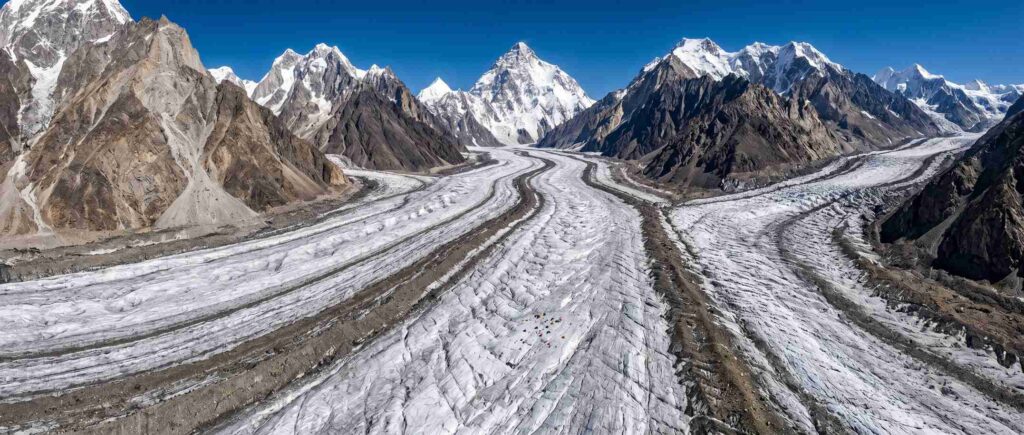
The Baltoro Glacier is the most celebrated glacier in Pakistan and arguably the most famous trekking glacier in the world. Located in the Baltoro Muztagh sub-range of the Karakoram, it flows 63 kilometres from the peaks surrounding Concordia down to its snout near Askole. Along its length, four of the world’s fourteen eight-thousanders rise directly from its edges or the ridges immediately above it: K2 (8,611m), Gasherbrum I (8,080m), Broad Peak (8,051m), and Gasherbrum II (8,035m). Mountaineers have called Concordia, the point where the Baltoro meets the Godwin-Austen Glacier at the foot of K2, the “Throne Room of the Mountain Gods.”
The Baltoro is classified as a valley glacier, flowing through a trough carved by the same glacial process over millions of years. Its surface is largely covered with a layer of rock debris called a moraine, which gives it its grey, rocky appearance when viewed from above. Beneath that debris the ice is deep and ancient, some of it hundreds of years old. The glacier moves approximately 70 centimetres per day, creeping slowly but measurably toward its snout. For trekkers on the approach to K2 Base Camp, walking the Baltoro is one of the most extraordinary physical journeys available anywhere on Earth.
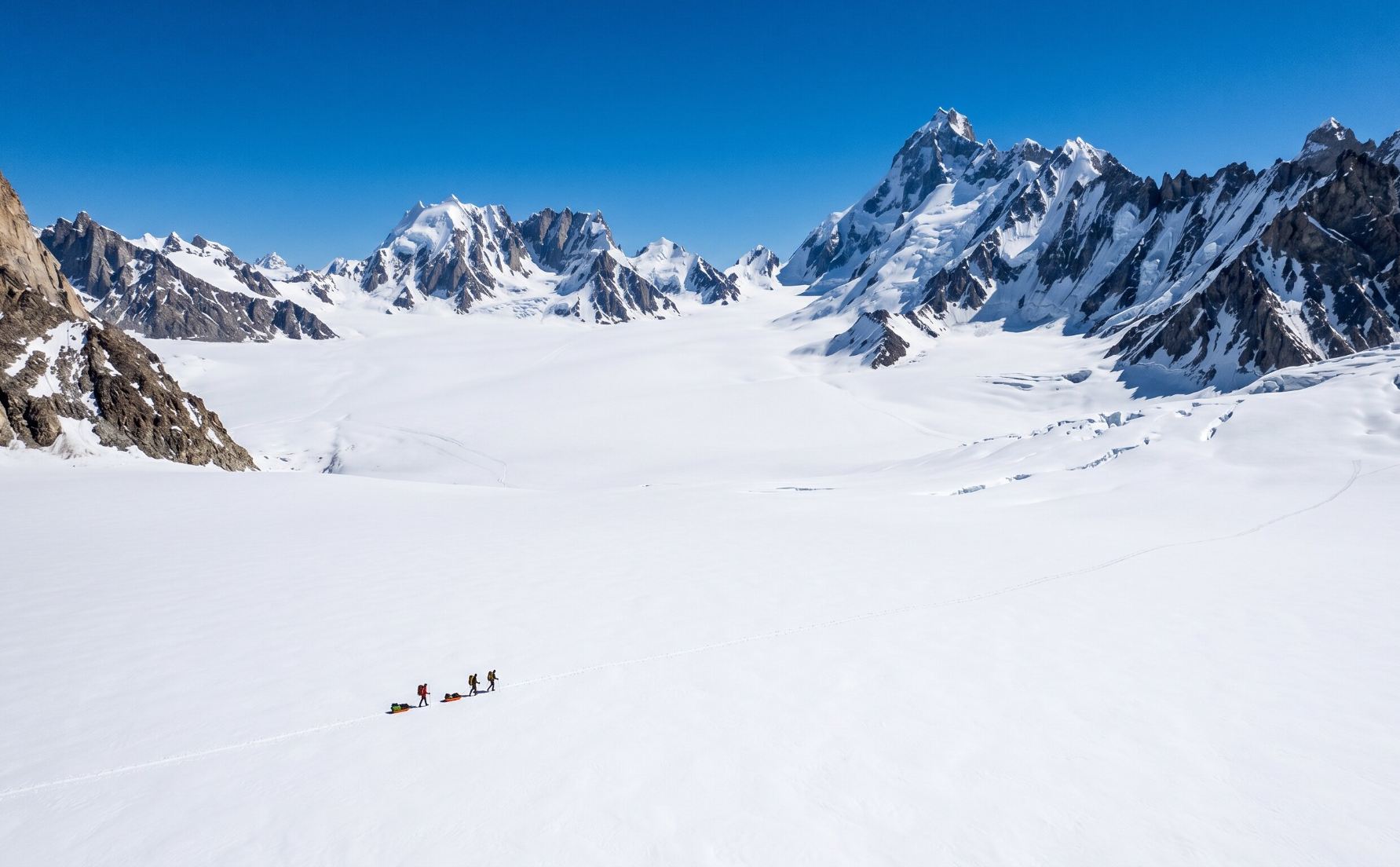
Snow Lake (Lukpe Lawo) where the Biafo and Hispar glaciers meet at 4,800 metres — one of the most remote and visually extraordinary places accessible to trekkers in Pakistan
The Biafo-Hispar: A 120-Kilometre Glacial Highway
The Biafo and Hispar glaciers connect at Snow Lake (Lukpe Lawo) at 4,800 metres to form a continuous ice corridor of approximately 120 kilometres, the longest glacial highway outside the polar regions. The Biafo runs 67 kilometres through the Karakoram from Hispar Pass down to Askole, while the Hispar runs 49 kilometres in the opposite direction through the Hispar Valley in Nagar to the Hunza side. Between them lies Snow Lake, a vast, flat, high-altitude snowfield enclosed by peaks that creates one of the most remote and visually extraordinary environments accessible to experienced trekkers anywhere in the world.
The Biafo-Hispar traverse, crossing the full 120-kilometre length of both glaciers through Snow Lake, is one of the great wilderness trekking routes on Earth. It requires a fully supported expedition with experienced guides, proper high-altitude equipment, and meticulous logistics. The glacier hosts remarkably diverse wildlife for its altitude, including ibex, markhor, Himalayan brown bear, and occasionally snow leopard along the moraine edges.
The Batura Glacier: The Giant of Upper Hunza
The Batura Glacier flows westward from the Batura Wall, a ridge holding six peaks above 7,000 metres, through the upper Hunza Valley in Gojal. At 57 kilometres it is the longest glacier in Pakistan outside of Baltistan and one of the most accessible major glaciers in the Karakoram, with its lower reaches visible from the Karakoram Highway. The snout of the glacier comes close enough to the road that travellers on the highway can see the grey, debris-covered ice terminating above the valley floor without any trekking required.
The lower reaches of Batura are characteristic of large Karakoram glaciers: a broad grey surface of rocky moraine covering the ice below, surrounded by lateral moraines and flanked by the villages and pastures of Passu and Gulmit. At its upper reaches, above the debris zone, the glacier opens into a pristine world of white ice, crevasses, and seracs beneath the extraordinary peaks of the Batura Muztagh.
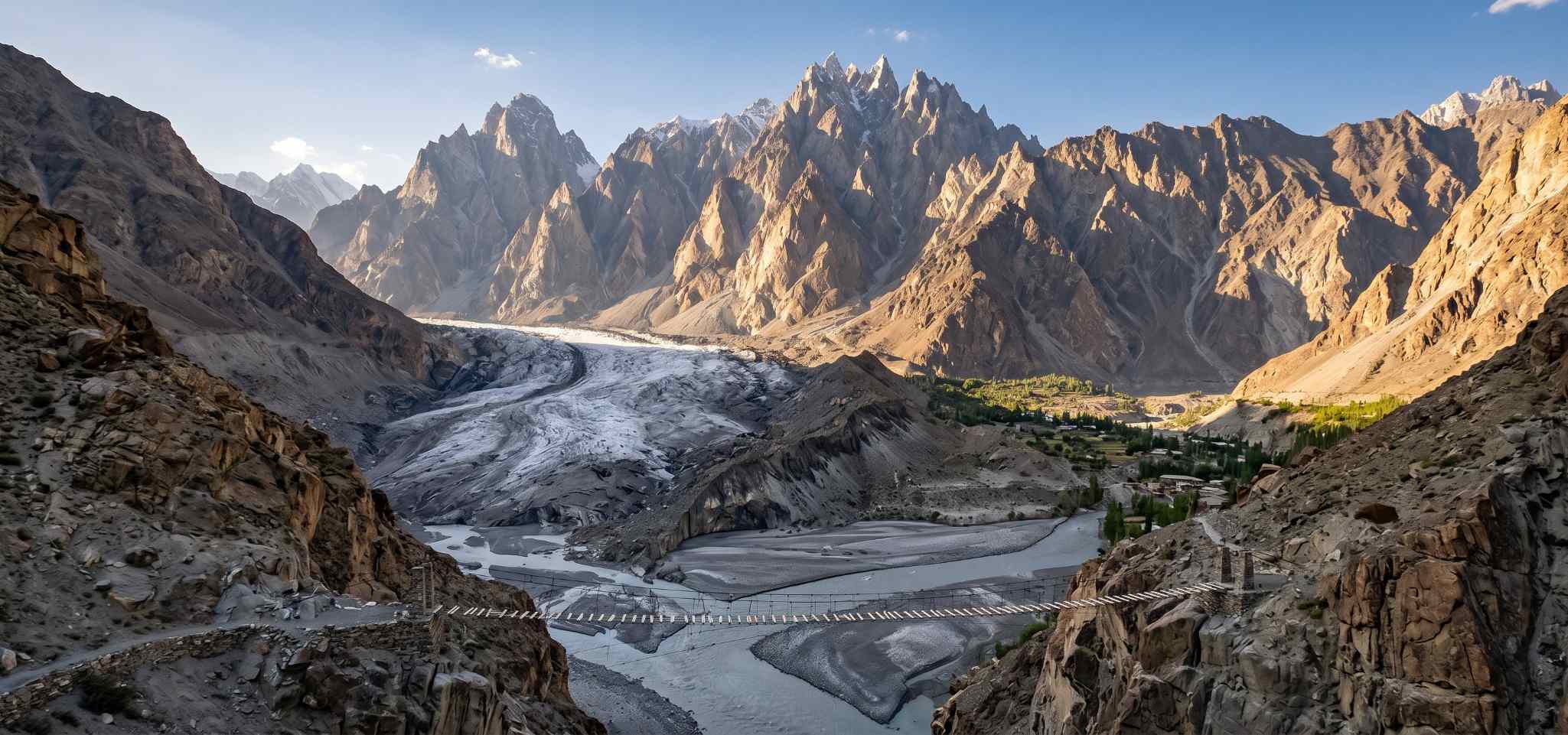
The Passu Glacier in Upper Hunza, with the iconic Passu Cones rising directly above, one of the most dramatic glacier and peak combinations visible from any road in the world
The Passu and Ghulkin Glaciers: Glaciers You Can Walk Beside
The Passu and Ghulkin glaciers in Upper Hunza are among the most accessible glaciers in Pakistan and among the most dramatically beautiful. The Passu Glacier flows directly toward the village of Passu, its snout terminating close enough to the Karakoram Highway that the ice is visible from the road. Above the glacier, the extraordinary spires of the Passu Cones (Tupopdan) rise to over 6,100 metres in a series of needle-like formations that are among the most photographed peaks in Pakistan.
The Ghulkin Glacier, a few kilometres further along the highway, is even more striking in its accessibility. The glacier’s surface can be reached by a short walk from the village of Ghulkin, and the combination of the Batura Wall peaks, the ice surface, and the Karakoram Highway below creates a visual juxtaposition of human scale and geological enormity that is genuinely difficult to process. Both glaciers are part of the experience on Crossroads Adventure’s Patundas Ridge trekking expedition in Upper Hunza.
The Chiantar Glacier: The Hindu Kush’s Frozen Giant
The Chiantar Glacier in Chitral, Khyber Pakhtunkhwa, is the largest glacier in Pakistan’s Hindu Kush range and one of the least visited of the country’s major glaciers. At 34 kilometres it is considerably smaller than the Karakoram giants, but it sits in a landscape of quite different and extraordinary character. The Hindu Kush valleys leading to Chiantar are green and culturally rich at lower elevations, passing through communities with deep Khowar and Nuristani cultural traditions before opening into the high, bare moraine landscapes of the upper glacier approaches.
The Hindu Kush glaciers, including Chiantar, feed rivers that flow through Chitral and into Afghanistan, contributing to water systems that serve communities on both sides of the border. Their relative inaccessibility compared to the Karakoram glaciers means they have been less studied, and the full scope of their contribution to regional water systems is still being documented by glaciologists.
Why Pakistan’s Glaciers Matter Beyond Their Beauty
The Indus River System
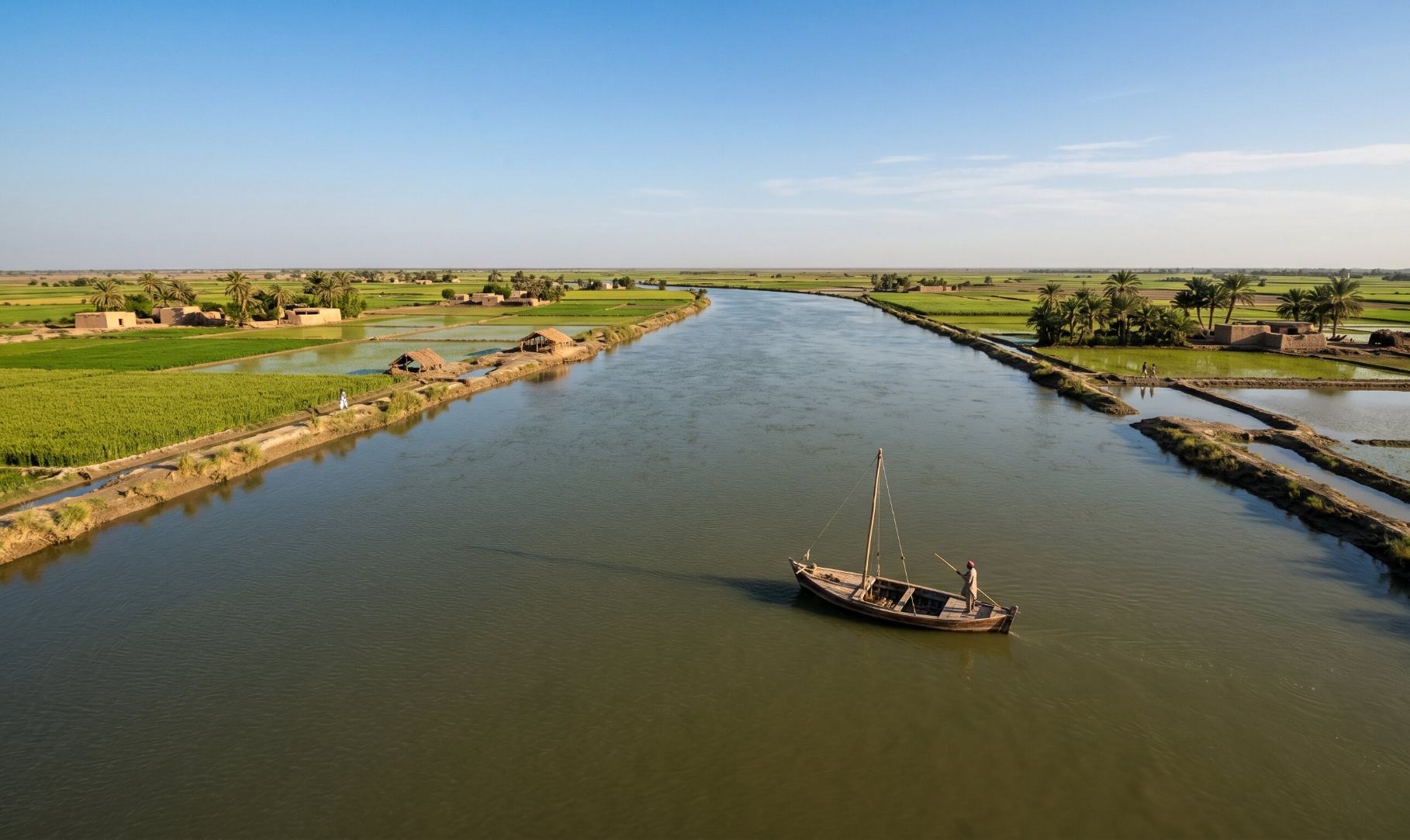
Pakistan’s glaciers are not simply natural spectacles. They are the country’s most critical freshwater infrastructure. The glaciers of the Karakoram, Himalayas, and Hindu Kush directly feed the Indus River system, which irrigates more than 90 percent of Pakistan’s agricultural land. Without glacial meltwater supplementing the Indus and its tributaries during the dry summer months, the entire agricultural economy of the country, which feeds over 220 million people, would face immediate and catastrophic water shortages. Pakistan’s glaciers are, in the most direct possible sense, the source of the country’s food security.
Hydropower Generation
Beyond agriculture, glacial meltwater is the primary source for Pakistan’s hydropower capacity. The Tarbela Dam on the Indus, the largest earth-filled dam in the world by volume, and dozens of smaller hydropower installations across Gilgit-Baltistan and KPK all depend on sustained glacial meltwater flows to generate electricity. As glaciers retreat, the long-term pattern of meltwater release changes in ways that make hydropower planning significantly more complex.
The Karakoram Anomaly
Pakistan’s Karakoram glaciers exhibit a scientifically documented phenomenon known as the Karakoram Anomaly. While glaciers globally are retreating in response to rising temperatures, many Karakoram glaciers have remained stable or even advanced over recent decades. Scientists believe this is partly because the debris covering Karakoram glaciers acts as an insulating layer that reduces surface melting, and partly because the specific precipitation patterns of the Karakoram deliver heavy snowfall at high elevations that replenishes ice mass. The anomaly makes Pakistan’s glaciers the subject of significant ongoing scientific interest and research.
Glacial Lake Outburst Floods: A Growing Risk
While the Karakoram Anomaly offers some protection for the largest glaciers, climate change is creating a different and serious problem across Pakistan’s glaciated regions. As glaciers melt at their edges and termini, they form glacial lakes dammed by moraines or ice. When these dams fail, the resulting Glacial Lake Outburst Floods (GLOFs) can release enormous quantities of water in minutes, destroying villages, roads, and bridges far downstream. Pakistan has more than 3,000 glacial lakes, of which approximately 33 are considered at risk of outburst. GLOFs have become increasingly frequent and destructive, particularly in Gilgit-Baltistan and Chitral, making glacier monitoring and early warning systems a critical national infrastructure priority. According to the United Nations Development Programme Pakistan, the country is among the world’s most vulnerable nations to climate-related glacial hazards.
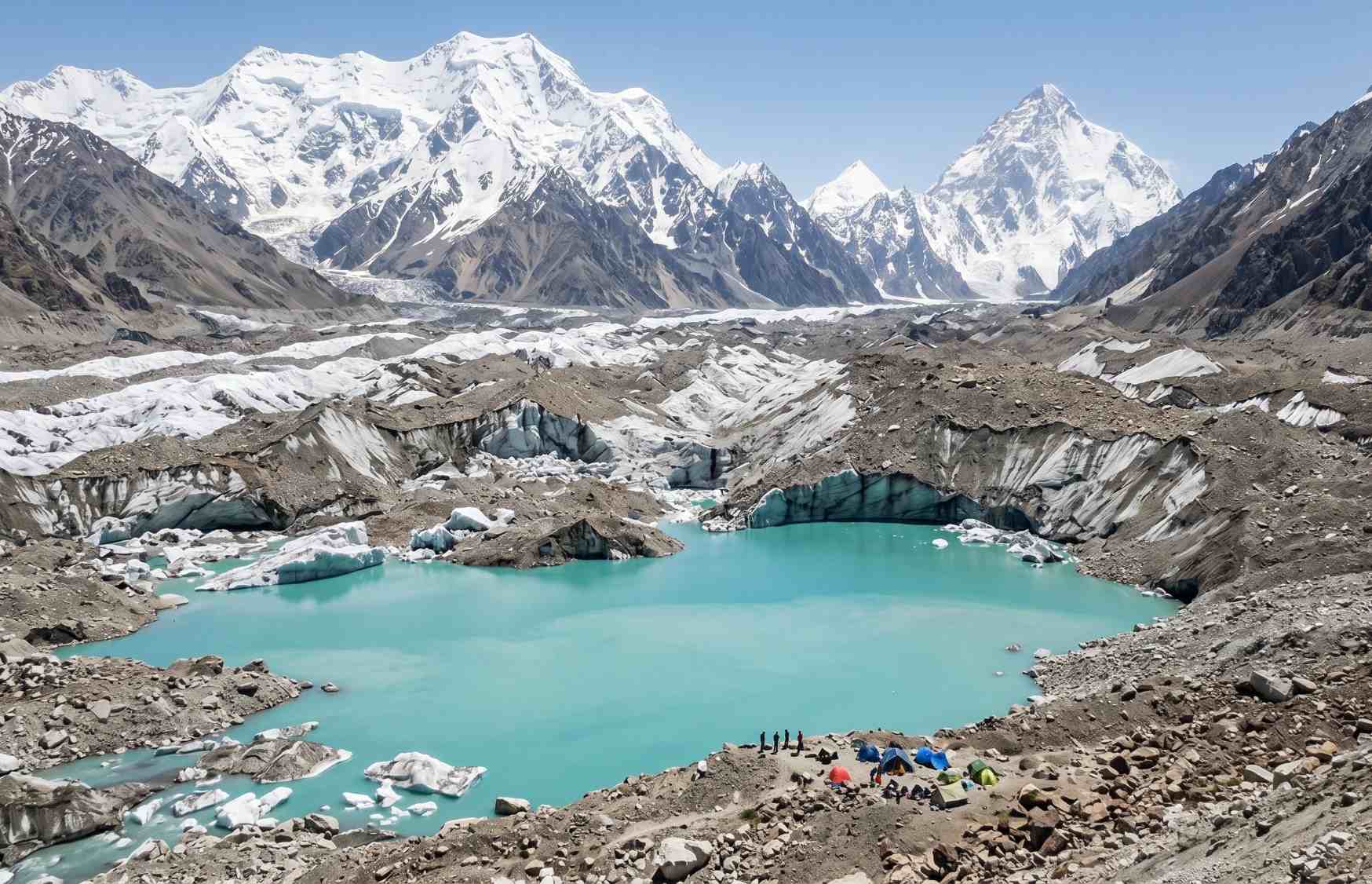
A glacial lake at a Karakoram glacier snout. Pakistan has over 3,000 such lakes, of which dozens are considered at risk of sudden outburst flooding downstream
Wildlife on and Around Pakistan’s Glaciers
Pakistan’s glaciers and the terrain surrounding them support a remarkable range of high-altitude wildlife, much of it found nowhere else in the world at these elevations. The margins of the Biafo Glacier and the Baltoro are home to markhor (Pakistan’s national animal), ibex, and Himalayan brown bear, all of which move through the moraine zones in search of vegetation exposed by seasonal ice retreat. Snow leopards, among the most elusive large predators on Earth, are documented across the high terrain bordering all three of Pakistan’s major mountain ranges, hunting ibex and markhor through the same landscapes that contain the glaciers. The Central Karakoram National Park, which encompasses much of the Baltoro and Biafo glacier catchment areas, is one of the largest protected areas in Asia and a critical habitat for all of these species.
Experiencing Pakistan’s Glaciers
For travellers wanting to see Pakistan’s glaciers firsthand, the options range from the entirely accessible to the seriously demanding. The Passu and Ghulkin glaciers in Upper Hunza are visible from the Karakoram Highway and reachable with a short walk. The lower Batura Glacier can be approached from Passu village on a half-day excursion. For those wanting to go deeper, the Baltoro Glacier and Concordia require the full K2 Base Camp expedition commitment of 18 to 22 days with full logistical support. The Biafo-Hispar traverse is a serious multi-week wilderness crossing demanding technical experience and a fully supported team.
Crossroads Adventure designs glacier-centred expeditions at every level of commitment. The K2 Base Camp expedition walks the Baltoro Glacier in full. The Shimshal Valley and high passes expedition crosses glaciated terrain in one of the most remote parts of Gilgit-Baltistan. And the Hunza and Baltistan premium expedition passes the accessible glaciers of Upper Hunza as part of a broader Karakoram journey.
Frequently Asked Questions
How many glaciers are in Pakistan?
Pakistan has more than 7,000 glaciers covering approximately 15,000 square kilometres of its mountain ranges. This makes it the country with the highest concentration of glacial ice anywhere outside the polar regions. The majority are located in Gilgit-Baltistan, where the Karakoram, western Himalayas, and Hindu Kush converge. The Karakoram alone, sometimes called the Third Pole, contains more glacial ice than any mountain range outside the poles.
What is the largest glacier in Pakistan?
By length, the Siachen Glacier at 76 kilometres is the longest glacier in Pakistan and the second longest non-polar glacier in the world, after the Fedchenko Glacier in Tajikistan. By drainage area, the Baltoro Glacier system drains a significantly larger area. By combined glacial system, the Biafo-Hispar corridor at 120 kilometres is the longest continuous glacial route outside the polar regions.
Why does Pakistan have so many glaciers?
Pakistan lies at the convergence of three of the world’s greatest mountain systems, the Karakoram, the western Himalayas, and the Hindu Kush. These ranges were pushed to extreme elevations by the ongoing collision of the Indian and Eurasian tectonic plates, creating the high-altitude, cold, and snow-rich conditions necessary for glaciers to form and persist. The Karakoram in particular receives substantial high-altitude snowfall that replenishes its glaciers faster than many comparable mountain ranges elsewhere in the world.
What is the Karakoram Anomaly?
The Karakoram Anomaly refers to the scientifically documented observation that many Karakoram glaciers have remained stable or advanced in recent decades while glaciers globally have retreated in response to rising temperatures. The anomaly is thought to result from the insulating effect of debris covering on glacier surfaces and the specific precipitation patterns of the Karakoram that deliver heavy high-altitude snowfall even as temperatures rise at lower elevations. It makes Pakistan’s Karakoram glaciers a subject of major ongoing scientific interest in glaciology and climate research.
Can tourists visit Pakistan’s glaciers?
Yes, many of Pakistan’s glaciers are accessible to visitors at various levels of difficulty. The Passu and Ghulkin glaciers in Upper Hunza are visible from the Karakoram Highway and reachable with a short walk. The lower Baltoro Glacier and the approach to K2 Base Camp require an 18 to 22 day trek with full guide support and permits. The Biafo-Hispar traverse is a serious technical undertaking. The Siachen Glacier is currently inaccessible to civilians due to its militarised status. All trekking in restricted glacial zones requires permits arranged through a licensed Pakistani tour operator.
Are Pakistan’s glaciers melting?
The situation is complex. Most glaciers in the Hindu Kush-Himalaya system are retreating due to climate change, and Pakistan has experienced serious consequences from glacial melt including an increase in Glacial Lake Outburst Floods (GLOFs). However, the Karakoram Anomaly means that many of Pakistan’s largest Karakoram glaciers have shown relative stability or even advance in recent decades. Scientific consensus is that climate change will ultimately affect all of Pakistan’s glaciers, with modelling suggesting significant retreat by the end of the century if current warming trends continue, with serious consequences for the Indus River system and Pakistan’s agricultural water supply.
See Pakistan’s Glaciers in Person
From the accessible ice of Upper Hunza to the legendary Baltoro Glacier under K2, Crossroads Adventure puts you inside Pakistan’s extraordinary glacial landscapes with the expertise and support the terrain demands.
Plan Your Pakistan Glacier Expedition