The history of Pakistan does not begin with the Mughal Empire, though that is where most international visitors start. Beneath the Mughal layer lies Gandhara and the Buddhist civilisation, beneath that the Mauryan and Indo-Greek empires, beneath those the Vedic and early Iron Age cultures, and beneath all of them the Indus Valley Civilisation, one of the three earliest urban societies in human history alongside ancient Mesopotamia and Egypt. That 5,000-year record is what makes Pakistan’s historical sites uniquely compelling.
Crossroads Adventure offers curated journeys through Pakistan’s greatest historical landscapes, from the Indus Valley Civilisation experience to the Taxila, Gandhara, and Peshawar heritage trail to the Mughal heritage trail through Lahore. Each is designed to bring historical depth to life with expert local guidance.
Pakistan’s Historical Heritage at a Glance
| Historical Site | Era / Civilisation | Location | UNESCO Status | Best Season |
|---|---|---|---|---|
| Mohenjo-daro | Indus Valley (2500 BC) | Larkana, Sindh | World Heritage Site | Oct to March |
| Harappa | Indus Valley (2600 BC) | Sahiwal, Punjab | World Heritage Site | Oct to March |
| Taxila | Gandhara / Buddhist (600 BC) | Near Islamabad, Punjab | World Heritage Site | Nov to March |
| Takht-i-Bahi | Gandhara Buddhist (1st century) | Mardan, KPK | World Heritage Site | Oct to April |
| Lahore Fort and Shalimar Gardens | Mughal (16th to 17th century) | Lahore, Punjab | World Heritage Site | Oct to March |
| Rohtas Fort | Suri Dynasty (16th century) | Jhelum, Punjab | World Heritage Site | Oct to April |
| Makli Necropolis | Islamic / Talpur (14th to 18th century) | Thatta, Sindh | World Heritage Site | Oct to March |
| Katas Raj Temples | Hindu (1st to 7th century) | Chakwal, Punjab | Tentative List | Oct to April |
| Baltit Fort | Hunza Silk Road (700 years old) | Karimabad, Hunza | Tentative List | April to October |
| Ranikot Fort | Talpur / pre-colonial | Jamshoro, Sindh | Tentative List | Oct to March |
| Badshahi Mosque | Mughal (1673) | Lahore, Punjab | Tentative List | Oct to March |
Mohenjo-daro: The World’s First Planned City
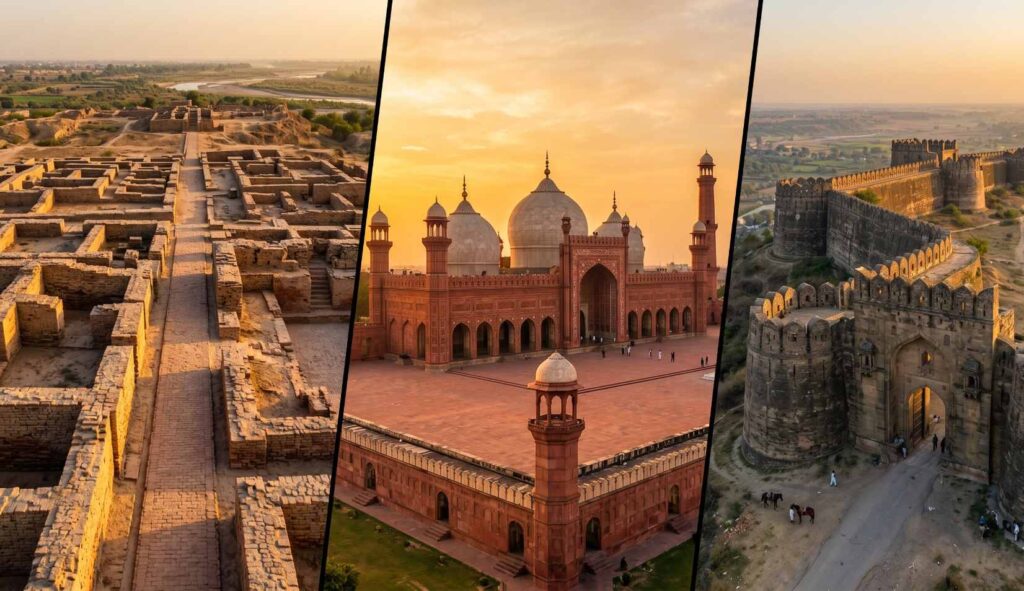
Mohenjo-daro is the most significant archaeological site in Pakistan and one of the most important in the world. Built around 2500 BC on the right bank of the Indus River in Sindh, it was one of the largest settlements of the Indus Valley Civilisation, with an estimated population of 23,500 and a built area of around 150 hectares. The name translates roughly as “Mound of the Dead” in Sindhi, a reference to its long burial beneath the earth before rediscovery by archaeologists in the 1920s.
What makes Mohenjo-daro extraordinary even by modern standards is its urban planning. The city was laid out on a precise grid of wide streets, with standardised baked-brick construction, a city-wide covered drainage and sewage system more sophisticated than many cities of the ancient world, public granaries, and the famous Great Bath, a large, watertight pool likely used for ritual purification that remains one of the most discussed structures in South Asian archaeology. No defensive walls were built around the city, suggesting a society confident in its safety and order.
The ruins today are haunting and impressive. Walking through the excavated lanes, with the ghost of a highly organised 4,500-year-old city visible in every preserved foundation, is one of those historical experiences that genuinely rearranges your understanding of how old human civilisation is. Crossroads Adventure’s Indus Valley Civilisation experience combines Mohenjo-daro with other Indus sites in a single journey through Pakistan’s most ancient chapter.
Harappa: The City That Named a Civilisation
Harappa, in Punjab’s Sahiwal district, gave its name to the Harappan Civilisation, the term archaeologists use for the Indus Valley Civilisation in its most developed phase. Settled as early as 3300 BC and at its peak between 2600 and 1900 BC, it was one of the largest cities of its era alongside Mohenjo-daro, connected to it and dozens of other settlements by trade routes that stretched from modern Afghanistan to the coast of Gujarat.
Harappa shows evidence of a writing system that has not yet been fully deciphered, a standardised system of weights and measures used across the entire civilisation, sophisticated craft production in pottery and metalwork, and extensive granary facilities indicating large-scale grain storage and redistribution. The site’s Harappa Museum displays remarkable artefacts including seals, jewellery, and tools, and provides essential context for the ruined urban fabric visible across the site. Harappa is less visited than Mohenjo-daro and rewards those who make the effort to reach it with a quieter, more contemplative encounter with the same extraordinary civilisation.
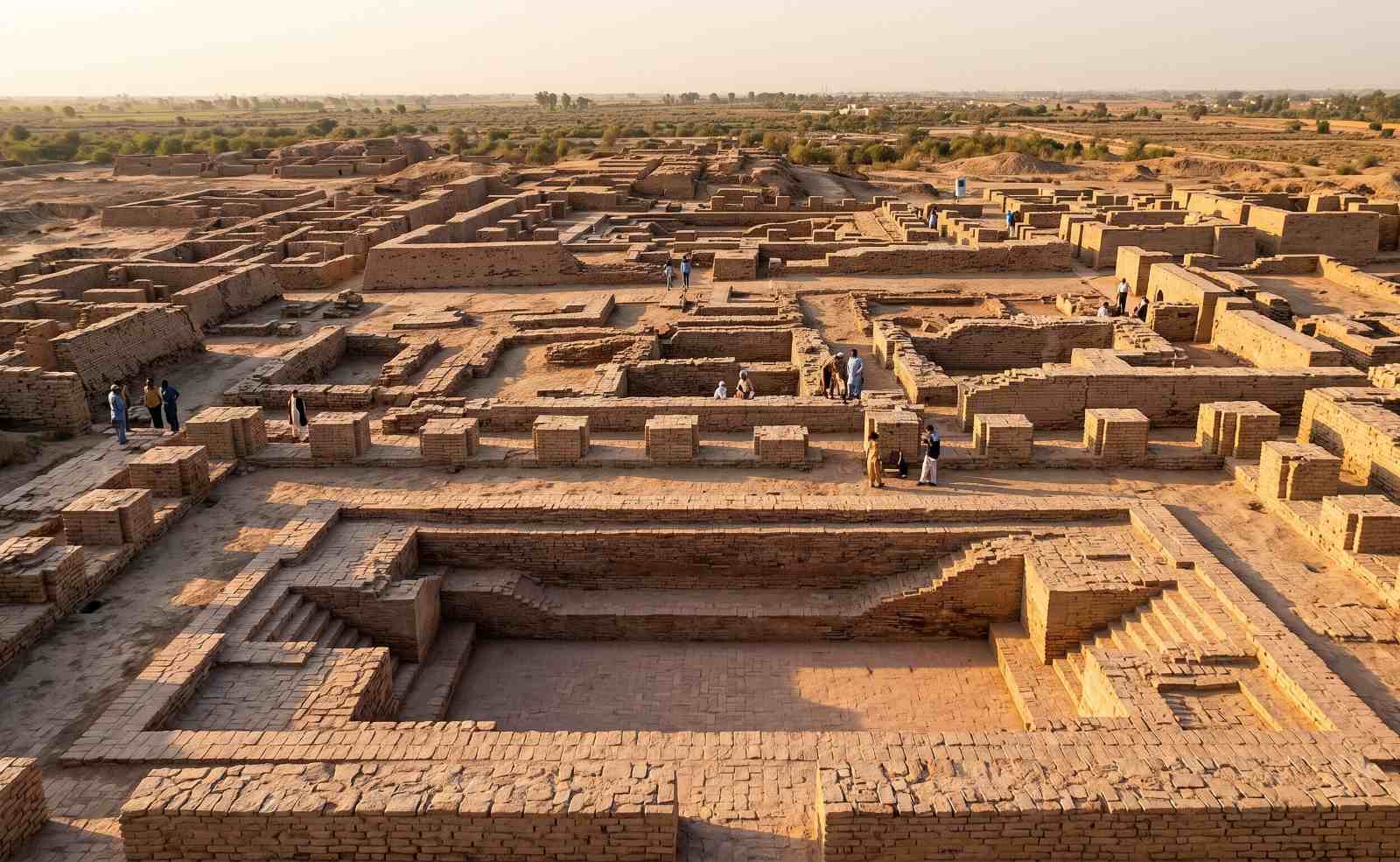
The ruins of Mohenjo-daro, built around 2500 BC in Sindh. The Great Bath in the foreground served as a centre of ritual life in one of the world’s first urban civilisations
Taxila: The Ancient World’s Greatest University City
Taxila, located 32 kilometres northwest of Islamabad, is one of the most intellectually significant archaeological sites in Asia. From the 6th century BC onward, it was a major centre of learning and commerce at the crossroads of Central Asian, Persian, Indian, and eventually Greek civilisations. Students came from across the ancient world to study medicine, mathematics, philosophy, law, and the Vedas. It was also one of the largest cities of the Gandhara civilisation, which produced the distinctive Gandhara art style that blended Greek aesthetics with Buddhist iconography in a synthesis that had no precedent in either tradition.
The Taxila site actually encompasses several distinct ancient settlements across the broader valley, including the Bhir Mound (the oldest urban settlement, from the Achaemenid Persian period), Sirkap (laid out on a Greek grid plan by the Indo-Greek rulers after Alexander’s successors took control), and Sirsukh (the Kushan city). The Taxila Museum holds one of the finest collections of Gandhara sculpture anywhere in the world. Alexander the Great passed through Taxila in 326 BC and the city welcomed him. It later came under Mauryan, Indo-Greek, Scythian, Parthian, and Kushan rule in succession, each leaving its mark on the built fabric of the city.
Crossroads Adventure’s Taxila, Gandhara, and Peshawar heritage trail combines Taxila with the wider Gandhara circuit in a journey through one of the ancient world’s most remarkable cultural zones.
Takht-i-Bahi: The Buddhist Monastery on the Cliff
Takht-i-Bahi (Throne of the Spring) is a 1st century AD Buddhist monastery complex built on the crest of a ridge in the Mardan district of Khyber Pakhtunkhwa. It is among the most intact early Buddhist monastery complexes in Asia, its elevated position having helped preserve it from urban encroachment and later construction. The complex includes a main court surrounded by tall votive stupas that once held Buddha images, assembly halls, monks’ residential cells, and a courtyard of stupas of various sizes covering the hillside.
Walking through Takht-i-Bahi is to understand the monastic life of Gandharan Buddhism in a way that no museum can replicate. The remains are substantial, the setting on the ridge with views across the plains of Mardan is dramatic, and the quality of carving and architectural organisation visible in the surviving walls and columns is extraordinary. The nearby ruins of Sahr-i-Bahlol, an ancient town from the same period, are included in the UNESCO designation and add an urban dimension to the monastery’s religious one. Crossroads Adventure includes Takht-i-Bahi in the Buddhist heritage expedition across Pakistan’s greatest Gandhara sites.
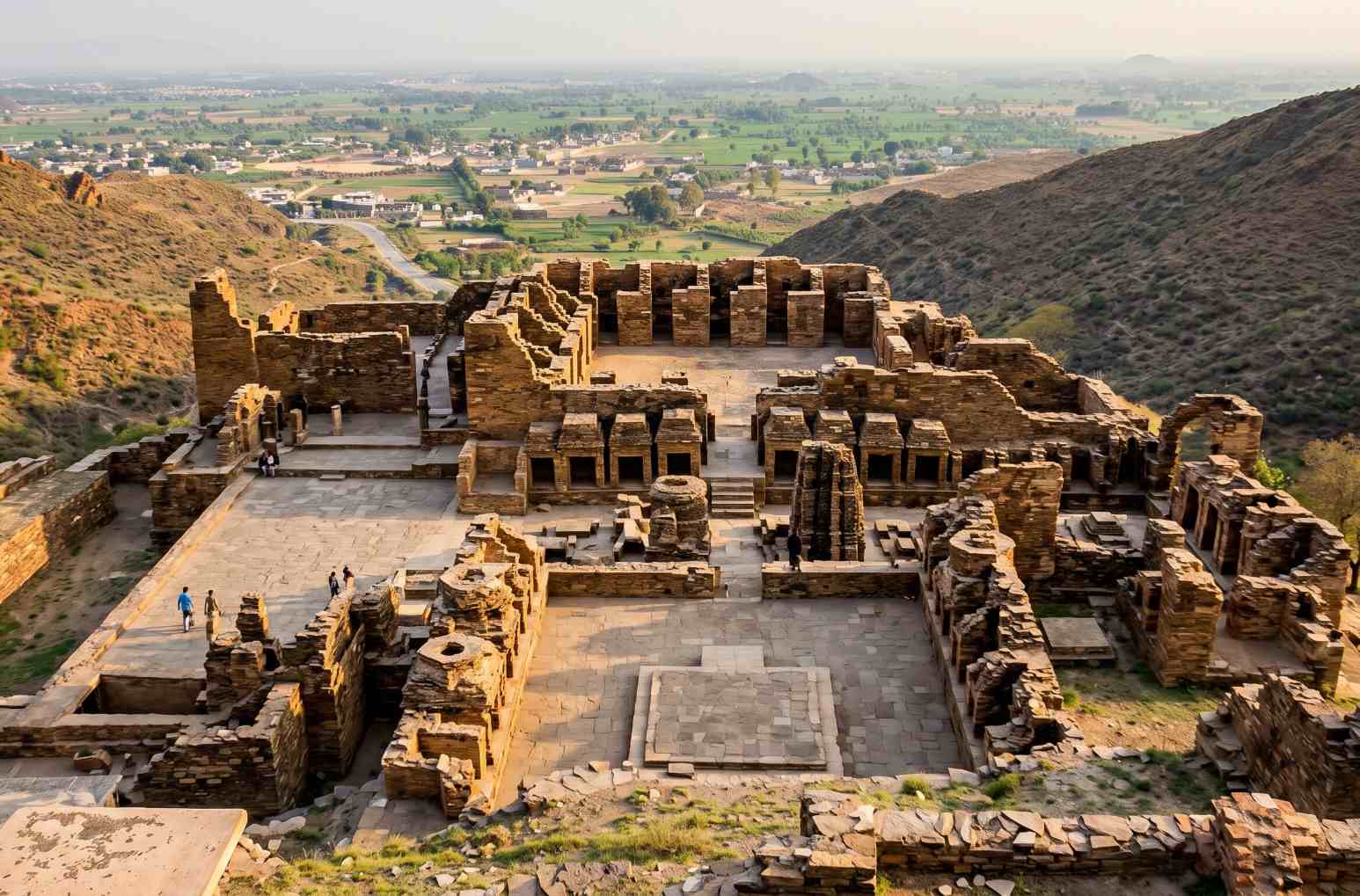
Takht-i-Bahi, a 1st century Buddhist monastery perched on a ridge in KPK, is among the best-preserved early Buddhist complexes anywhere in Asia
Lahore Fort (Shahi Qila): The Jewel of Mughal Architecture
The Lahore Fort, known as Shahi Qila or Royal Fort, is the defining monument of Mughal power in Pakistan. Covering 20 hectares in the heart of Lahore’s walled city, it contains 21 distinct monuments from the reigns of successive emperors: Akbar, Jahangir, Shah Jahan, and Aurangzeb. Each emperor left his architectural signature, creating a layered complex that traces the full arc of Mughal style from Akbar’s robust red sandstone to Shah Jahan’s refined white marble inlay work.
The fort’s centrepiece is the Sheesh Mahal, the Palace of Mirrors, built by Shah Jahan with its interior surfaces covered entirely in thousands of small convex mirrors that, by candlelight or torchlight, created the impression of a starlit sky within a room. The Naulakha Pavilion, named for the nine lakh rupees it cost to build, is a small jewel of marble and pietra dura inlay facing the gardens of the fort. The Diwan-e-Aam (Hall of Public Audience) and Diwan-e-Khas (Hall of Private Audience) tell the story of Mughal imperial administration in stone and mortar. The Picture Wall, a 150-metre-long decorative facade on the fort’s northern side, is one of the most ambitious examples of Mughal tile mosaic work anywhere.
Crossroads Adventure’s Mughal heritage trail and the Islamabad to Lahore cultural experience both include the Lahore Fort as a centrepiece.
Badshahi Mosque: One of the World’s Greatest Mosques
Built in 1673 under the Mughal Emperor Aurangzeb, the Badshahi Mosque stands directly beside the Lahore Fort and was for centuries the world’s largest mosque by courtyard capacity. The mosque accommodates 100,000 worshippers in its open courtyard and was designed to project the might of the Mughal Empire at its zenith. Its four minarets are some of the tallest in South Asia, and the main prayer hall’s facade, constructed of dark red Lahori brick inlaid with white marble tracery, is one of the most distinctive architectural compositions in Islamic design.
At sunset, when the warm light catches the red sandstone and the white marble of the domes turns gold, the Badshahi Mosque is one of the most beautiful buildings in Pakistan. Its scale, when you stand in the open courtyard, is genuinely humbling.
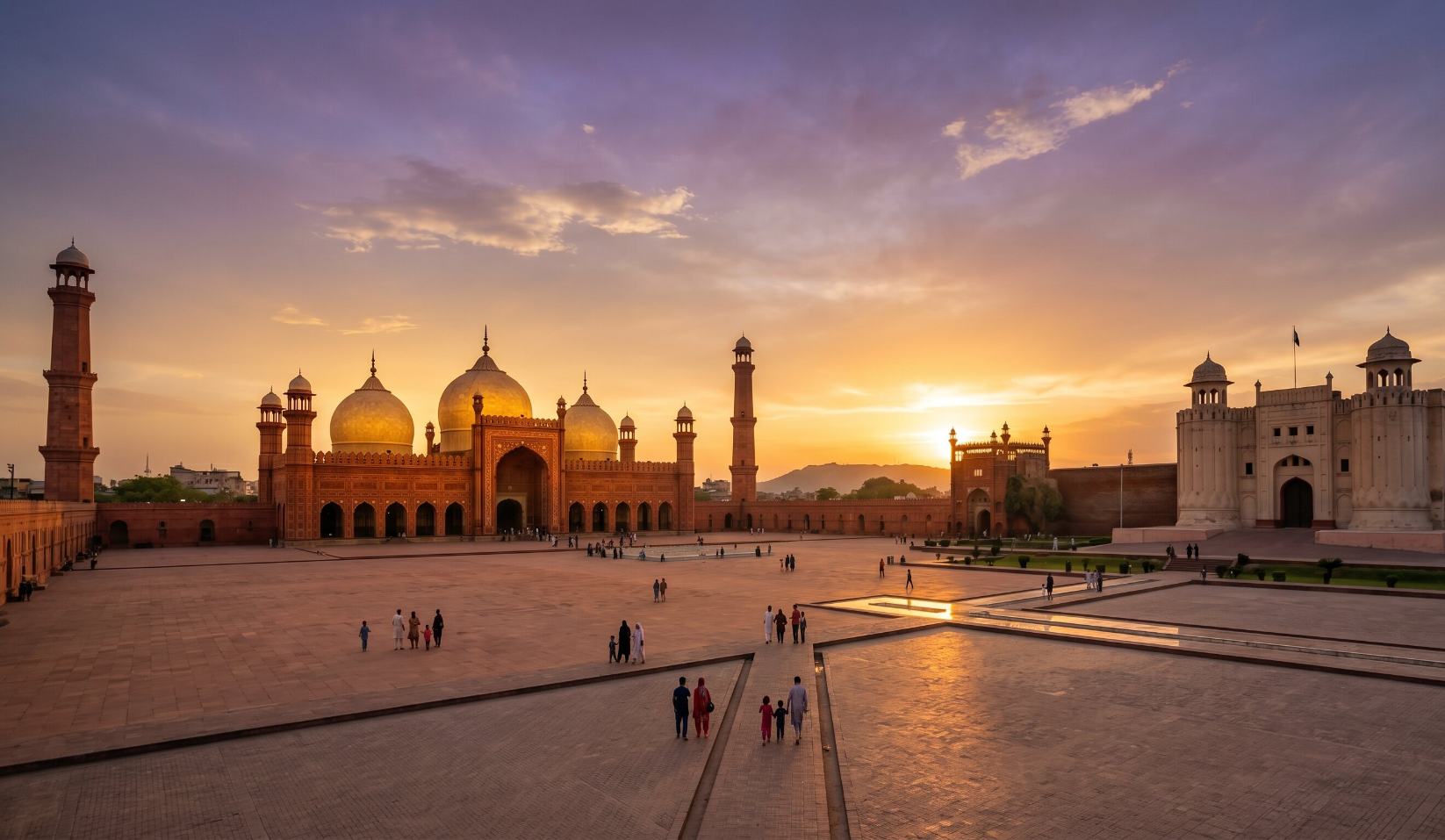
The Badshahi Mosque and Lahore Fort at sunset, two of the greatest Mughal monuments in Pakistan standing side by side in the heart of Lahore’s walled city
Shalimar Gardens: The Art of Mughal Paradise
The Shalimar Gardens were laid out by the Mughal Emperor Shah Jahan in 1641 as a royal pleasure garden and retreat outside the walls of Lahore. The garden follows the Persian chahar bagh (four-garden) principle of geometric paradise design: a walled enclosure divided into three descending terraces connected by a central water channel fed by over 410 fountains. At the head of the terrace system, a large tank receives water from the channel and redistributes it through the fountains that line both sides of the garden’s length.
The Shalimar Gardens represent the pinnacle of Mughal garden design, conceived as an earthly echo of the Islamic paradise described in the Quran: flowing water, shade, fruit trees, and order amid the world’s chaos. Walking through the terraces with the fountains running in the morning light is one of the most genuinely peaceful historical experiences in Lahore.
Rohtas Fort: Military Engineering at Its Greatest
Rohtas Fort was built in 1541 by the Afghan emperor Sher Shah Suri, who briefly displaced the Mughal Emperor Humayun and ruled northern India for five years before his death. Built specifically to suppress the Gakhar tribes of the Salt Range who remained loyal to the Mughal cause, Rohtas is a masterwork of 16th-century military architecture covering 70 hectares with walls averaging 10 to 18 metres in height and up to 12 metres wide. The fort has 68 semi-circular bastions and 12 massive gates, of which Sohail Gate is the finest, a great stone arch with decorative spandrels and an inscription in Persian poetry.
Rohtas was designed for defence above all else, and it succeeds completely. Standing on its walls looking across the undulating Punjab plateau, you understand immediately why no army ever successfully stormed it. UNESCO recognised it as an outstanding example of early Muslim military architecture in Central and South Asia, combining Afghan, Central Asian, and South Asian construction traditions in a single monumental structure. It is two hours from Islamabad and entirely worth the journey.
Makli Necropolis: The City of the Dead
The Makli Necropolis near Thatta in Sindh is one of the largest funerary sites in the world, stretching over approximately 10 square kilometres of a low plateau and containing an estimated half million graves from the 14th through 18th centuries. Buried at Makli are the rulers of the Samma, Arghun, Tarkhan, and Talpur dynasties that governed Sindh during this period, alongside Sufi saints, scholars, governors, and queens. The range of architectural styles across the site is extraordinary: stone tombs with floral and geometric carving in the Sindhi tradition, later tombs with blue and turquoise tilework from the Persian tradition, and royal mausoleums combining both.
Walking through Makli is one of the strangest and most profound historical experiences in Pakistan. The scale of the site means that even on busy days, it is possible to find yourself entirely alone among 500-year-old stone tombs covered in intricate carving, with only the wind and distant birds for company. The nearby city of Thatta contains the Shah Jahan Mosque, another masterpiece of Mughal-Sindhi tile architecture, making this part of Sindh one of the richest heritage concentrations in the country.
Ranikot Fort: The Great Wall of Sindh
Ranikot Fort in Sindh is the largest fort in the world by perimeter, with a circuit wall stretching 26 kilometres through the Khirthar hills. Its origin and purpose remain partly mysterious to historians: the exact date of construction and who built it are still debated, with theories ranging from a pre-Talpur fortification to Sassanid-era construction or later Talpur modification. What is undeniable is the ambition and scale of the structure: massive stone walls following the ridgelines for 26 continuous kilometres, with towers, bastions, and four main gates in a landscape of extraordinary natural drama.
The scale of Ranikot, combined with the dramatic Khirthar hill setting, makes it one of the most visually stunning forts in Pakistan, despite being far less visited than the Mughal monuments of Lahore. The interior contains a smaller central fort (Miri) and a palace complex (Sann Gate area) that speak to prolonged human habitation within the walls. Ranikot is for travellers willing to venture beyond the obvious circuit.
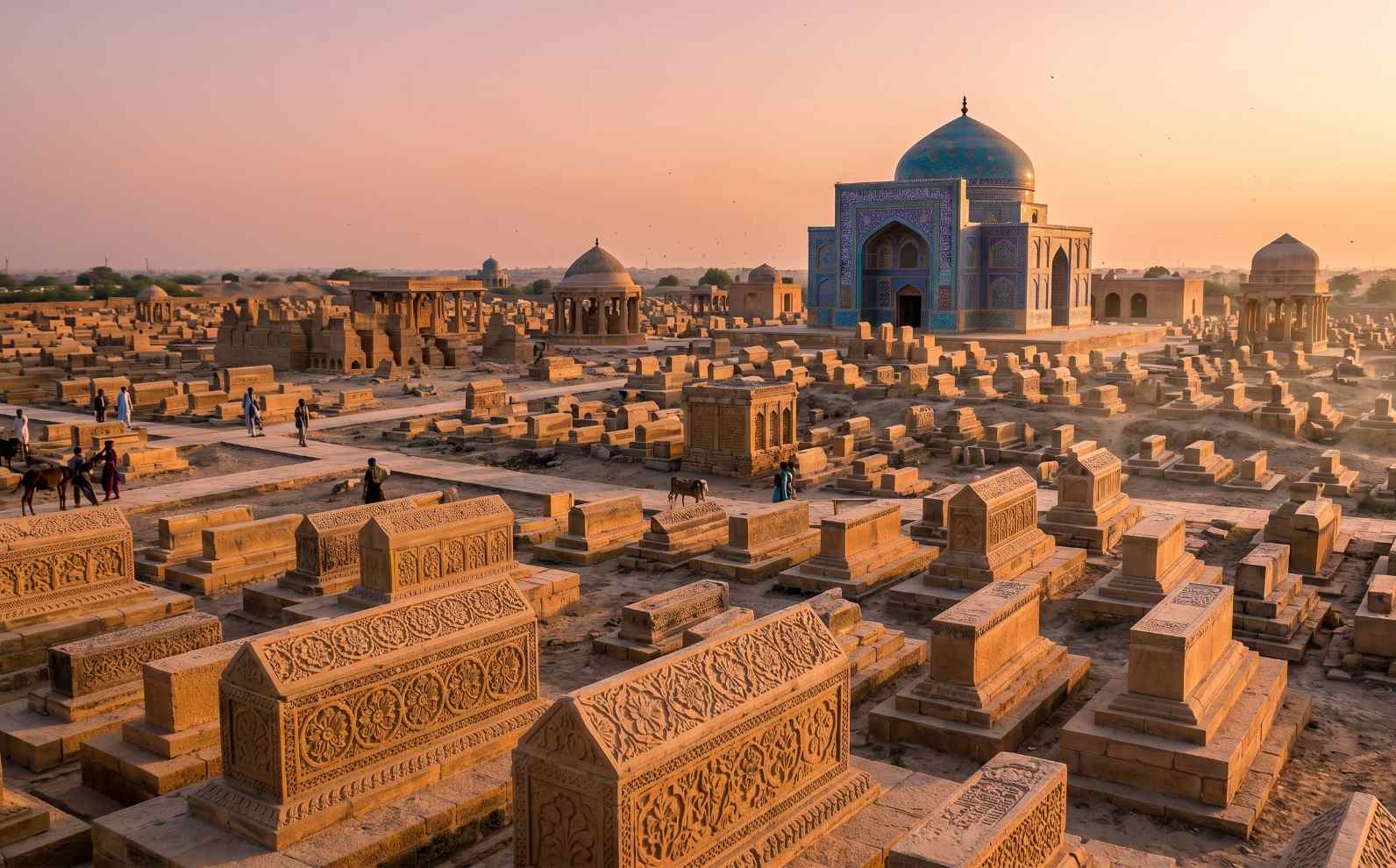
The Makli Necropolis near Thatta, one of the largest funerary sites in the world, with over 500,000 tombs covering 10 square kilometres of a Sindh plateau
Katas Raj Temples: Sacred Pond of the Mahabharata
The Katas Raj temple complex in Chakwal district, Punjab, is one of the most sacred Hindu pilgrimage sites in South Asia. At its heart is the Katas lake, believed in Hindu tradition to have formed from the tears of Lord Shiva after the death of his wife Sati. The Mahabharata references Katas Raj as a place where the Pandava brothers spent part of their exile. The temples surrounding the sacred pond span multiple centuries of construction, with the oldest structures dating to the 1st century AD, and include examples of post-Gupta architectural style rarely found west of Rajasthan. The complex continues to receive Hindu pilgrims from Pakistan and India for major festivals, demonstrating the living religious significance of one of Pakistan’s oldest sacred sites.
Crossroads Adventure’s Hindu heritage experience covers Katas Raj alongside the wider multi-faith heritage of Pakistan’s Punjab in depth.
The Silk Road Heritage of Hunza: Baltit and Altit Forts
The mountain forts of Hunza Valley represent the historical heritage of the ancient Silk Road in its most dramatic natural setting. Baltit Fort, perched above Karimabad on a rocky spur with Rakaposhi (7,788m) rising directly behind it, was the seat of the Mir of Hunza for centuries. Built around 700 years ago in a style that shows both Tibetan and Central Asian architectural influences, it was restored in the 1990s by the Aga Khan Trust for Culture and now stands as both a heritage museum and one of the finest viewpoints in the Karakoram.
Altit Fort is older still, estimated at over 1,100 years, and sits in a more dramatically precarious position above the Hunza River gorge. It was the original seat of Hunza’s rulers before Baltit was built and contains the oldest extant wooden structure in the Karakoram, a watchtower whose timbers have been carbon-dated to over a thousand years old. Together these two forts tell the story of a mountain kingdom that sat astride the ancient trade route between China and the Indian subcontinent for over a millennium.
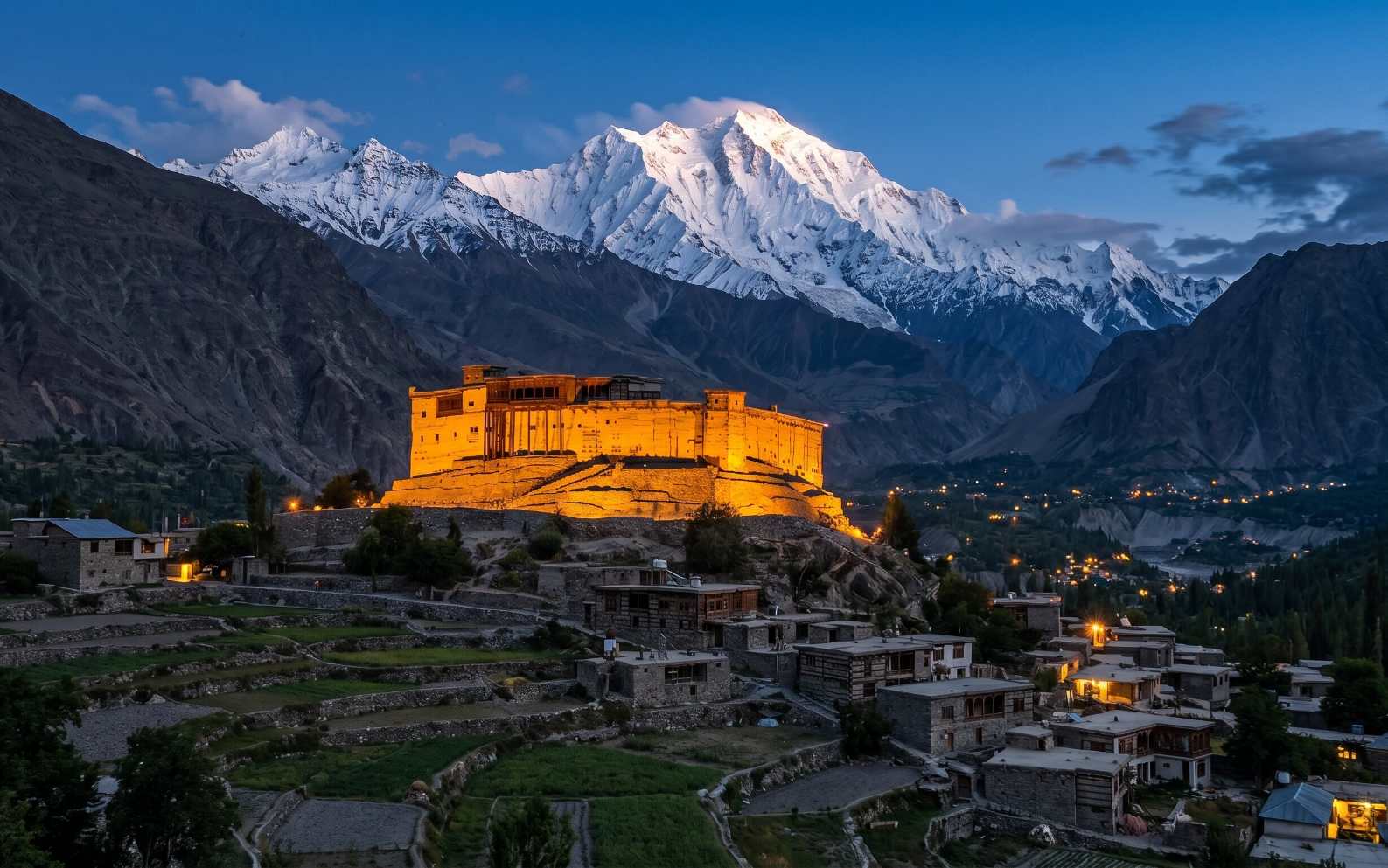
Baltit Fort in Hunza, built 700 years ago as the seat of the Mir of Hunza, with Rakaposhi (7,788m) rising directly behind it. One of the most dramatically sited historical monuments in Pakistan
Planning a Historical Tour of Pakistan
The essential insight: Pakistan’s historical sites are not scattered randomly. They fall into logical circuits that make geographical sense. The Indus Valley sites of Sindh can be combined into a southern heritage journey. Taxila, Takht-i-Bahi, and the Gandhara circuit around Peshawar form a natural northern Punjab and KPK heritage route. Lahore concentrates the Mughal heritage in a single extraordinary city. And Hunza adds Silk Road history to the mountain experience of the north. Crossroads Adventure builds each of these as a distinct expedition, and they can be woven together for travellers with more time.
Best Season for Historical Sites
October to March is optimal for the major historical sites in Sindh and Punjab, where summer temperatures can reach 42°C. Lahore and Taxila are pleasant in the cool winter months. The northern mountain heritage sites of Hunza (Baltit Fort, Altit Fort) are best visited April to October when the mountain roads are clear.
Start with Lahore
Lahore is the single richest heritage city in Pakistan and a logical starting point for any historical tour. The Lahore Fort, Badshahi Mosque, Shalimar Gardens, Wazir Khan Mosque, and Tomb of Jahangir are all within the city or a short drive from it. Allow a minimum of two full days in Lahore for the major sites.
Hire Expert Local Guides
The difference between walking through Mohenjo-daro with a knowledgeable guide and walking through it without is enormous. Sites like Taxila, with multiple distinct archaeological zones across the valley, require guided explanation to make sense of what you are seeing. Crossroads Adventure assigns specialist cultural guides for all heritage expeditions.
Combine Heritage with Landscape
Pakistan’s greatest historical sites do not exist in isolation from its landscape. Rohtas Fort sits in the Salt Range. Baltit Fort rises above the Karakoram. Takht-i-Bahi overlooks the Mardan plains. Building itineraries that combine historical depth with scenic travel between sites creates a journey that is far richer than either heritage or landscape alone.
Frequently Asked Questions
How many UNESCO World Heritage Sites are in Pakistan?
Pakistan has six UNESCO World Heritage Sites: Mohenjo-daro (1980), Taxila (1980), Takht-i-Bahi and Sahr-i-Bahlol (1980), Makli Necropolis (1981), Lahore Fort and Shalimar Gardens (1981), and Rohtas Fort (1997). An additional 26 sites are on the UNESCO Tentative List including Baltit Fort, Ranikot Fort, the Badshahi Mosque, Katas Raj Temples, and many others awaiting full inscription.
What is the oldest historical place in Pakistan?
Mehrgarh, in Balochistan, is the oldest known settlement in Pakistan, with evidence of occupation dating back to around 7000 BC, making it one of the earliest farming communities anywhere in South Asia. For the better-known sites, Harappa and Mohenjo-daro date to around 2600 to 2500 BC and are among the oldest urban settlements in the world. Katas Raj Temples are among the oldest continuously sacred sites in Pakistan, with origins in the 1st century AD.
What are the main historical eras represented by Pakistan’s sites?
Pakistan’s historical sites cover seven distinct civilisational layers: the Indus Valley Civilisation (3300 to 1300 BC), the Gandhara and Buddhist era (600 BC to 7th century AD), the Hindu and Vedic heritage (multiple periods), the pre-Islamic and early Islamic Sindh dynasties (7th to 14th century), the Suri and Mughal empires (16th to 18th century), the Sikh era in Punjab (early 19th century), and the British colonial period. Few countries compress this breadth of civilisational history into a single geography.
Can Pakistan’s historical sites be visited independently?
Some sites, particularly the Lahore Fort, Badshahi Mosque, Shalimar Gardens, and Rohtas Fort, are well-served by local transport and can be visited independently with relative ease. Others, including Mohenjo-daro in rural Sindh and Makli Necropolis near Thatta, require more planning and benefit significantly from a guided approach. Takht-i-Bahi and the Taxila circuit are best explored with a guide who can explain the different archaeological zones and their significance. Crossroads Adventure designs all historical tours with expert local guides who bring genuine depth to every site.
Are Pakistan’s historical sites well-preserved?
Preservation quality varies by site and managing authority. The Aga Khan Trust for Culture has done exceptional restoration work at Baltit Fort, Altit Fort, and the Wazir Khan Mosque in Lahore. The Lahore Fort is actively maintained and well-presented. Mohenjo-daro faces serious preservation challenges from rising water tables and salt crystallisation, and UNESCO has flagged its condition as a concern requiring urgent attention. Taxila is well-managed and clearly signposted. Makli Necropolis has ongoing preservation work but remains vulnerable due to its scale.
Explore Pakistan’s 5,000 Years of History with Crossroads Adventure
From the world’s first planned cities on the Indus to Mughal palaces that still stun visitors today, Pakistan’s historical heritage is extraordinary. Let Crossroads Adventure build the journey that does it justice.
Start Planning Your Pakistan Heritage Journey