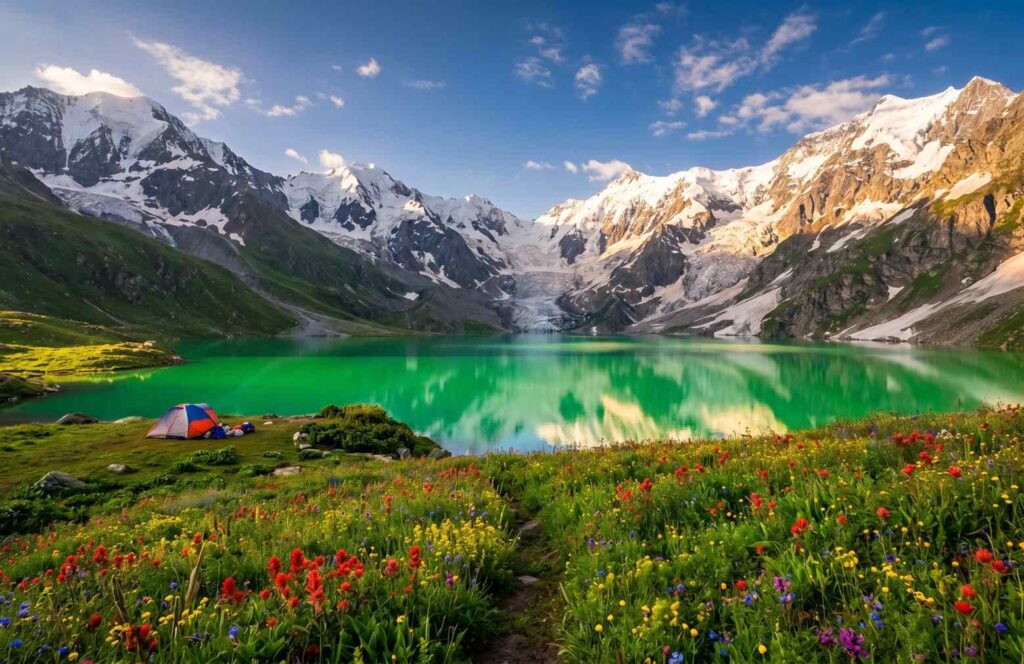
Azad Kashmir, the Pakistan-administered territory bordering the western Himalayas, is home to a concentration of glacial lakes that rivals anything found in Nepal or the European Alps for beauty, while offering a fraction of the visitor footfall. The Neelum Valley alone, the long river corridor that runs northeast of Muzaffarabad toward the Line of Control, contains dozens of lakes at various elevations, each with its own character, colour, and trekking approach.
For travellers wanting to combine Kashmir’s lakes with a wider experience of Pakistan’s mountain landscapes, Crossroads Adventure’s Kashmir alpine meadows and Ratti Gali experience brings these extraordinary places together with professional guide support and carefully designed logistics.
The Lakes of Kashmir at a Glance
| Lake | Valley | Elevation | Access | Difficulty | Best Season |
|---|---|---|---|---|---|
| Ratti Gali | Neelum Valley | 3,683m (12,083ft) | Jeep + 1hr trek from Dowarian | Moderate | June to September |
| Chitta Katha | Shounter Valley | 4,115m (13,500ft) | Jeep from Kel + 5km trek | Challenging | July to August |
| Shounter Lake | Shounter Valley | 3,100m (10,200ft) | Jeep from Kel + trek | Moderate | June to August |
| Saral Lake | Neelum Valley | 4,100m (13,450ft) | Multi-day trek via Gumot or Noori Top | Challenging | July to September |
| Hansraj Lake | Neelum Valley | 3,900m (12,795ft) | Trek from Ratti Gali via Pass | Challenging | July to September |
| Spoon Lake | Shounter Valley | 3,100m (10,200ft) | 20km from Shounter Valley road | Moderate | June to September |
| Gattian Lake | Neelum Valley | 3,658m (12,000ft) | 2km behind Ratti Gali | Moderate | June to September |
| Banjosa Lake | Near Rawalakot | 1,981m (6,500ft) | Road accessible from Rawalakot | Easy | April to October |
Neelum Valley Lakes
Ratti Gali Lake: The Crown of Azad Kashmir
Ratti Gali is the most celebrated lake in Azad Kashmir and one of the most beautiful alpine lakes in Pakistan. Sitting at 3,683 metres in the Neelum Valley, it is fed by the surrounding glaciers and maintains a vivid, shifting colour between emerald green and deep turquoise depending on the light and season. The name Ratti Gali comes from the Kashmiri word for the red wildflowers (ratti phool) that bloom across its meadows in abundance each summer, their reflection doubling in the clear water below.
The approach from the town of Dowarian involves a three-hour jeep ride on a rough mountain track, followed by a 45-minute to one-hour hike to the lake shore. The base camp near the lake shore has become well-organised over recent years, with basic accommodation, food stalls, and camping facilities available. Spending at least one night at the lake is strongly recommended: the early morning light, before clouds form over the peaks, turns the water and surrounding snowfields into shades that no afternoon visit can replicate.
Ratti Gali is also the gateway to five interconnected high-altitude lakes, including Hansraj Lake, Kalasar, and Gattian Lake, accessible by further trekking from the base camp. For travellers wanting a guided experience, Crossroads Adventure’s Kashmir alpine meadows expedition includes Ratti Gali as its centrepiece, with full logistics and professional guidance throughout.
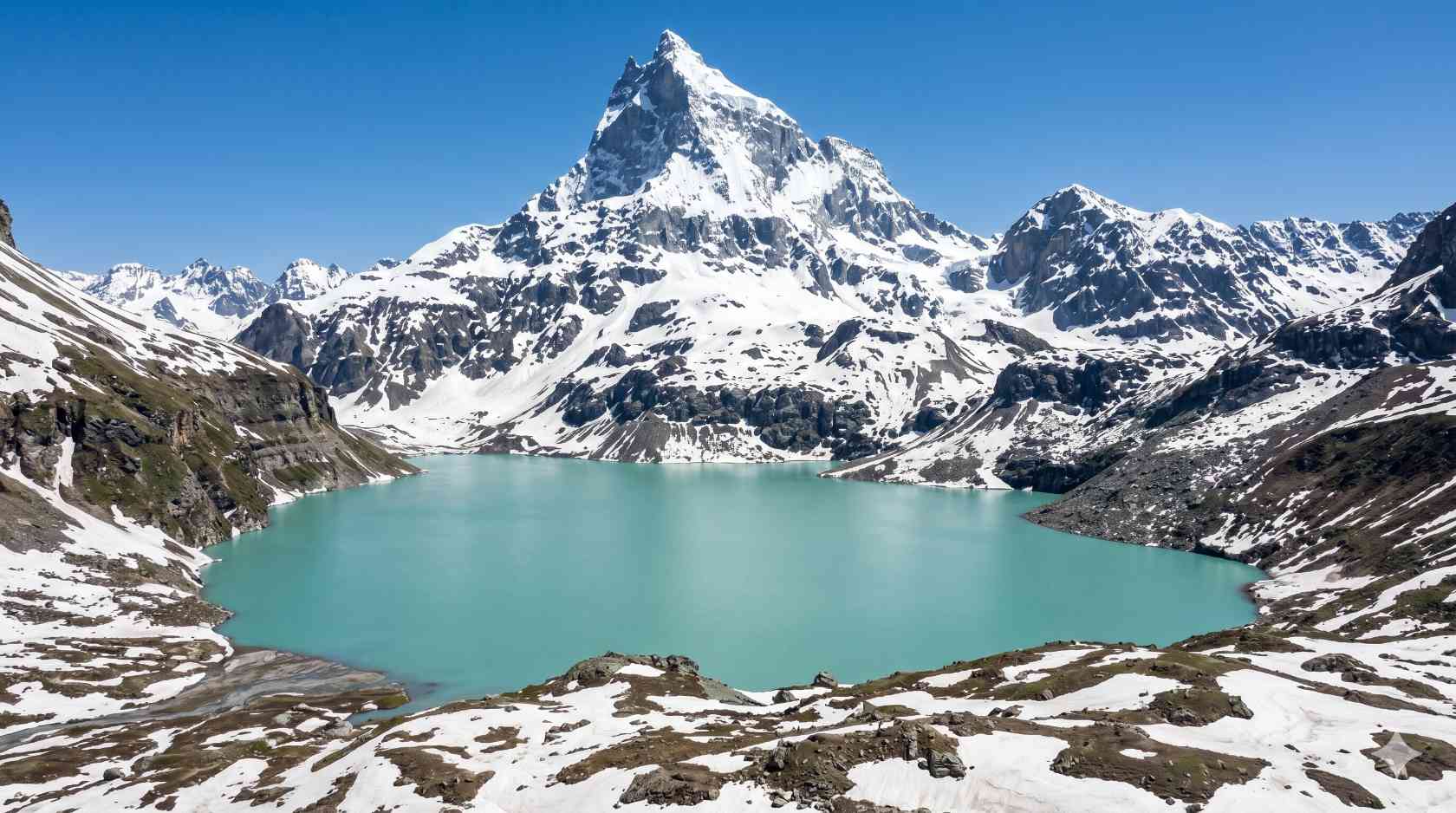
Chitta Katha Lake at 4,115 metres in Shounter Valley, its milky turquoise waters fed by Mount Hari Parbat’s glaciers. One of the highest and most remote lakes in Azad Kashmir
Hansraj Lake and the Chain of Neelum Valley Lakes
The Neelum Valley contains a chain of high lakes connected by trekking routes that allow experienced walkers to move between them over multiple days. Hansraj Lake (also called Hans Raj Lake) sits at approximately 3,900 metres and is reached by crossing the Ratti Gali Pass from the base camp, a route that takes four to five hours from the lake. Famous Pakistani travel writer Mustansir Hussain Tarar wrote about this lake and effectively introduced it to a wider Pakistani readership, attaching his name to it in popular usage.
From Hansraj, further trekking leads to the Kalasar lakes, a cluster of three small glacial lakes at 4,130 metres, and onward toward the Shounter Valley on the far side of the pass. The interconnected nature of these lakes and valleys means that a properly supported multi-day trek can include four or five distinct lake experiences in a single journey, each at a different elevation and with a different character. This is exactly the kind of route that benefits most from a local guide with genuine knowledge of the terrain.
Gattian Lake: The Hidden Sister of Ratti Gali
Gattian Lake sits just two kilometres behind Ratti Gali Lake on the reverse side of the ridge that backs the main lake. Because it requires an additional hour or two of walking from Ratti Gali base camp, a significant portion of visitors to Ratti Gali never reach it, which makes it noticeably quieter despite its proximity. The lake’s character is slightly different from Ratti Gali, sitting in a narrower bowl with steeper surrounding terrain, and its colour shifts from pale turquoise to a deeper blue depending on the season and cloud cover. Travellers who camp at Ratti Gali for more than one night should make the short extension to Gattian a priority.
Saral Lake: The Wild and Remote
Saral Lake is the highest and most remote of the major Neelum Valley lakes, sitting at 4,100 metres in a wild, untouched setting that sees far fewer visitors than Ratti Gali. Its remoteness is its most defining quality: reaching it requires a multi-day approach either from Gumot National Park below, or by crossing from the Kaghan Valley via Dudipatsar Lake and the Saral Pass, one of the finest high-altitude crossings in the western Himalayas.
Saral is most dramatically viewed from Noori Top, the pass that connects Azad Kashmir to the Kaghan Valley. From the top of the pass, the lake lies directly below, a perfect circle of deep blue in a high mountain bowl, with the Kaghan peaks stretching away on the far side. The crossing from Saral to Kaghan via Noori Top is one of the great wilderness routes in Pakistan, combining two of the country’s finest valley systems through genuinely high-altitude terrain with no developed infrastructure in between.
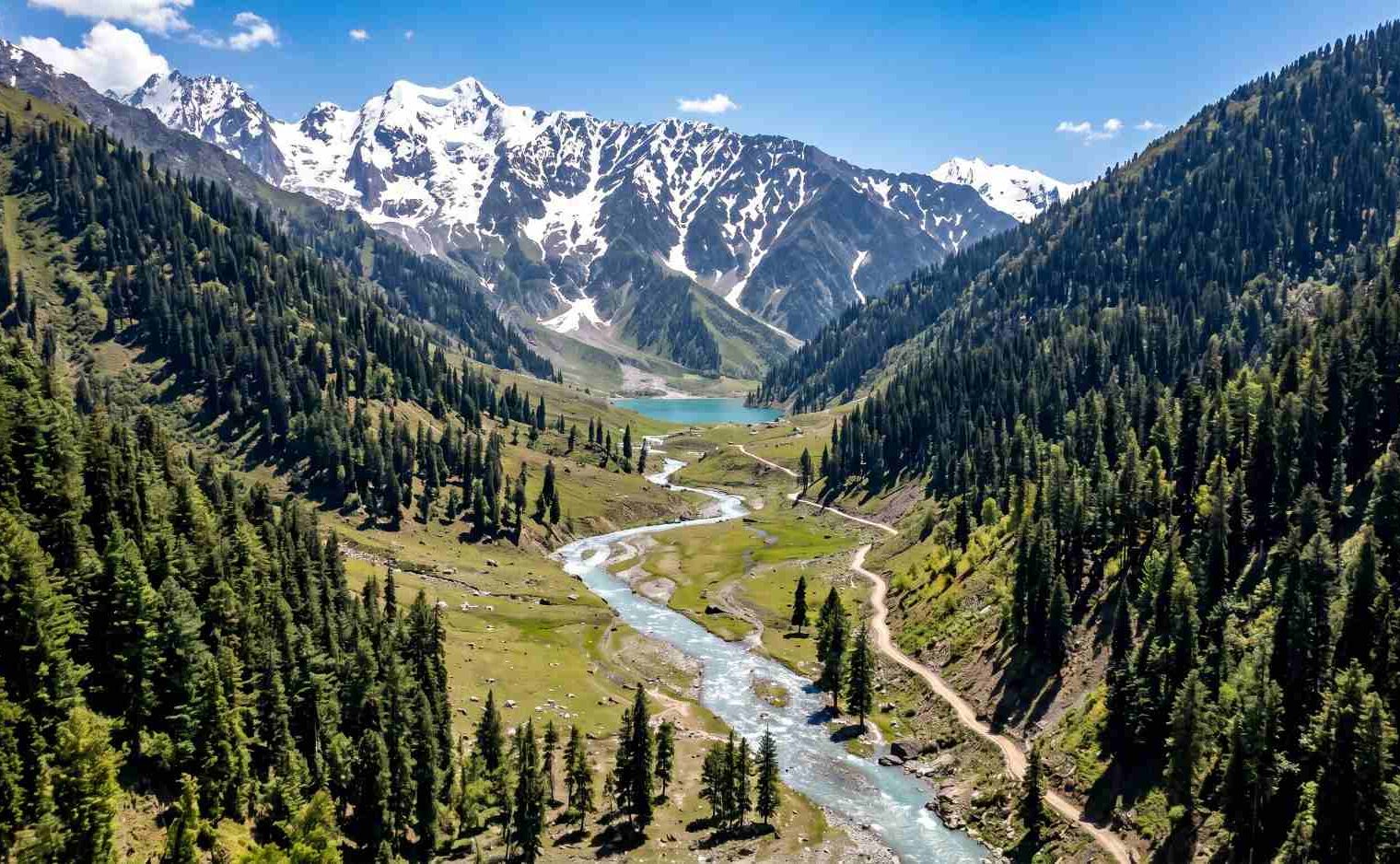
Saral Lake at 4,100 metres, photographed from Noori Top. The pass connects Azad Kashmir to the Kaghan Valley via one of Pakistan’s finest high-altitude crossings
Shounter Valley Lakes
Chitta Katha Lake: The Highest and Most Dramatic
Chitta Katha Lake is the highest major lake in Azad Kashmir and arguably the most visually striking of all the region’s lakes. Its name means “white stream” in Kashmiri, and the name fits: the lake’s water has a milky, glacial quality, fed directly by the glaciers of Mount Hari Parbat (Deosai Peak), which rises immediately above it. At 4,115 metres, the lake is set in a landscape of bare rock, permanent snowfields, and glacial ice with virtually no vegetation at the lake’s immediate shore. It is starkly beautiful in the way that only very high mountain environments can be.
The approach from Kel involves hiring a jeep to Domal Bala, followed by a five-kilometre trek of three to four hours. The terrain is rough and the altitude is significant. The window for visiting is narrow, typically July and August only, as snow closes the approach route from September onward and access is difficult before late June. The effort and the altitude are high enough that Chitta Katha requires solid physical fitness and ideally an experienced local guide for the approach. The rewards are proportionate: few lakes in Pakistan at this elevation are reachable by trekkers without technical mountaineering skills.
Shounter Lake: Gateway to the Valley
Shounter Lake sits lower in the Shounter Valley than Chitta Katha and provides a more accessible introduction to this remarkable sub-valley of Neelum. At 3,100 metres, it is enclosed within snow-capped mountains with glaciers as its primary water source, and its turquoise waters reflect the surrounding peaks on clear mornings. The valley is accessible from Kel by jeep, making Shounter Lake reachable without a demanding multi-day commitment.
The Shounter Valley opens a wider network of possibilities beyond the lake itself. Trekkers from Shounter can continue over the Shounter Pass toward Astore Valley, a two to three day crossing that connects Azad Kashmir to Gilgit-Baltistan through genuinely remote wilderness. This pass route is one of the less-travelled high crossings in Pakistan and rewards those who make it with views across two entirely different mountain landscapes.
Spoon Lake: Named for Its Shape
Spoon Lake, located 20 kilometres into the Shounter Valley, takes its name from its distinctive spoon-shaped outline visible from the ridges above. The lake is glacier-fed and, in winter, merges entirely back into the surrounding glacial ice, becoming almost indistinguishable from the frozen landscape around it. In summer, as the ice retreats, it re-emerges as a clearly defined body of water surrounded by dense forest and mountain terrain. It is less visited than Shounter Lake itself and rewards those who continue further up the valley road with a more solitary experience.
Shounter Valley, a sub-valley of Neelum in Azad Kashmir, containing Shounter Lake, Chitta Katha, and Spoon Lake within its extraordinary mountain setting
Accessible Lakes Near Rawalakot
Banjosa Lake: The Family-Friendly Escape
Banjosa Lake near Rawalakot is the most accessible lake in Azad Kashmir and one of the most popular with domestic tourists. It is an artificial lake, created to serve the needs of the local area, but surrounded by natural pine forests that give it a genuinely scenic setting. Boating facilities are available on the lake, and the surrounding forest has well-developed walking paths, picnic areas, and facilities that make it the ideal option for families, first-time visitors to Azad Kashmir, or those who want the experience of a mountain lake without a demanding trek.
Banjosa is not the remote wilderness experience that Ratti Gali or Chitta Katha offer, but it does what it does very well: a comfortable, accessible, and genuinely pleasant lake experience in the rolling forested hills above Rawalakot, easily combined with other lower-altitude sights in the area including Toli Pir viewpoint.
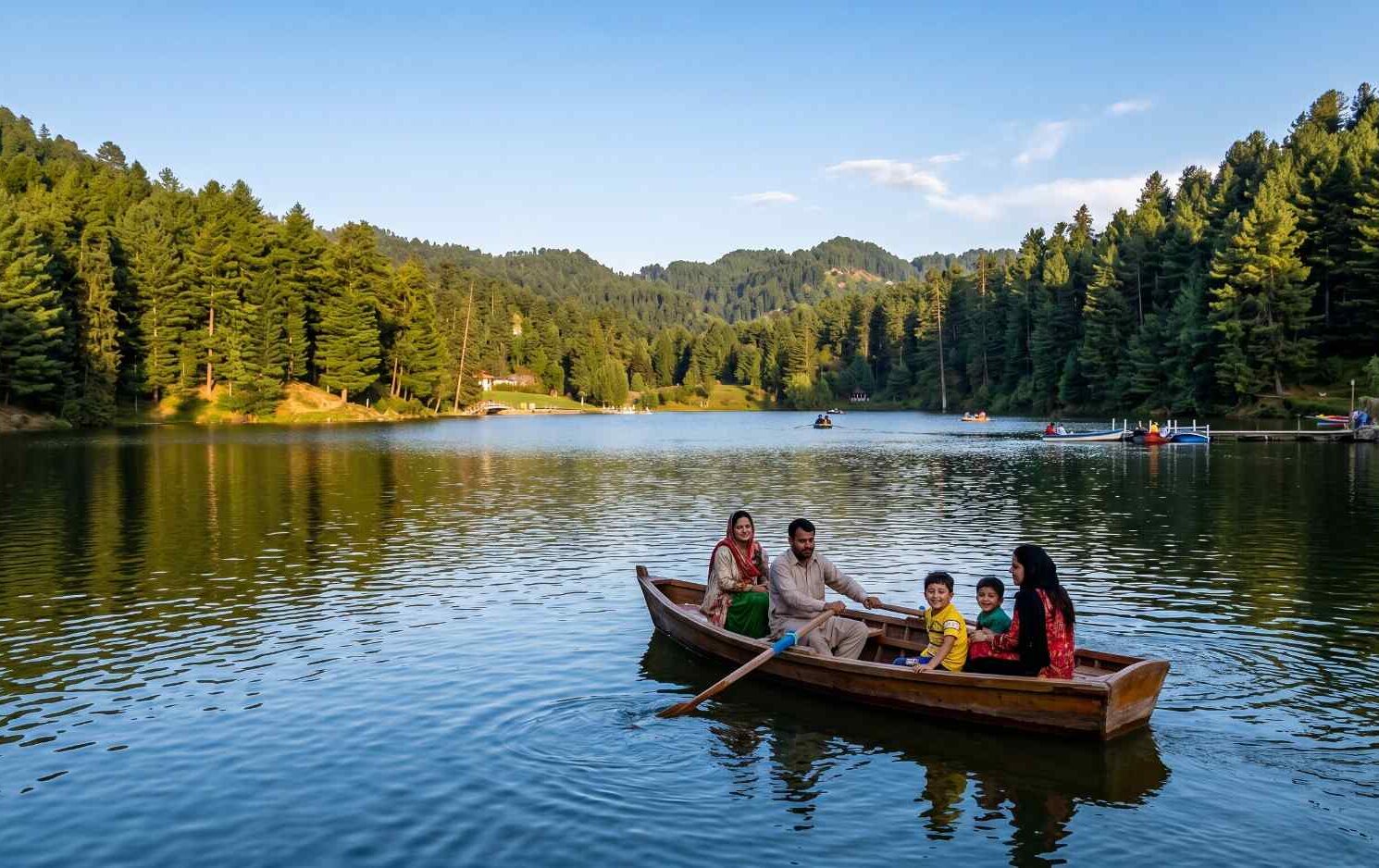
Banjosa Lake near Rawalakot, the most accessible lake in Azad Kashmir and a natural pine forest escape for families and first-time visitors
What Makes Kashmir’s Lakes Different
The lakes of Azad Kashmir are glacial in origin, fed by the snowfields and glaciers of the western Himalayas. Unlike the lakes of some other regions, which may be reservoir-fed or river-connected, the Kashmir lakes are enclosed high mountain basins where glacial meltwater accumulates with minimal outflow. This gives them their extraordinary clarity and their vivid colouring, the suspended glacial flour that makes Chitta Katha milky turquoise, the dissolved minerals that give Ratti Gali its emerald depth.
The surrounding terrain is equally significant. These lakes sit within the western Himalayan system, in valleys carved by glacial action over millions of years and still actively shaped by snowmelt and seasonal ice. The wildflower meadows that bloom around Ratti Gali and the high passes between the lakes are genuinely exceptional, comparable to alpine wildflower displays found in Switzerland or the Canadian Rockies, but without the trails, the cable cars, or the permanent infrastructure that has changed those landscapes permanently.
From the Crossroads team: The lakes of Kashmir have a quality of silence about them that is increasingly rare in mountain destinations. Ratti Gali at 5am, before the mist has lifted off the water and the first trekkers arrive from base camp below, is one of those moments that stays with a traveller for a lifetime. The approach matters as much as the arrival. Getting there with a guide who knows the valley, the route, and the conditions is what makes the difference between a walk and an experience.
Planning Your Visit: Practical Tips for Kashmir’s Lakes
Best Season: June to September
Most lake approaches in Azad Kashmir open in late May or June as the snow clears. July and August are the busiest months with domestic tourists. September offers quieter trails, excellent light, and the start of autumn colour in the lower valleys. High lakes like Chitta Katha have a narrower window of July to August only.
Getting to Neelum Valley
The Neelum Valley road runs northeast from Muzaffarabad. Muzaffarabad is approximately 150 kilometres from Islamabad and three to four hours by road. Dowarian (the Ratti Gali trailhead) is around 75 kilometres northeast of Muzaffarabad. All lake approaches require either jeep hire from the nearest town or independent trekking with local guides.
Jeeps and Local Transport
4×4 jeeps are essential for most lake approaches in the Neelum Valley. They can be hired in Muzaffarabad, Sharda, Kel, and Dowarian. Confirm road conditions locally before departure, as tracks can be damaged by seasonal flooding. Your guide or operator should arrange all transport as part of a supported trip.
Altitude and Acclimatisation
Ratti Gali sits at 3,683 metres and Chitta Katha at 4,115 metres. Visitors arriving from low altitudes should allow a day of rest in the valley before attempting the higher lake approaches. Altitude sickness symptoms including headache and breathlessness should not be ignored at these elevations.
Camping vs. Guesthouse
Ratti Gali base camp has basic guesthouses and food stalls in summer. Chitta Katha, Shounter, and the remote lakes require camping with your own tent and supplies. All camping equipment should be carried from below, and Leave No Trace principles apply strictly in these fragile high-altitude environments.
Guide Recommendation
For any lake beyond Ratti Gali, a local guide with specific knowledge of the Neelum Valley is strongly recommended. Routes between lakes cross high passes where conditions change rapidly. A good guide adds cultural depth, route safety, and local connections to accommodation and transport that independently sourced logistics rarely match.
Combining Kashmir’s Lakes with Wider Pakistan
Azad Kashmir and the Neelum Valley sit close enough to Islamabad to be combined with the capital as a starting point, and the region pairs naturally with several other destinations. Muzaffarabad, the capital of Azad Kashmir, is an excellent base city with good hotels and local character. The Neelum Valley road itself is beautiful throughout its length, with forested hillsides and riverside villages worth exploring even without reaching the upper lakes.
For travellers who want to combine Kashmir’s lake country with the broader mountain heritage of northern Pakistan, Crossroads Adventure designs itineraries that bring together the Neelum Valley with the alpine grandeur of Gilgit-Baltistan. Explore the complete Pakistan expedition catalogue to see how these journeys come together, or begin with the dedicated Kashmir alpine meadows and Ratti Gali experience as the starting point for planning your journey into this extraordinary lake country.
Frequently Asked Questions
What is the most famous lake in Kashmir (Pakistan)?
Ratti Gali Lake in the Neelum Valley is the most famous and most visited lake in Azad Kashmir. Sitting at 3,683 metres and surrounded by wildflower meadows and snow-capped peaks, it is also the base point for accessing five interconnected high-altitude lakes, making it the natural centrepiece of any Kashmir lake itinerary. Chitta Katha in the Shounter Valley is arguably the most dramatically beautiful, though significantly more difficult to reach.
How do I get to Ratti Gali Lake?
Ratti Gali is reached from Dowarian, a town in the Neelum Valley approximately 75 kilometres northeast of Muzaffarabad. From Dowarian, a jeep track climbs for two to three hours to the base camp, from where a 45-minute to one-hour hike reaches the lake shore. The total journey from Islamabad takes around seven to eight hours including the drive to Muzaffarabad and the jeep ride. Local jeeps can be hired in Dowarian. Crossroads Adventure coordinates all jeep transport and guide services for guests on the Kashmir experience.
Is Chitta Katha Lake accessible to non-trekkers?
No. Chitta Katha at 4,115 metres requires a jeep ride from Kel followed by a five-kilometre trek of three to four hours over rough, high-altitude terrain. It has a narrow seasonal window of July to August only. Solid physical fitness, appropriate gear, and a local guide are all essential. It is not suitable for visitors without previous trekking experience at altitude.
What is the best time to visit the lakes of Azad Kashmir?
June through September is the main visiting season. July and August are peak domestic tourist months for Ratti Gali. September is quieter and offers excellent light. The narrow window for Chitta Katha is July and August only. Banjosa Lake near Rawalakot can be visited from April through October. Most upper lake routes close with the first heavy snowfall in October.
Is Azad Kashmir safe to visit?
The tourist areas of Azad Kashmir, including Muzaffarabad, the Neelum Valley, Rawalakot, and the lake trekking routes, are safe and well-established destinations for both domestic and international travellers. The valley has a strong tourism infrastructure in summer months. Travellers should always check the current situation with their tour operator before departure, as conditions near the Line of Control can vary. The trekking areas covered in this guide are well within the safe tourist zone of Azad Kashmir.
Can I camp at the lakes in Azad Kashmir?
Yes. Camping is permitted at most lake sites in Azad Kashmir. Ratti Gali base camp has established camping areas with basic facilities in summer. For higher and more remote lakes like Chitta Katha, Saral, and Hansraj, self-sufficient camping with your own tent, sleeping bag, and supplies is required. No permanent infrastructure exists at these elevations. Leave No Trace principles apply, and all waste should be carried out from the lake area.
Experience the Lakes of Kashmir with Crossroads Adventure
From the wildflower shores of Ratti Gali to the remote glacial world of Chitta Katha, Kashmir’s lakes reward those who reach them with experiences that are genuinely hard to find anywhere else. Let Crossroads build the perfect itinerary around them.
Start Planning Your Kashmir Lake Journey