Most travellers who visit Pakistan focus exclusively on the mountain landscapes of the north, and rightly so. But Khewra, sitting in the Salt Range of Punjab around 160 kilometres from Islamabad, offers something genuinely different: a journey underground into one of the planet’s most remarkable geological formations, decorated with salt mosques, brine pools more saline than the Dead Sea, crystal chambers, and monuments crafted entirely from blocks of pink, red, and white rock salt.
Crossroads Adventure includes Khewra as part of broader Pakistan heritage journeys. If you want to combine the mine with the ancient Buddhist sites of Taxila, the Mughal splendour of Lahore, or the vast cultural sweep from the Indus Valley to the Karakoram, explore the full range of culture and heritage expeditions designed to cover Pakistan’s extraordinary past in a single cohesive journey.
Khewra Salt Mine: The Essential Facts
The mine sits in the Salt Range of the Potohar Plateau in Jhelum District, Punjab. The salt deposits here were formed over 800 million years ago through the evaporation of ancient shallow seas, long before the Himalayas existed. The resulting rock salt seam, up to 150 metres thick in places, runs beneath the Salt Range in a massive dome-like structure covering over 110 square kilometres. At current extraction rates, the estimated reserves are sufficient to last another 350 years.
The mine has 19 storeys, of which 11 are below ground. From the entrance, it extends approximately 730 metres into the mountain. Mining uses the room and pillar method: only 50 percent of the salt is extracted at any point, with the remaining 50 percent left as structural pillars supporting the tunnels above. This is why the mine has remained stable for centuries. Annual production runs at around 325,000 to 385,000 tonnes of rock salt, accounting for roughly half of Pakistan’s total rock salt output.
The History of Khewra Salt Mine
Discovery by Alexander the Great’s Army
The story begins in 326 BC, when Alexander the Great and his army were camped in the region during the Indian campaign. Soldiers noticed their horses licking the rocks along the ground. Curious, the soldiers tasted the rocks themselves and discovered they were salt. This accidental discovery, by horses rather than geologists, revealed one of the largest salt deposits anywhere on Earth. However, no formal mining took place at this stage.
Janjua Tribe and the Mughal Era
The earliest recorded salt extraction at Khewra was organised by the local Janjua Raja tribe from the 13th century onward. When the Mughal Emperor Akbar learned of the deposits in the 16th century, he incorporated the mines into the imperial economy, using the salt for nutrition and taxation. Mughal craftspeople also began working the rock salt into decorative objects during this era: tableware, vases, and artistic pieces. The underground brine pools that visitors see today were formed largely from Mughal-era mining chambers.
Sikh Rule
The Sikh Empire took control of the mines from the Mughals in 1809. It was during this period that the mines were given the name Khewra, after the locality. Salt production continued and the mines became an important source of revenue for the Sikh administration in Punjab.
British Industrialisation
The British took over the mines in 1849 and brought industrial methods to what had been largely manual extraction. The most significant development came in 1872 when mining engineer H. Warth designed and built the main tunnel at ground level, the same tunnel visitors travel through today. The British widened tunnels, built ventilation systems, constructed a railway to transport salt to the Jhelum River, and introduced lathe machinery to craft artistic pieces from the rock salt. By 1914, annual production had reached 80,000 metric tonnes. Steam engines were installed in the 1920s to further improve haulage. The Victoria Bridge over the Jhelum River was built in 1890 specifically to transport Khewra salt to markets across British India.
Pakistan Mineral Development Corporation
After Pakistan’s independence, the mines passed through several administrative bodies before coming under the Pakistan Mineral Development Corporation (PMDC), the government entity that operates them today. In 2003, a major tourist development programme was completed, converting sections of the mine into a structured visitor experience with guided tours, a small electric train, illuminated chambers, salt sculptures, and a café. A salt therapy clinic treating asthma and respiratory conditions was established in 2007, following the model of similar facilities in Polish and Ukrainian salt mines.
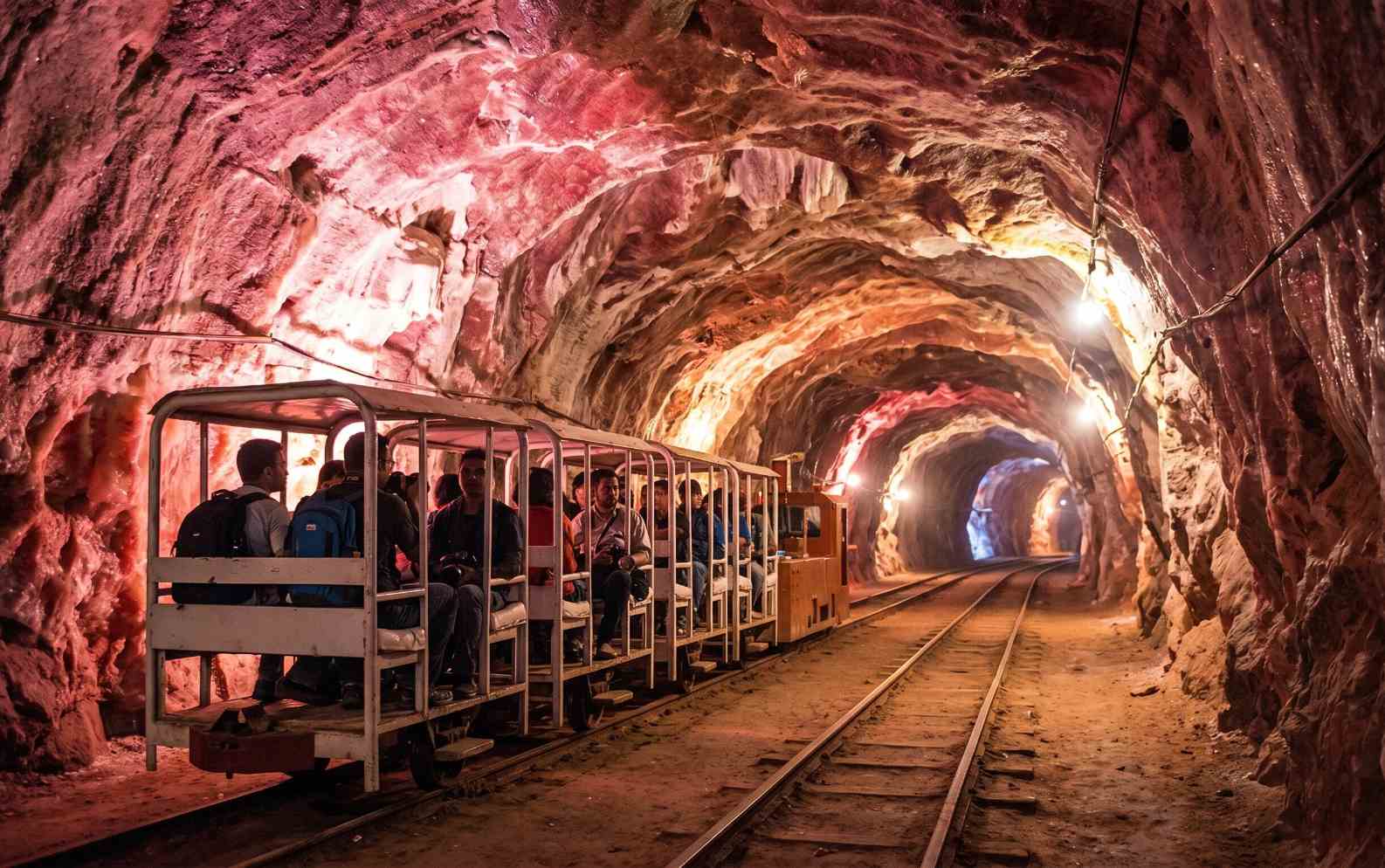
The Khewra Salt Mine railway, a narrow-gauge electric train that carries visitors 730 metres into the mountain through the tunnel built by H. Warth in 1872
What to See Inside Khewra Salt Mine
The tourist experience at Khewra is well-organised and genuinely impressive. Visitors travel into the mine on a narrow-gauge electric train through the main ground-level tunnel, then explore a route that passes through chambers, sculptures, brine pools, and architectural features crafted from salt over many decades. The temperature inside remains a constant 18°C to 20°C year round, making it comfortable in all seasons.
The Badshahi Mosque and Salt Mosque
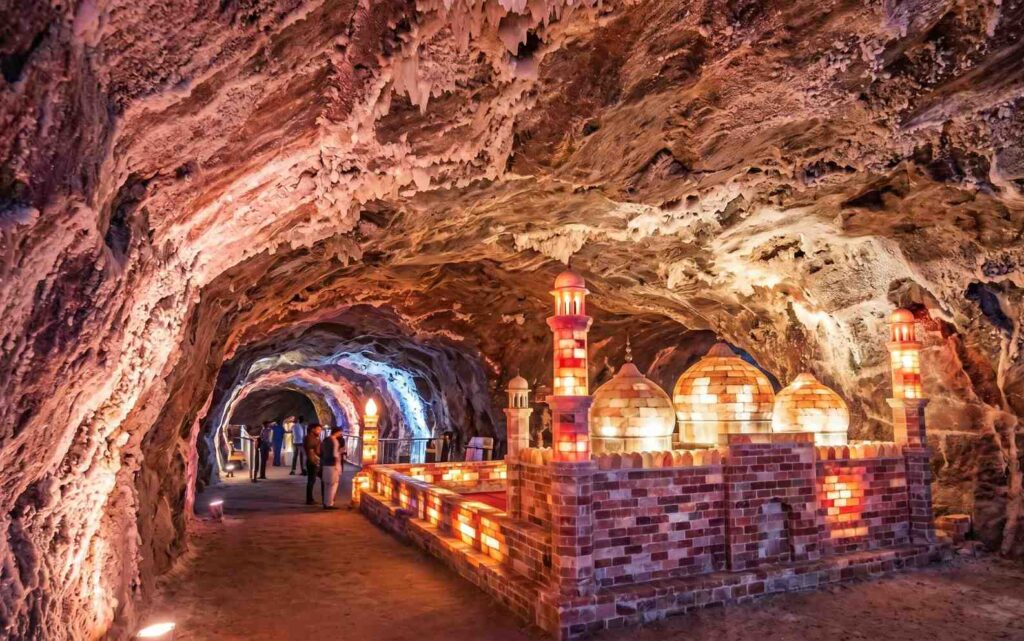
The most celebrated structure inside the mine is a replica of Lahore’s Badshahi Mosque, built from multi-coloured salt bricks in shades of pink, red, white, and off-white. The bricks are arranged in precise architectural patterns and illuminated from within, creating a glowing, warm effect that is genuinely breathtaking in the underground context. A functional prayer mosque, also built from salt bricks, was added approximately 50 years ago and continues to be used by mine workers for daily prayers. Both structures illustrate what happens when an ancient material and a skilled craftsman’s eye meet: the results are not obviously expected to be beautiful, but they are.
The Brine Pools: More Saline Than the Dead Sea
Several underground pools of brine water formed in the chambers excavated during the Mughal era are among the most extraordinary features of the mine. The salt concentration in these pools is higher than that of the Dead Sea, meaning objects float effortlessly and the water has a density that makes the ceiling’s reflection appear perfectly sharp and mirrorlike. The pools are illuminated with coloured lights to reveal their depth and the salt formations on their surfaces. Standing at the edge of a Mughal-era brine pool, 730 metres inside a mountain, looking at the glowing salt ceiling reflected below you, is one of those moments that genuinely requires no embellishment.
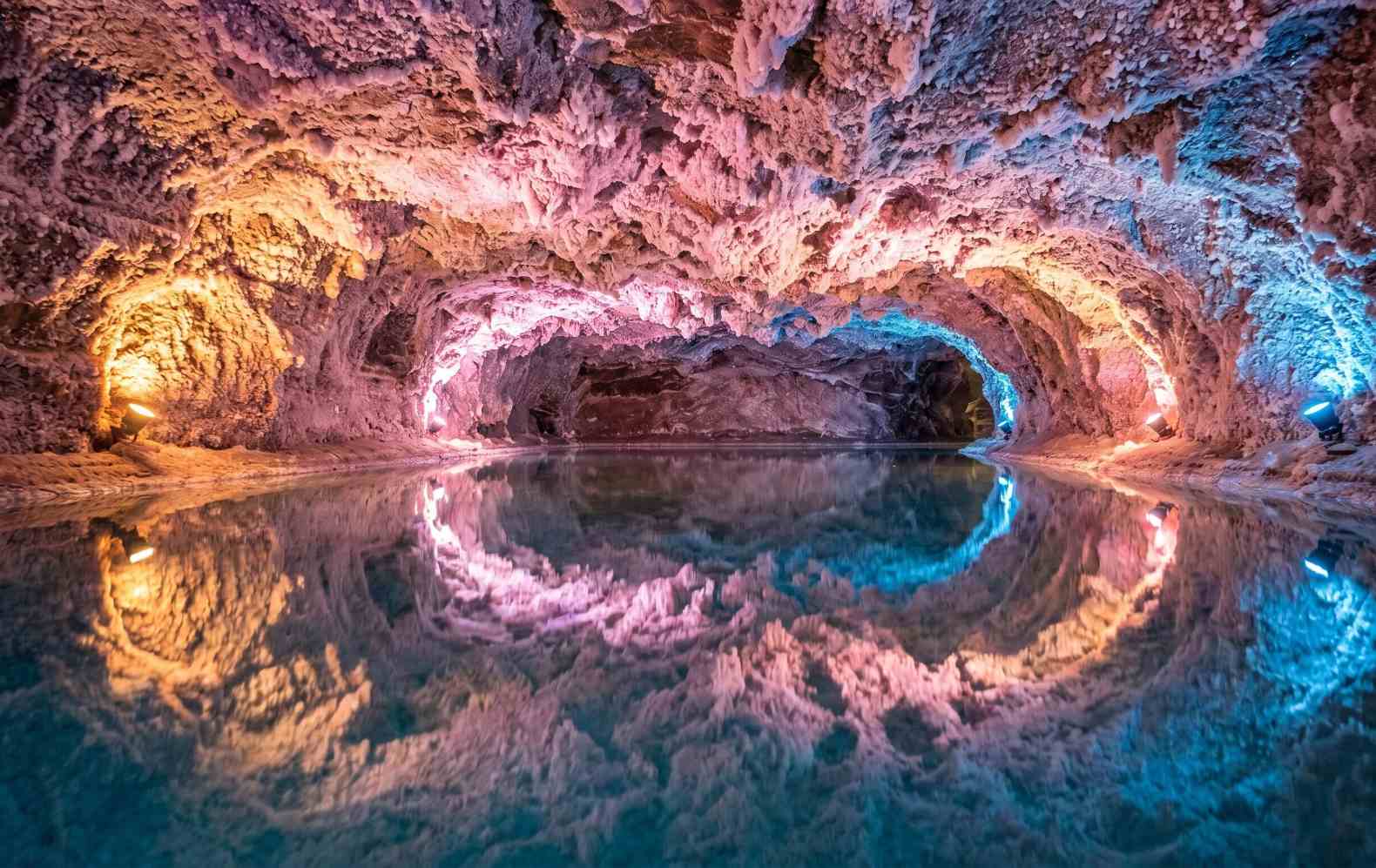
A Mughal-era brine pool inside Khewra, with salinity exceeding the Dead Sea. The ceiling reflects perfectly in the still water below
Crystal Valley
Crystal Valley is a section of the mine where natural rock salt crystals cover both the walls and the ceiling of a long tunnel. When light falls on them, the crystals refract and scatter it into a thousand points of sparkle. The effect is genuinely stunning, particularly because it is entirely natural: no artificial decoration, just millennia of salt crystallisation producing a display that rivals any man-made installation. This is consistently cited by visitors as the most memorable single experience inside the mine.
The Assembly Hall
The Assembly Hall is the largest single chamber in the mine, rising 75 metres from floor to ceiling with well-built stairs ascending the walls. The scale is genuinely vertiginous. Standing on the floor of the chamber looking upward at 75 metres of pink and white salt overhead creates an impression of cathedral-like grandeur achieved entirely by natural geology and extraction over centuries. The chamber is illuminated and serves as one of the major staging points on the tourist route.
Pul-Saraat: The Salt Bridge
Pul-Saraat is a naturally formed salt bridge spanning a deep brine pond with no pillars supporting it from below. The bridge’s name is drawn from Islamic tradition, where Pul-Saraat refers to the bridge that souls must cross on the Day of Judgement. Whether that association was applied to the geological formation or inspired its creation is unclear, but the physical experience of crossing a pillarless salt bridge 25 metres above a brine pool inside a mountain is arresting regardless of theological associations.
Salt Sculptures and Monuments
Throughout the visitor route, craftspeople have created detailed replicas of national monuments and icons using salt bricks of varying colours. The Minar-e-Pakistan, Pakistan’s independence monument in Lahore, has been recreated in multi-coloured salt blocks illuminated from within. A statue of national poet Allama Iqbal stands in one of the chambers. A model of the Great Wall of China uses the natural range of Khewra salt colours to differentiate architectural sections. The calligraphic name of Muhammad in Urdu script has been formed from salt crystal accumulation in one area, a natural formation rather than a constructed one. These details accumulate into an underground world that is simultaneously geological, historical, artistic, and distinctly Pakistani.
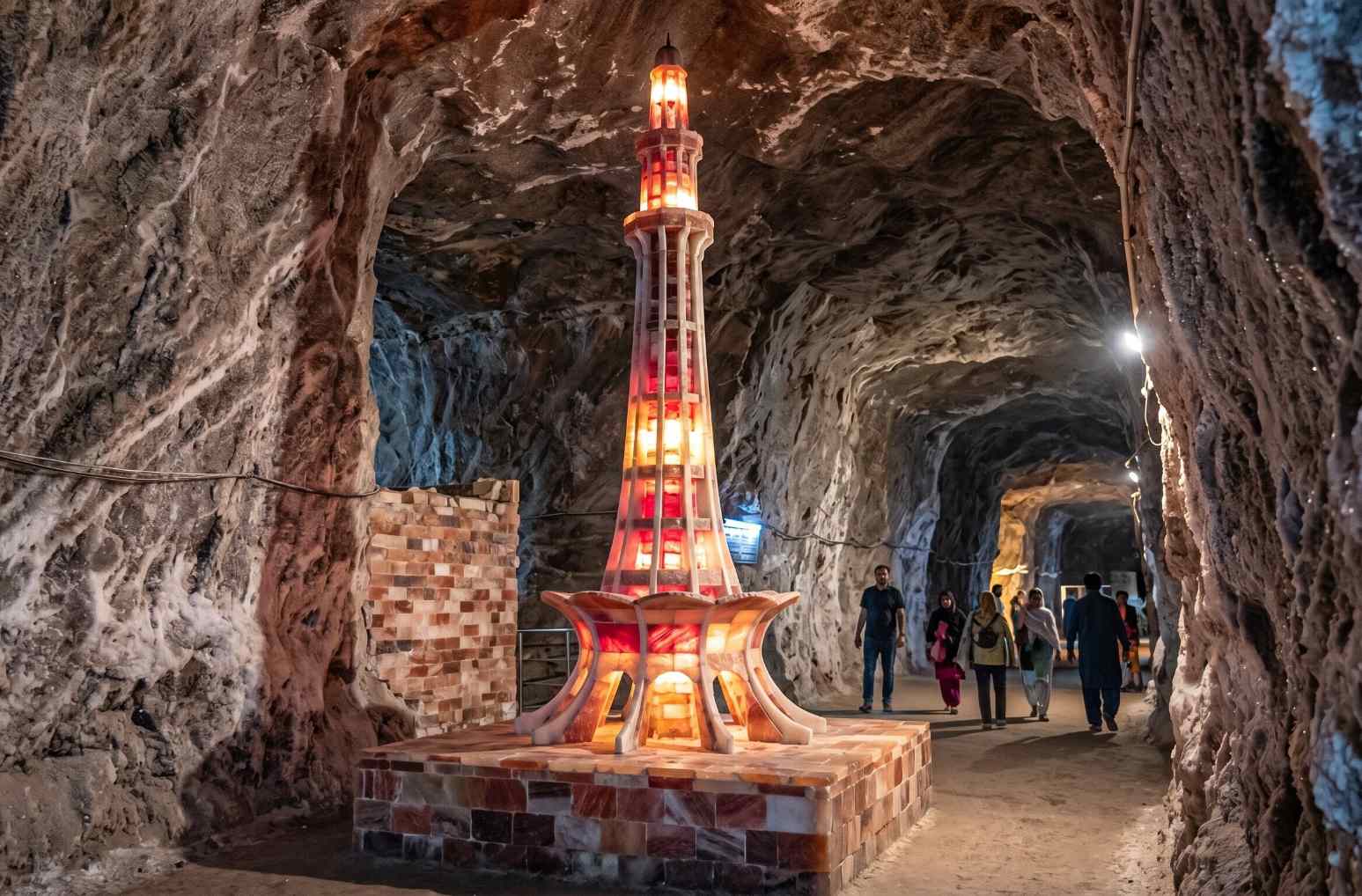
A replica of the Minar-e-Pakistan, built from coloured salt bricks inside Khewra, one of many monuments and sculptures crafted from the mine’s naturally varied rock salt
The Salt Therapy Clinic
In 2007, a clinical ward was established at Level 5 of the mine, following the model of salt therapy clinics in Polish and Ukrainian salt mines. The principle is that the microclimate of a salt mine, with low humidity, stable temperature, and salt-laden air, benefits patients with asthma, allergies, and other respiratory conditions. Patients undergo a course of treatment requiring around 110 hours inside the mine’s microclimate, spending approximately 10 hours per day underground. The PMDC reports encouraging results from this facility. For general visitors, the simple act of breathing the mine’s clean, salt-saturated air for an hour or two is noticeably refreshing.
Himalayan Pink Salt: What Khewra Produces
The Truth About Himalayan Salt
The pink salt sold globally as “Himalayan salt” comes primarily from Khewra. Despite the name, the mine is not located in the Himalayas but in the Salt Range of Punjab, around 300 kilometres from the nearest Himalayan foothills. The salt’s distinctive colour comes from trace mineral impurities, primarily iron oxide, which give it shades ranging from pale pink to deep red. The higher the iron content, the darker and redder the salt. The salt is considered among the purest and least processed forms of rock salt in the world. Beyond cooking salt, Khewra’s rock salt is used to produce decorative lamps, vases, candle holders, bath salt, and industrial raw materials including soda ash. These products are exported globally, particularly to the United States and European markets.
Practical Visitor Information
| Detail | Information |
|---|---|
| Location | Khewra, Jhelum District, Punjab, Pakistan. 160km from Islamabad, 30km from Jhelum city. |
| Opening Hours | Daily 9:00 AM to 4:00 PM. Open year round. |
| Entry Fee (Adults) | Rs. 800 for Pakistani adults. Rs. 500 for students. USD 20 for foreign visitors. Confirm current prices locally before visiting as fees may be updated. |
| How to Get There | By road from Islamabad via the M2 motorway toward Lahore, exit at Pind Dadan Khan, then follow signs to Khewra (approximately 2 to 2.5 hours total). By train to Khewra station. Private car hire from Islamabad is the most flexible option. |
| Inside Temperature | Stable 18°C to 20°C year round. Take a light layer regardless of outside temperature. |
| Duration of Visit | 1.5 to 2.5 hours covers the full standard tourist route including the train ride, chambers, and sculptures. |
| Best Season | October to March. Pleasant outside temperatures make the journey and the roadside experience more comfortable. The mine itself is enjoyable year round due to its constant internal temperature. |
| Photography | Permitted in most areas. Flash photography is discouraged in some chambers to protect salt structures. Check on-site guidance. |
| Facilities | Café, souvenir shops selling salt lamps and edible salt products, toilets at the entrance area. |
| Operated by | Pakistan Mineral Development Corporation (PMDC), Government of Pakistan. |
Tips for Visiting Khewra Salt Mine
Arrive Before Noon
The mine is busiest on weekends and during school holidays from June through August. Arriving by 9:30 or 10:00 AM gives you the best chance of joining a smaller tour group and experiencing the chambers before afternoon crowds arrive.
Wear a Light Jacket
The inside temperature is 18 to 20°C year round. In summer, when Pakistan’s plains can reach 40°C outside, this is genuinely refreshing. In winter, when outside temperatures drop, it can feel warmer than you expect. A light layer handles both scenarios.
Confirm Ticket Prices Locally
Entry fees are set by the PMDC and can change. Foreign visitor prices in particular have varied over the years. Check with your driver or hotel before arrival to avoid surprises at the gate. The mine is operated as a working industrial facility alongside a tourist attraction.
Buy Salt Products Directly
The souvenir stalls outside the mine sell salt lamps, decorative pieces, and edible salt at competitive prices, and buying here directly supports the mine’s local economy. Salt lamps make excellent, lightweight gifts and are the same product sold internationally at a significant markup as “Himalayan salt lamps.”
Combine with Islamabad or Lahore
Khewra is best visited as a day trip from Islamabad (2 to 2.5 hours) or as a stop on the drive between Islamabad and Lahore. It pairs well with the ancient Buddhist heritage of Taxila, which is also within day trip distance from Islamabad, for a full historical heritage day.
The Mine is Family-Friendly
The electric train, illuminated sculptures, and accessible route make Khewra excellent for children and families. The mine is not physically demanding and requires no particular fitness or mobility beyond the ability to walk reasonable distances on flat, well-maintained ground.
Combining Khewra with Pakistan’s Heritage Circuit: Khewra sits naturally on the cultural route between Islamabad and Lahore. Visitors who want to make the most of this corridor can combine the mine with the Taxila, Gandhara, and Peshawar heritage trail, the Mughal heritage trail through Lahore, and the broader Indus Valley civilisation experience into a single comprehensive journey through 5,000 years of Pakistan’s history.
Frequently Asked Questions
Where is Khewra Salt Mine located?
Khewra Salt Mine is located in the town of Khewra in Jhelum District, Punjab, Pakistan. It sits in the Salt Range of the Potohar Plateau, approximately 160 kilometres south of Islamabad and 30 kilometres from Jhelum city. The mine is easily reached by road from Islamabad in around two hours, or as a stop on the Islamabad to Lahore road route.
Is Khewra the largest salt mine in the world?
Khewra is the second-largest salt mine in the world by production and reserve, after the Sifto Mine in Goderich, Canada (sometimes listed as Poland’s Wieliczka, though comparisons vary by measurement criteria). It is the largest salt mine in Pakistan and the largest in Asia, and by historical continuity of use, it is among the oldest active salt mines on Earth. Its annual output of around 325,000 to 385,000 tonnes accounts for roughly half of Pakistan’s total rock salt production.
Who discovered Khewra Salt Mine?
The salt deposits at Khewra were first discovered in 326 BC by the horses of Alexander the Great’s army, who were observed licking the salt from rocks during the campaign through the region. The soldiers tasted the rocks and confirmed they were salt. Formal mining did not begin until the Mughal era, centuries later, when Emperor Akbar’s administration incorporated the mine into the imperial economy.
What is Himalayan pink salt and does it come from Khewra?
Himalayan pink salt is the commercial name for rock salt extracted primarily from the Khewra mine. Despite the name, the mine is not located in the Himalayas but in the Salt Range of Punjab. The pink and red colouring comes from trace iron oxide minerals in the salt. Khewra salt is sold globally as a culinary product, bath salt, and raw material for decorative items including the well-known salt lamps. It is considered one of the purest and least-processed rock salts commercially available.
How long does a visit to Khewra Salt Mine take?
A standard guided visit including the electric train journey into the mine, the main chamber route, the brine pools, Crystal Valley, the Assembly Hall, the salt mosque and sculptures, and the return journey takes approximately 1.5 to 2.5 hours. Adding time to browse the souvenir stalls and have tea or food at the café outside, a comfortable half-day allocation is ideal. The mine is well-suited to a morning visit before continuing to Lahore or returning to Islamabad in the afternoon.
Is Khewra Salt Mine safe to visit?
Yes. The mine has been receiving tourists since 2003 and welcomes over 250,000 visitors annually, including large numbers of international travellers, students, and families. The tourist route is well-maintained, properly illuminated, and managed by trained staff. The structural stability of the mine is maintained by the room and pillar method, which leaves 50 percent of the salt intact as structural support. The constant temperature and low humidity of the interior are considered beneficial rather than hazardous for most visitors.
Add Khewra to Your Pakistan Journey
Pakistan’s heritage runs from ancient salt mines to Mughal palaces to Buddhist ruins that predate the Roman Empire. Crossroads Adventure builds itineraries that connect these extraordinary threads into a single journey worth making.
Start Planning Your Pakistan Heritage Tour