Crossroads field guides · Heritage & culture
Sikh heritage in Pakistan is concentrated in places where the faith began, where its Gurus lived and taught, and where the Sikh Empire later governed Punjab. Nankana Sahib commemorates Guru Nanak’s birth. Kartarpur represents the community he established during the final part of his life. Panja Sahib in Hasan Abdal preserves a deeply revered tradition associated with his travels. Lahore connects the martyrdom of Guru Arjan, the birthplace of Guru Ram Das, and the political world of Maharaja Ranjit Singh.
These are different kinds of heritage. A working gurdwara is a place of worship with its own daily rhythm. A royal samadhi is a memorial. A fort contains layers of political history. Understanding those distinctions helps a visitor plan meaningful experiences instead of treating every location as an interchangeable monument.
This guide explains the main sites, the history behind them, realistic transport arrangements, appropriate conduct and the important difference between a Pakistan pilgrimage journey and the Kartarpur Corridor. Travel estimates below are planning ranges, not live navigation readings. They exclude lengthy religious ceremonies, exceptional traffic, immigration and festival security arrangements.
Important access update: research checked on 6 October 2026 found that India’s official Kartarpur pilgrimage portal displayed a suspension notice for corridor services. Do not interpret an accessible registration website or an old agreement as confirmation that crossings are operating. Check the official portal and both countries’ current instructions before committing to travel. Ordinary access from within Pakistan follows a separate process. 1
By Sultan Uddin · Crossroads Adventure · Editorial review: 6 October 2026
Why Pakistan matters in Sikh history
The Punjab of Guru Nanak
Guru Nanak was born in 1469 in Talwandi, now Nankana Sahib in Pakistan’s Punjab. His life unfolded before the modern boundary between India and Pakistan existed. The sacred geography of Sikhism therefore crosses today’s international border: some major places are in Indian Punjab, while foundational sites remain in Pakistan.
For a first-time visitor, it is useful to begin with the Gurus rather than with a list of buildings. Guru Nanak was the first Sikh Guru. The teaching tradition continued through nine subsequent human Gurus. Sikhs revere the Guru Granth Sahib as the living Guru; its presence determines how worshippers behave within the prayer hall. A guide should explain the scripture’s place in Sikh life before asking visitors to understand the architecture.
Nankana Sahib is associated with childhood and beginnings. Kartarpur is associated with settled community life. Journeys between them should leave room for these different meanings. Someone undertaking a personal pilgrimage may need substantial time for prayer and reflection; an architectural visitor may prefer interpretation of courtyards, patronage and rebuilding. Neither needs to rush through a sacred place to meet a photographic checklist.
Lahore, the Gurus and the Sikh Empire
Lahore contains memories of both spiritual leadership and later state power. Guru Arjan, the fifth Guru, was martyred in 1606; Gurdwara Dera Sahib commemorates that event. Guru Ram Das, the fourth Guru, is associated with a birthplace shrine in the city’s Chuna Mandi area. These places should be understood independently of the later kingdom. 23
Maharaja Ranjit Singh established Lahore as his capital after taking the city in 1799. He became maharaja in 1801 and died in 1839. The state he built was annexed by the British in 1849. This nineteenth-century history is visible around Lahore Fort, Hazuri Bagh and his samadhi. A visit can therefore move from the Gurus’ religious history to the court’s material culture without confusing one period with another. 4
Partition and the present-day custodians
Partition in 1947 transformed the population and administration of Punjab, separating many Sikhs from shrines in what became Pakistan. Today, the Evacuee Trust Property Board has responsibilities for Sikh and Hindu religious properties and pilgrim arrangements, working in the Sikh context with the Pakistan Sikh Gurdwara Parbandhak Committee. Officially arranged festival pilgrimages and individual foreign visits may involve different procedures. 5
This administrative reality matters. A gurdwara’s inclusion on a heritage list does not mean every visitor can enter it without coordination. Smaller shrines can have limited opening arrangements or different security procedures. Build your journey around confirmed access and leave smaller locations as coordinated additions.
The main places at a glance
| Site | Location and principal meaning | Practical base | Suggested visit allocation |
|---|---|---|---|
| Gurdwara Janam Asthan | Nankana Sahib; Guru Nanak’s birthplace | Lahore or arranged local stay | 2–3 hours, longer for worship |
| Associated Nankana gurdwaras | Childhood and other Sikh traditions | Nankana Sahib | A further half day or full day |
| Gurdwara Darbar Sahib | Kartarpur, Narowal district; Guru Nanak’s final community | Lahore or confirmed local accommodation | 2–4 hours after entry procedures |
| Gurdwara Panja Sahib | Hasan Abdal; revered Guru Nanak tradition | Islamabad/Rawalpindi | 1.5–3 hours |
| Gurdwara Dera Sahib | Lahore; martyrdom of Guru Arjan | Lahore | 1–2 hours |
| Janam Asthan Guru Ram Das | Chuna Mandi, Lahore; fourth Guru’s birthplace tradition | Lahore | 45–90 minutes if access arranged |
| Ranjit Singh’s Samadhi | Beside the Lahore Fort and Badshahi Mosque ensemble | Lahore | 45–90 minutes if access arranged |
| Sacha Sauda | Near Farooqabad; charitable service tradition | Lahore/Nankana circuit | 45–90 minutes |
| Rohri Sahib | Eminabad, near Gujranwala; Guru Nanak association | Lahore | 45–90 minutes |
These suggested durations are editorial planning allowances. A major celebration, a kirtan programme or a family’s personal prayers can extend them considerably.
Nankana Sahib and its associated gurdwaras
Gurdwara Janam Asthan: the essential starting point
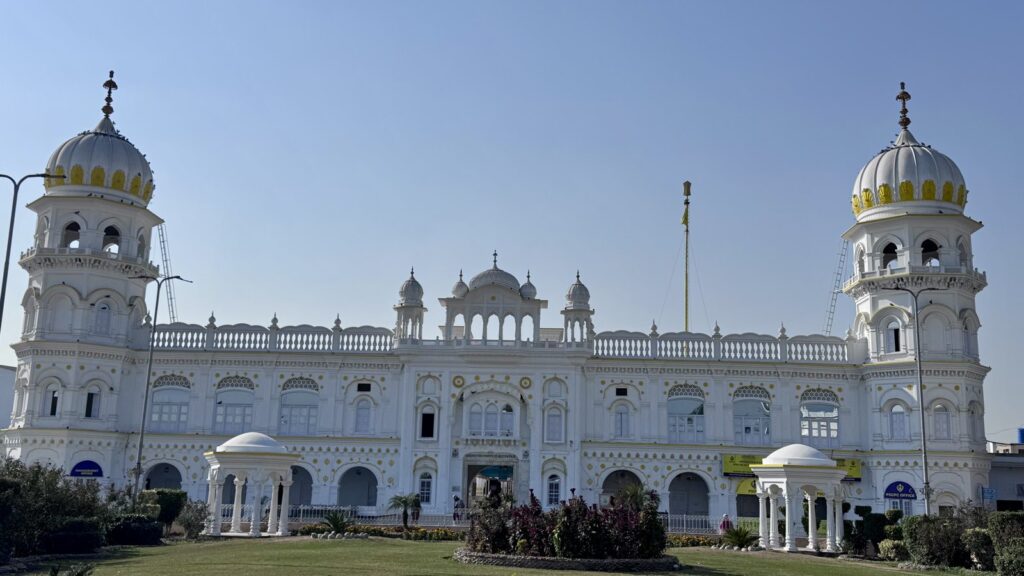
Gurdwara Janam Asthan stands at the site revered as Guru Nanak’s birthplace. The town was historically known as Talwandi. Its current identity is inseparable from Guru Nanak and the pilgrims who visit it. Punjab’s official heritage information identifies Janam Asthan within an important group of Nankana shrines. 6
The visit is principally about the birthplace and its continuing religious significance. The standing complex has evolved through patronage, rebuilding and maintenance; it should not be introduced as an untouched building from 1469. Visitors who care about architectural history should ask which parts belong to particular rebuilding phases, rather than assuming the date of an event is also the construction date of everything visible.
Allow time to understand the entrance routine, remove footwear, cover the head and sit quietly in the prayer hall where permitted. A sensitive guide can explain the arrangement of the Guru Granth Sahib, the role of the granthi and the meaning of congregational worship. Interpretation should be brief inside the hall; longer historical discussions belong outside so that worship continues undisturbed.
The broader site also carries memories of the gurdwara reform movement and Saka Nankana Sahib in 1921. For an in-depth pilgrimage, request a guide familiar with that later history and ask the custodians which commemorative features can be visited. Avoid reducing the town to a single birth-date narrative.
Other gurdwaras in Nankana Sahib
The SGPC’s Pakistan shrine directory lists Bal Lilah, Patti Sahib, Mall Ji Sahib, Kiara Sahib, Tambu Sahib and Guru Hargobind Sahib among the town’s associated places. Spellings vary across English-language sources; use both the local name and a confirmed location when arranging transport. 7
Several names relate to remembered episodes in Guru Nanak’s youth. They make most sense as a connected account interpreted by someone who knows Sikh devotional literature. Bal Lilah Sahib recalls childhood activities. Patti Sahib is associated with learning. Kiara Sahib and Mall Ji Sahib relate to traditions around cattle grazing and the recognition of Guru Nanak’s spiritual qualities. Tambu Sahib belongs to the town’s larger sacred landscape.
Devotional narratives are part of what makes these places meaningful. They should be presented explicitly as Sikh tradition, rather than as events proven through modern archaeological evidence. The SGPC’s account of Mall Ji Sahib, for example, relates the protective cobra episode and Rai Bular’s recognition of the young Guru. That tells a visitor how the shrine is understood religiously; it does not establish the age of every current wall or tree. 8
Do not promise that all associated gurdwaras have identical facilities or can be visited in one uninterrupted walk. Confirm each opening arrangement. A practical schedule combines a main visit to Janam Asthan with a selected sequence of nearby shrines, leaving enough time for prayer instead of counting completed stops.
Getting to Nankana Sahib
Lahore is the most convenient arrival base for most international visitors. Depending on your hotel and road choice, plan roughly 85–100 kilometres and 1.5–2.5 hours each way to Nankana Sahib. The driver should select the route using current motorway and local-road conditions. Festival days can add security checks, congestion and restricted vehicle access near the complex.
For a day visit, leave Lahore in the morning and avoid squeezing in a full city programme on the same evening. To include several associated shrines and Sacha Sauda, use two days or accept that a one-day circuit will have less contemplative time.
Travel is across the Punjab plains; this is not a high-altitude destination. The physical issues are heat, standing time, barefoot walking and occasional uneven paving. Pilgrim accommodation may be available through specific arrangements, but should never be assumed to operate like an ordinary hotel with guaranteed private bathrooms, cooling or unrestricted booking.
Kartarpur Sahib and corridor access
Why Darbar Sahib matters
Gurdwara Darbar Sahib at Kartarpur, in Narowal district, is associated with the final phase of Guru Nanak’s life and the community he established there. It is especially significant for understanding Sikh practice as community life: worship, work, shared meals and service.
Visitors should distinguish the historic religious core from the large modern development around it. Expansive courtyards and visitor infrastructure help manage large numbers of pilgrims, but the sacred meaning predates those additions. An informed visit asks how the place represents Guru Nanak’s teaching and community rather than merely comparing the size of the modern complex.
The open spaces can require appreciable walking. Even when routes are flat, they can be tiring in heat or glare. Allow extra time for older guests and anyone using mobility assistance. Ask ahead about accessible routes, internal transport and the exact point where footwear must be removed.
Visiting from within Pakistan
Travel from Lahore to Kartarpur is generally a substantial excursion, with a planning allowance of approximately 120–150 kilometres and 2.5–3.5 hours each way, depending on the starting point and selected route through the Narowal area. Border-area checks and entry formalities can extend the day. A visitor coming from Islamabad should normally incorporate Kartarpur into a Punjab itinerary instead of attempting a same-day return.
Foreign guests already admitted to Pakistan must confirm Pakistan-side entry requirements for their nationality and travel documents. Carry your passport and the applicable visa or entry authorization. Do not assume that a passport photocopy is sufficient at every checkpoint. Your host should reconfirm identification, advance coordination, fee and photography arrangements shortly before the visit.
The Kartarpur Corridor is a separate arrangement
The corridor connects the Indian side at Dera Baba Nanak with Kartarpur in Pakistan under a dedicated bilateral framework. The official Indian guidance describes eligibility for Indian citizens and Overseas Citizen of India cardholders, with valid passport documentation and an OCI card where applicable. This is not a general border crossing for all foreign travelers. 19
Under the published framework, the corridor is a restricted pilgrimage visit, not permission to travel onward to Lahore, Nankana Sahib or Islamabad. Pakistan’s Ministry of Religious Affairs describes the agreed visit as visa-free, from dawn to dusk, with a service charge specified in the bilateral arrangements. Those agreement terms should not be treated as a guarantee of current operation, current fee collection or admission on a chosen date. 10
As noted at the beginning of this guide, the official portal’s suspension notice was present in the research checked on 6 October 2026. Anyone considering corridor travel should first establish whether services have resumed. Only then should they rely on current registration deadlines, authorized dates, document lists and return instructions. An old confirmation, social-media video or operator advertisement cannot replace that check.
A traveler eligible for an ordinary Pakistan visa still has to comply with that visa’s conditions. Indian passport holders should seek nationality-specific guidance rather than assuming arrangements available to a British, Canadian or Malaysian citizen also apply to them.
Panja Sahib in Hasan Abdal
The sacred tradition
Gurdwara Panja Sahib is in Hasan Abdal, northwest of Islamabad. Its central religious association is the revered handprint on a stone, understood in Sikh tradition through the account of Guru Nanak, Bhai Mardana and Wali Qandhari. Present the narrative respectfully as tradition; visitors need not confuse devotion with a geological explanation. The SGPC includes Panja Sahib among Pakistan’s major historical gurdwaras. 11
The spring and sarovar are important elements of the setting. Follow the custodians’ directions about approaching the sacred features and about any permitted participation. A sacred pool is not a general recreational swimming area, and rules should be confirmed locally.
Panja Sahib is also strongly associated with Vaisakhi pilgrimage gatherings. ETPB and SGPC material identify it as a major place for these observances. Festival travel offers congregational atmosphere, but also greater crowding and more structured visitor movement. 512
How to reach Panja Sahib
Use Islamabad or Rawalpindi as the base. From central Islamabad, a reasonable planning estimate is 45–60 kilometres and about 1–1.5 hours each way. Traffic on the approaches and through Hasan Abdal can extend that. Confirm the designated vehicle drop-off instead of asking a driver to reach the prayer-hall entrance.
Allow 1.5–3 hours at the gurdwara, depending on prayer, interpretation and langar. A rushed stop on a long transfer day provides little time to understand it. If continuing to Lahore, consider visiting Panja Sahib before beginning the motorway journey, with a realistic rest stop and arrival margin.
The main pilgrimage is not a mountain hike. Nearby hilltop associations should not be automatically included, particularly for older guests or during hot weather. Any uphill extension requires separate assessment of access, conditions, walking difficulty and the visitor’s interest.
Sikh heritage in Lahore
Gurdwara Dera Sahib
Dera Sahib commemorates Guru Arjan’s martyrdom in 1606. It stands in one of Lahore’s most historically layered areas, beside the fort, Badshahi Mosque and royal Sikh memorials. The Walled City of Lahore Authority identifies its connection to the fifth Guru. 2
The religious significance deserves its own time. Visitors should avoid treating the gurdwara as a quick architectural add-on after the mosque. Plan a quiet visit, ask about current services and let a guide explain the broader circumstances outside the prayer space. Be careful with simplified accounts that present disputed historical details as universally agreed.
Access to the religious compound and access to adjacent public monuments are separate matters. A Lahore Fort admission ticket does not automatically grant entry to Dera Sahib. Foreign visitors should arrange appropriate introductions and bring identification.
Maharaja Ranjit Singh’s Samadhi
The samadhi is the memorial associated with Maharaja Ranjit Singh’s cremation and remains. Official Lahore heritage information places its construction after his death in 1839 and completion in 1848. Its position next to Dera Sahib and the Mughal monuments makes the area an exceptional place to understand Punjab’s successive periods of rule. 4
The memorial combines architectural and decorative traditions rather than representing a single isolated style. Look closely at domes, surface ornament and the relationship between interior memorial space and the exterior ensemble. Interior access and photography should be confirmed; conservation or security arrangements can limit entry.
The samadhi is not a gurdwara simply because it belongs to Sikh royal history. Ask your guide to distinguish commemorative function, court patronage and religious practice. That explanation helps visitors understand what they are seeing without flattening all Sikh heritage into one category.
Janam Asthan Guru Ram Das, Chuna Mandi
The shrine associated with Guru Ram Das’s birthplace is within the Walled City’s Chuna Mandi area. Official Walled City programming includes this site in its Sikh heritage itinerary. It adds the fourth Guru’s history to a visit otherwise dominated by Guru Arjan and Ranjit Singh. 3
Walking through the surrounding lanes is part of the experience: dense commercial streets, small entrances and local traffic require a slower pace than open monument grounds. Arrange access first, use a guide familiar with the approach, and avoid making a firm promise of entry based only on a map pin.
Allow 45–90 minutes for the shrine and its immediate setting. Comfortable walking shoes are helpful outside, but footwear must still be removed where required inside. For guests with limited mobility, ask about the distance from a suitable vehicle drop-off, thresholds and any stairs before confirming the visit.
Lahore Fort and the Sikh court
Lahore Fort is often introduced through its Mughal palaces, but a specialist Sikh heritage visit should also interpret its use during the nineteenth century. The important question is how an existing royal complex was occupied, adapted and understood by later rulers.
A guided walk can connect the fort with Hazuri Bagh and the adjacent samadhi. Do not label every palace or decorative feature “Sikh” simply because the court used it. Separate original construction, later use and subsequent conservation. If a gallery contains relevant objects, check it is currently open rather than promising particular exhibits.
Sacha Sauda and Rohri Sahib
Gurdwara Sacha Sauda, near Farooqabad, is associated with the Sikh tradition of Guru Nanak using money intended for trade to feed people in need—the “true bargain.” It provides a meaningful link between narrative and the principles of service and shared food seen at gurdwaras today. ETPB includes the site in its major shrine list. 5
A Lahore departure generally requires roughly 1.5–2.5 hours of driving, depending on the start point and route. It can be combined with the Nankana region when timings and access are coordinated, but the detour should be planned rather than treated as negligible.
Gurdwara Rohri Sahib is in Eminabad near Gujranwala, also listed by ETPB. It extends a Punjab pilgrimage into another setting associated with Guru Nanak. A Lahore-based excursion usually needs approximately 1.5–2.5 hours each way, with traffic and local approaches influencing the journey. 5
Choose these additions according to purpose. A devoted pilgrim may value them highly; a traveler with three available days should prioritize the core sites and avoid spending most of the journey in a vehicle. Smaller or more distant heritage locations in other provinces require additional current access and security checks and should be researched individually.
Practical planning: visas, weather and facilities
Documents and permissions
Pakistan’s official online visa portal is the starting point for checking eligibility and the appropriate application category. Consular guidance recognizes pilgrimage applications, but requirements depend on nationality and the selected route. Obtain the required authorization before travel; a guide booking or hotel reservation is not an immigration approval. 1314
Confirm whether your approved visa or entry authorization includes city restrictions, reporting requirements or other conditions. Organized religious groups may follow arrangements different from independent travelers. Travel between India and Pakistan needs specific attention to currently permitted crossing points and services. Never build an itinerary around a presumed Wagah crossing without confirmation.
For shrine visits, your organizer should reconfirm identification, any advance guest list, access permission and security contact. Ask for these practical arrangements in writing together with accommodation and transport details.
Weather and the best season
These sites are principally in lowland Punjab and the Islamabad–Hasan Abdal region. October to March often provides more comfortable outdoor conditions than the hottest months, but the choice involves trade-offs. Lahore and central Punjab can experience winter smog and reduced visibility, while fog can disrupt motorway travel. Festival dates may fall in busier periods.
Broad seasonal planning ranges for the Punjab plains are approximately 15–30°C on many autumn and spring days, potentially below 10°C during winter mornings, and often above 35°C in summer, with hotter spells. These are regional expectations, not a forecast for any particular day. Check the forecast and air-quality conditions shortly before departure and allow flexibility.
Summer visits require early starts, shade breaks and drinking water. Monsoon rain can affect local travel. Winter visitors need layers for early departures and should avoid tight airport connections after long fog-prone drives.
Food, accommodation and mobility
Langar is a community kitchen and meal, grounded in equality and service. It can be an important part of the visit, but should not be sold as a guaranteed restaurant-style lunch at a fixed time. Dietary restrictions, allergies and medical needs require separate planning. Carry drinking water and allow a practical food alternative without disrupting the community’s arrangements.
Lahore and Islamabad offer the widest choice of conventional accommodation for this circuit. Gurdwara lodging can be meaningful for pilgrims but differs in availability, privacy and amenities. Confirm room arrangements, washrooms and accessibility; do not describe every pilgrim facility as a premium hotel equivalent.
Most core visits involve level courtyards and urban walking rather than strenuous trekking. Nevertheless, bare feet on hot or cold surfaces, long corridors, steps and standing during ceremonies can be demanding. Ask specifically about wheelchairs, ramps and seating. “Easy visit” should mean suitability for your group, not merely absence of a hill.
Respectful conduct inside a gurdwara
Cover your head securely with an appropriate scarf or cloth, remove footwear at the designated place and wash hands or feet as instructed. Wear modest clothing covering shoulders and knees. A supplied head covering may be available, but bringing your own is more reliable.
Keep tobacco and intoxicants out of the religious premises and follow posted rules about food and other prohibited items. Silence your phone. Speak quietly and avoid crossing between worshippers and the Guru Granth Sahib or obstructing people approaching it.
Non-Sikh visitors can respectfully observe. Ask your host how to sit and move within the hall; do not feel obliged to imitate an action you do not understand. Avoid pointing feet toward the Guru Granth Sahib. Accept guidance from the attendants, including alternative seating where medically necessary.
Ask before photographing interiors, sacred objects, ceremonies or identifiable worshippers. Consent to enter does not mean consent to publish someone’s prayer online. Drones are particularly inappropriate to assume permissible near border and security-sensitive areas. Obtain explicit authorization if a professional photography project is intended.
If invited to receive karah prasad or join langar, ask about the correct manner and any dietary concerns. Voluntary service, or seva, should be offered through the attendants instead of starting an unsolicited activity. Donations are voluntary; clarify any actual administrative fee separately from religious giving.
Suggested pilgrimage routes
Three days based in Lahore
Day 1: Arrive and recover from travel. If arrival timing allows and access is confirmed, visit Dera Sahib and the adjacent Sikh royal memorial area. Keep the first day light after an overnight international flight.
Day 2: Spend the day in Nankana Sahib. Begin at Janam Asthan and include a small number of associated gurdwaras. Add Sacha Sauda only if your group accepts a longer day or reduce the number of town visits.
Day 3: Visit Kartarpur from within Pakistan if permitted and confirmed. Allow a substantial driving day and avoid booking an immediate international departure that evening. This route does not include Panja Sahib.
Six days covering the main Punjab circuit
Day 1: Arrive in Islamabad and rest.
Day 2: Visit Panja Sahib from Islamabad. Return for a relaxed afternoon or continue only if a long transfer is suitable.
Day 3: Drive Islamabad to Lahore, allowing approximately 5–6.5 hours including a break under normal motorway conditions. Treat the transfer as the main activity; traffic or fog can extend it.
Day 4: Visit Janam Asthan and selected Nankana gurdwaras. Consider Sacha Sauda according to access and your group’s pace.
Day 5: Make the Kartarpur excursion, subject to confirmed Pakistan-side admission. Stay in Lahore again unless suitable accommodation elsewhere has been arranged.
Day 6: Visit Dera Sahib, Ranjit Singh’s Samadhi and Janam Asthan Guru Ram Das where permitted. Add Lahore Fort interpretation if time allows. Depart the following morning for a less pressured programme.
This route describes an ordinary Pakistan journey with appropriate immigration approval; it is not available under a Kartarpur Corridor day permission. A seventh day allows Rohri Sahib or a slower Lahore heritage visit. Families, older guests and pilgrims attending long services benefit from additional time.
Frequently asked questions
Can non-Sikhs visit gurdwaras in Pakistan?
Visitors from other faiths can often visit respectfully, subject to the particular shrine’s access arrangements and current security rules. Confirm entry beforehand, follow the head-covering and footwear requirements and respect ongoing worship.
Is a Kartarpur Corridor permit sufficient for Nankana Sahib?
No. The corridor arrangement is restricted to its authorized pilgrimage visit. A broader journey within Pakistan requires the appropriate separate immigration authorization and compliance with any associated conditions.
Is the Kartarpur Corridor currently open?
The official Indian portal displayed a suspension notice in the research checked on 6 October 2026. Operational status can change. Check the current official notice before arranging travel; this guide does not promise a crossing date.
How much time is needed for Sikh heritage in Pakistan?
Three full days can cover selected Lahore, Nankana and Kartarpur visits with confirmed access. Around six or seven days gives a more realistic circuit including Panja Sahib and adequate transfer time. Add days for major festivals or extended worship.
Are Nankana Sahib and Kartarpur the same place?
No. Nankana Sahib is Guru Nanak’s birthplace town west of Lahore. Kartarpur is in Narowal district to the northeast and is associated with his final community. They require separate journeys.
Are all historic gurdwaras open daily?
Do not assume so. Major functioning shrines and smaller historical properties can have different access arrangements. Confirm visits individually and keep a flexible alternative for any location affected by closure or restoration.
Can the experience be combined with Mughal heritage?
Yes. Lahore is particularly suitable because Sikh and Mughal sites are geographically close. Allocate separate interpretation for each period and do not sacrifice prayer time to fit an excessive number of monuments into one day.
For a private Sikh heritage journey, share your nationality, pilgrimage priorities, mobility needs, preferred dates and desired prayer time with Crossroads Adventure. Those details help build a realistic route around confirmed access, appropriate accommodation and the meaning of each sacred place.
Sources and verification notes
Historical associations, administrative responsibilities and immigration distinctions were checked against the sources below. Driving ranges, visit durations and route pacing are practical editorial planning estimates, not official promises. Fees, opening arrangements, border services and visa rules must be reconfirmed for the actual travel dates.
- Government of India, Ministry of Home Affairs: Kartarpur pilgrimage portal and operational notice.
- Walled City of Lahore Authority: monuments, including Gurdwara Dera Sahib.
- Walled City of Lahore Authority: Sikh heritage Yatra itinerary.
- Walled City of Lahore Authority: monuments and Ranjit Singh’s Samadhi.
- Evacuee Trust Property Board: Shrines Branch and major gurdwaras.
- Government of Punjab: religious monuments.
- Shiromani Gurdwara Parbandhak Committee: gurdwaras in Pakistan.
- SGPC historical account: Mall Ji Sahib, Nankana Sahib.
- Government of India: 2019 Kartarpur operational agreement and documentation framework.
- Pakistan Ministry of Religious Affairs: Kartarpur agreement information.
- SGPC historical account: Panja Sahib.
- SGPC: Vaisakhi congregation at Panja Sahib.
- Pakistan Online Visa System.
- Pakistan Embassy in Norway: pilgrimage visa guidance.