Crossroads field guides · Heritage & culture
Mughal heritage in Pakistan is most concentrated in and around Lahore. Within a manageable journey, visitors can compare an imperial fortress, two very different mosques, a restored public bathhouse, formal water gardens, royal burial grounds and a hunting retreat. These places explain how the Mughal court governed, worshipped, displayed wealth and shaped urban life. They also reveal the work of governors, artisans, engineers and powerful women whose contributions are sometimes overshadowed by the emperors.
This guide focuses on monuments that can form a coherent Lahore-based heritage experience, with a separate extension to Shah Jahan Mosque in Thatta, Sindh. It explains what each site represents, what to examine there, how to group visits geographically and what practical arrangements matter. It also distinguishes Mughal buildings from earlier Suri monuments and later Sikh additions, so that a visitor does not leave with a confused chronology.
Planning note: The visit durations and driving ranges below are suggested allowances, not official schedules or guaranteed journey times. Lahore traffic, weather, worship, security arrangements and conservation work can change access. Confirm current opening arrangements, admission charges and restricted sections directly with the site administration before travelling. No fixed ticket prices or unverified opening hours are presented here.
By Sultan Uddin · Crossroads Adventure · Editorial review: 6 October 2026
Historical background and chronology
The Mughal dynasty established its rule in the Indian subcontinent under Babur in 1526. The empire’s founders brought Central Asian dynastic traditions, while Persian language and court culture became particularly influential. Their buildings also depended on South Asian craftspeople, existing construction methods and local artistic forms. Calling Mughal architecture simply “Persian” misses this exchange.
The early empire was not secure. Humayun lost power to the Suri dynasty before recovering his throne. His son Akbar developed a much more extensive political and administrative system. Under Akbar, Lahore became a principal imperial residence from 1585; the city’s position connected the court with the northwest, Kabul and the routes towards Kashmir. The Metropolitan Museum of Art identifies this move in its account of early Mughal patronage. 1
Lahore’s importance continued under Jahangir, Shah Jahan and Aurangzeb, although the location of the imperial court shifted. A building does not have to stand in a permanent capital to be an important Mughal monument. Provincial governors financed major structures, and royal journeys required gardens, lodging places and road infrastructure.
The following sequence is useful when walking through Lahore:
| Ruler or period | Relevant dates | What a visitor can connect with it |
|---|---|---|
| Akbar | Reigned 1556–1605 | Major rebuilding of Lahore Fort and a strongly established imperial presence |
| Jahangir | Reigned 1605–1627 | Fort decoration, royal interest in nature and the commemorative landscape at Hiran Minar |
| Shah Jahan | Reigned 1628–1658 | Marble palace architecture, Shalimar Gardens, the Shahdara burial ensemble and Wazir Khan’s patronage |
| Aurangzeb | Reigned 1658–1707 | Badshahi Mosque and Lahore Fort’s Alamgiri Gate |
| Sikh and British periods | Principally nineteenth century in Lahore | Reuse, alterations and additional structures within or around older Mughal places |
The eighteenth century brought declining Mughal authority in Punjab and changing regional powers. Buildings survived through periods of appropriation, repair, damage and reuse. Later conservation has also shaped what visitors see. A restored surface, exposed archaeological feature or modern protective barrier is part of the monument’s present condition; it should not be described as untouched seventeenth-century fabric.
The Mughal legacy also includes painting, manuscript production, textiles and the movement of skilled craftsmen. The Victoria and Albert Museum describes the especially productive artistic period spanning Akbar, Jahangir and Shah Jahan. This helps explain why Lahore’s architecture contains such varied surface decoration rather than a single repetitive style. 2
Understand the architecture
A few terms make the buildings easier to interpret. A charbagh is a garden organised into four principal divisions, usually through intersecting paths or water channels. Actual Mughal gardens vary considerably, so a three-terrace garden should not be forced into a simple four-square diagram. A baradari is a pavilion traditionally associated with twelve openings; its open sides help ventilation and provide views.
A jharoka is a projecting window or balcony, often associated with royal appearances. A jali is a pierced screen, commonly carved in stone. Look at how it filters light and reduces the visibility of interior rooms. An iwan is a vaulted space open on one side. These terms describe forms rather than the religion or dynasty of every building that uses them.
For decoration, distinguish glazed tile mosaic from painting. At Wazir Khan Mosque, ceramic decoration gives the exterior much of its colour, while painted ornament occupies interior surfaces. At marble monuments, pietra dura, or hard-stone inlay, involves shaped coloured stones inserted into another stone surface. A photograph may make these techniques look similar; seeing them close up makes the labour involved much clearer.
When examining any monument, ask three questions: who commissioned it, who was meant to enter it, and how was it supplied or maintained? A fort audience hall organised access to authority. A mosque coordinated public worship. A garden needed functioning water infrastructure. A bathhouse depended on heating, drainage and commercial support. These practical questions reveal more than simply counting domes or describing every building as magnificent.
Lahore Fort: the imperial citadel
Location: Northwest edge of Lahore’s Walled City, beside the Badshahi Mosque area.
Suggested visit: Three to four hours for a substantial visit; longer for specialist architectural interests.
Combine with: Badshahi Mosque and the surrounding Hazuri Bagh precinct.
Lahore Fort, locally called Shahi Qila, occupies a site with a history older than the Mughal dynasty. The surviving complex contains successive building campaigns rather than the work of one emperor. It and Shalimar Gardens were inscribed together as a UNESCO World Heritage property in 1981. UNESCO identifies the change from Akbar’s brick and red-sandstone vocabulary to the elaborate marble, inlay and decorative work associated with Shah Jahan. 3
What to prioritise inside the fort
Start with the broad organisation of the site. A knowledgeable guide should explain the relationship between arrival, public audiences, more restricted court spaces and the royal residential quarters. Without this introduction, the fort can feel like disconnected courtyards with unfamiliar building names.
The Diwan-i-Am, or public audience area, provides a useful starting point for discussing government and ceremonial access. “Public” did not imply unrestricted modern public access: the arrangement staged a formal relationship between ruler, officials and petitioners. Compare this with the smaller, more selective spaces associated with private audiences.
The Sheesh Mahal is known for its reflective ornament and finely worked surroundings. Its surfaces reward slow examination: look at the scale of the small mirror pieces, the organisation of decorative patterns and the changing effect of light. Avoid flash or close contact with fragile ornament. Do not assume that every room associated with the palace is included in general admission or available on every visit.
The nearby Naulakha Pavilion is particularly distinctive because of its curved roof and white-marble form. Its compactness contrasts with the fort’s larger audience spaces. The Walled City of Lahore Authority records conservation of the pavilion in 2021, an important reminder that maintaining these buildings requires continuing intervention. 4
The Moti Masjid, or Pearl Mosque, brings a quieter scale to the complex. When accessible, it provides a comparison with the far larger Badshahi Mosque outside. A court mosque and a monumental congregational mosque served different settings, even though both belonged to the same broad imperial tradition.
Allow time for the Picture Wall rather than treating it as an incidental exterior. Its imagery offers a different route into understanding court culture. The panels are not simply abstract ornament: figures, animals and scenes broaden the visitor’s understanding of Mughal visual expression. Conservation documentation from the Walled City authority explains the extensive decorated surface and its restoration work. 5
The Alamgiri Gate creates an architectural connection with Aurangzeb’s mosque across the precinct. Use it to discuss the seventeenth-century reshaping of the approach to the fort. A monumental gate is also an instrument of display: its scale controls the impression of a person arriving below it.
Practical access
Travel by car or taxi to the designated fort approach or parking area, then walk. From a hotel around Mall Road or central Lahore, allow roughly 30–60 minutes for the drive; from the airport area or outer residential districts, it can take longer. The appropriate entry point should be checked on the day because operational arrangements can change.
The fort includes steps, sloping approaches, uneven paving and exposed courtyards. Visitors with mobility limitations should request a route assessment in advance rather than relying on a general claim that the site is accessible. Ask specifically about ramps, toilets, seating and how far a vehicle can approach the entrance.
Wear footwear suitable for several hours of walking. Carry water, especially outside winter, and schedule a seated break before continuing to the mosque. Trying to cover the fort in one hurried hour usually means seeing entrances and famous rooms without understanding their connections.
Badshahi Mosque: Aurangzeb’s imperial statement
Location: Opposite Lahore Fort, across the Hazuri Bagh precinct.
Suggested visit: Forty-five to seventy-five minutes, subject to worship and access.
Main interest: Monumental congregational architecture and the relationship between religious space and imperial power.
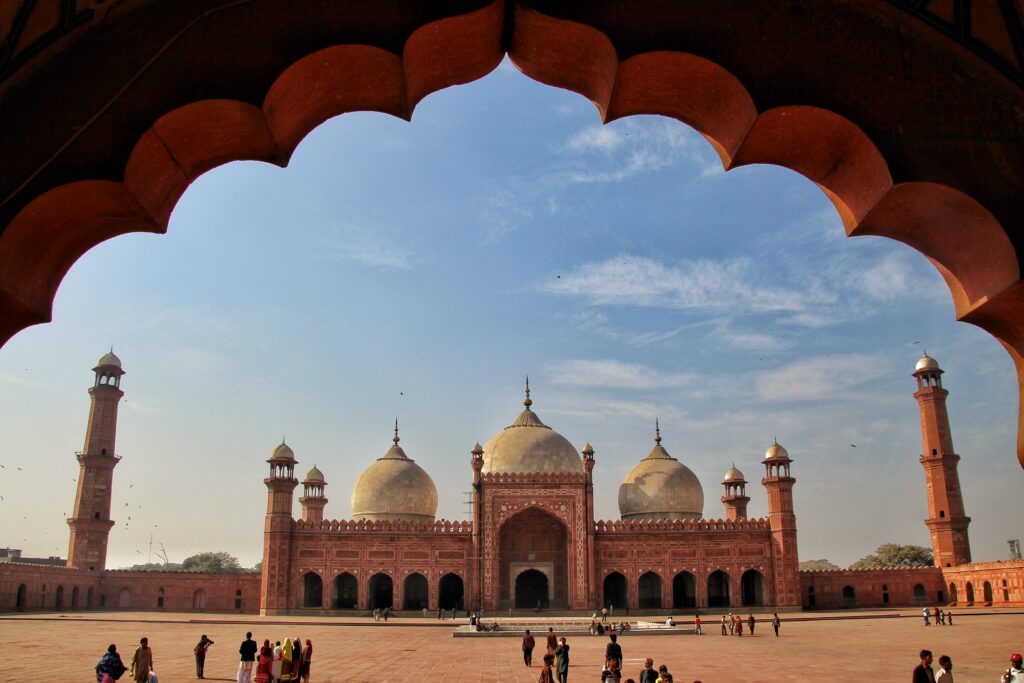
Badshahi Mosque was commissioned under Aurangzeb and completed in 1673. Its red sandstone, white-marble elements, corner minarets and enormous open courtyard distinguish it from Wazir Khan Mosque. UNESCO’s Tentative List entry recognises its significance, but a Tentative List entry is not the same as inscription on the World Heritage List. 6
Begin outside, looking at the approach and elevation. The mosque’s raised platform and entrance change the visitor’s physical relationship with the surrounding city. Once inside, compare the courtyard’s openness with the enclosed prayer hall. This is a place where spatial scale carries much of the architectural message.
Visit the prayer hall only where permitted and when doing so will not disturb worship. Listen to how sound behaves under the vaulted spaces. Examine decoration from a respectful distance rather than moving close to people who are praying. Religious activity gives the building its present purpose; it is not a museum hall available solely for sightseeing.
Remove shoes where required. Dress modestly, with shoulders and legs covered; women should carry a headscarf and follow instructions from mosque staff. Expect adjustments during Friday prayers, Ramadan and major religious occasions. Permission for ordinary visitor photography does not automatically cover staged portraits, commercial equipment or drone use.
A useful historical distinction stands immediately outside: Hazuri Bagh’s marble baradari is a Sikh-period structure, commissioned by Maharaja Ranjit Singh in 1818. It should not be labelled as an Aurangzeb pavilion simply because it sits between Mughal monuments. The Walled City authority explains this later addition within the precinct’s layered history. 7
The nearby memorial to Muhammad Iqbal belongs to a much later national and literary context. Seeing several eras together is valuable, provided that the guide identifies them accurately.
Wazir Khan Mosque and Shahi Hammam
Location: Within the Walled City, approached through Delhi Gate.
Suggested visit: Two to three hours for the bathhouse, mosque and connecting lanes.
Main interest: Provincial patronage, decorative craft and the functioning Mughal city.
Wazir Khan Mosque
Wazir Khan Mosque was built under the patronage of Hakim Ilm-ud-din, known as Wazir Khan, during Shah Jahan’s reign. Aga Khan conservation documentation dates its construction to 1634–1635 and places it about 260 metres inside Delhi Gate, along the historic royal route through Lahore. 8
This is one of the most rewarding Mughal sites in Pakistan for visitors interested in craftsmanship. Allocate time to look at a few panels carefully rather than photographing every wall from a distance. Compare floral forms, geometric arrangements and calligraphy. Notice how decoration is positioned around an entrance or beneath an arch, directing attention to particular architectural surfaces.
The courtyard also helps explain the mosque’s relationship with the surrounding city. It sits inside a working neighbourhood, rather than at the centre of a broad landscaped precinct. Streets, shops, visitors and worshippers converge at its approach. That setting is part of the experience, although present-day buildings and commercial uses cannot all be assigned to the Mughal period.
Use a guide who can distinguish a translated inscription from an improvised interpretation. If a guide cannot read a particular inscription, it is better to acknowledge that than invent its meaning. Architectural interpretation should also separate original material, repaired sections and areas still undergoing conservation.
As at Badshahi Mosque, observe prayer, dress and shoe-removal requirements. Minaret climbing and roof access should be treated as separate permissions; do not promise these in an itinerary unless the site has confirmed them.
Shahi Hammam
Shahi Hammam, also called Wazir Khan Hammam, stands near Delhi Gate. It gives unusually direct insight into the infrastructure of the Mughal city. Instead of another palace or tomb, visitors encounter a public bathhouse with different temperature zones and systems for heating and water movement.
The conservation programme completed in 2015 exposed archaeological features and preserved painted decoration. The project received an Award of Merit in UNESCO’s Asia-Pacific heritage conservation awards in 2016. This award recognises conservation work; it does not make the hammam an individually inscribed World Heritage Site. 8
Follow the designated walkways and interpretive panels. Look for the contrast between rooms designed for different uses, the relationship of ceilings to light and ventilation, and visible evidence of the heating system. The building no longer operates as a bathing facility. A visit is an architectural and archaeological experience.
Getting there and walking the route
Arrange a drop-off near Delhi Gate and walk into the old city. A car is unsuitable for following the narrow lanes between these monuments. Allow time for slow movement around handcarts, motorcycles and shopfronts; the short map distance does not represent the full experience.
A practical sequence is Delhi Gate, Shahi Hammam, the intervening lanes, then Wazir Khan Mosque. A local heritage guide is especially useful here because the route’s meaning depends on both monuments and urban context. Keep the first walk focused: a long detour through several bazaars can leave little time for the mosque itself.
Shalimar Gardens: water engineering and royal leisure
Location: Baghbanpura, northeast Lahore, beside the historic Grand Trunk Road corridor.
Suggested visit: Ninety minutes to two hours.
Combine with: A separate northeast-Lahore half-day rather than assuming it is adjacent to the fort.
Built under Shah Jahan in 1641–1642, Shalimar Gardens demonstrates the importance of water, levels and controlled views in Mughal landscape design. The gardens comprise three terraces and form the second component of the UNESCO property shared with Lahore Fort. 3
Walk the terraces in sequence. Look along the main axes, compare the upper and lower sections, and observe how pavilions frame views across water features. The difference in levels matters: the design used elevation to organise both experience and water movement.
A successful visit should explain the engineered landscape rather than simply identify fountains. Water supply, channels and maintenance were essential to the garden’s appearance and cooling effects. If fountains are not operating, the layout can still be understood, but it would be misleading to promise flowing cascades throughout every visit.
Ask the site staff which areas and water features are operating on the day. Seasonal planting, maintenance and restoration affect what is visible. The gardens are an historic place within a busy modern city, so visitors should not expect the surrounding landscape to resemble a secluded seventeenth-century imperial retreat.
From central Lahore, use a taxi or private car and allow roughly 35–75 minutes depending on the starting point and traffic. A vehicle should collect you after the visit; there is no benefit in planning a long walk along busy connecting roads simply to link it with the fort.
The open garden areas offer less protection from summer heat than a photograph may suggest. Carry water and choose an early visit in warmer months. After rain, check the condition of paths and steps. For anyone travelling with young children, identify toilets and resting places before starting a complete circuit.
Shahdara: Jahangir, Asif Khan, Nur Jahan and Akbari Sarai
Location: Shahdara Bagh, northwest of central Lahore across the Ravi.
Suggested visit: Three to four hours for the principal ensemble, with additional allowance for separate access to Nur Jahan’s tomb.
Main interest: Dynastic burial, family relationships and the survival of garden architecture.
Shahdara should be understood as a group of related places rather than a quick stop at a single royal grave. The emperor Jahangir, his empress Nur Jahan and her brother Asif Khan belong to the same political and family story. Asif Khan was also the father of Mumtaz Mahal, Shah Jahan’s wife. These relationships help make sense of the ensemble without reducing its history to romantic anecdotes.
Jahangir’s tomb
Jahangir died in 1627; the mausoleum belongs to the subsequent Shah Jahan period and dates to 1637. Its low central mass, four corner towers and richly decorated surfaces differ from the dominant central dome that many visitors expect in a Mughal royal tomb. Punjab’s Lahore district portal records its date and Shahdara location. 9
Approach through the garden to appreciate the building’s proportions. Then examine the contrast between the red exterior and the finer marble and inlay work associated with the interior. UNESCO’s Tentative List account describes the corner towers, decorative stonework and cenotaph bearing the ninety-nine attributes of Allah. 10
A cenotaph is a commemorative marker, not necessarily the actual burial level. Avoid implying that visitors can enter every part of the burial arrangement. Access to internal chambers and towers should be confirmed locally, and worshipful or funerary behaviour should be respected even where the wider site is managed as a monument.
Akbari Sarai
Akbari Sarai lies between the tombs of Jahangir and Asif Khan. Its large courtyard, gateways and rows of cells help explain the support infrastructure of an imperial complex. UNESCO’s description notes approximately 180 cells and a mosque within the ensemble. The surviving architectural evidence should be discussed carefully: the familiar name “Akbari” does not establish that every standing component was built by Akbar. 10
Spend time here rather than walking straight through. It is a useful place to discuss lodging, attendants and the practical organisation of major sites. The relationship of service spaces and ceremonial structures is part of Mughal heritage, even when the service spaces attract fewer photographs.
Asif Khan’s tomb
Asif Khan’s octagonal mausoleum provides a direct architectural comparison with Jahangir’s square monument. Its high dome and surviving form are more important to interpretation than an expectation that all decoration will appear intact. Losses and conservation should be acknowledged rather than concealed beneath a description of former grandeur.
Look at the overall plan, the change from exterior to interior and the remaining decorative evidence. A guide can help explain what survives, what has been lost and what is known through documentation. Avoid touching vulnerable plaster, climbing damaged masonry or moving beyond barriers for a better camera position.
Nur Jahan’s tomb
Nur Jahan’s separate mausoleum deserves an intentional visit. Her significance extends beyond being Jahangir’s wife: her place in imperial politics and patronage is central to understanding the period. The Department of Archaeology and Museums records the tomb and the loss of the original cenotaphs associated with Nur Jahan and her daughter Ladli Begum. 11
The quieter scale of the monument offers a useful contrast with Jahangir’s burial place. Interpretation should be sensitive to damaged and reconstructed elements. Do not assume that a clean-looking surface is original simply because it resembles a familiar Mughal motif.
Although these places belong to one historical landscape, present-day roads and railway infrastructure complicate movement. Arrange a driver and check the permitted approach to Nur Jahan’s tomb rather than planning an informal crossing of tracks. From central Lahore, allow roughly 40–90 minutes to reach Shahdara, with extra time possible around bridge traffic and busy junctions.
Hiran Minar: a Mughal landscape outside Lahore
Location: Near Sheikhupura, northwest of Lahore.
Suggested visit: Ninety minutes to two hours at the site; usually a half-day excursion once transport is included.
Main interest: The relationship of royal hunting, animal commemoration, water and leisure.
Hiran Minar adds a different dimension to a Mughal heritage journey. The tower was associated with Jahangir and the memory of a favoured antelope, as recorded by the Sheikhupura district administration; 14 the wider water landscape developed through imperial patronage. The complex includes the tower, a large tank and a central pavilion approached by a causeway. UNESCO lists Hiran Minar and its tank on Pakistan’s Tentative List. 12
Avoid turning its history into an unsupported dramatic story about exactly how the animal died. A sound interpretation can explain the commemorative purpose and the broader royal landscape without presenting folklore as established fact.
Walk around the tank where permitted to appreciate how the pavilion changes against the water and sky. Look at the relationship between the isolated tower and the geometric water enclosure. This is a landscape to experience at a slower pace, rather than a building that requires constant movement through interiors.
The setting is particularly rewarding for visitors who have already examined the density of old Lahore. It provides a contrast between urban authority and a more open royal retreat. Photography benefits from oblique views and reflections, although water levels, surface conditions and weather affect the result.
Arrange a car from Lahore, generally allowing about one to two hours each way depending on the departure point and chosen road. Confirm access and the day’s return arrangements before leaving. Do not rely on finding convenient onward transport outside the monument. Bring water and sun protection, and take particular care near the tank edges when travelling with children.
Shah Jahan Mosque in Thatta: a Sindh extension
Location: Thatta town, Sindh, reached from Karachi.
Suggested visit: One to one-and-a-half hours, subject to worship.
Main interest: Imperial patronage expressed through Sindh’s brickwork and ceramic traditions.
Shah Jahan Mosque is an essential addition for anyone considering Mughal heritage beyond Punjab. Sindh’s Directorate General of Antiquities dates the building to 1644–1647. The mosque connects Shah Jahan’s imperial period with a regional architectural setting that looks markedly different from Lahore’s marble palaces and red-sandstone monumental fronts. 15
The building is organised around a courtyard, with substantial brick walls, arcaded spaces and numerous domes. Its blue-and-white tile decoration is especially important: look upward into the main domed spaces, then compare the radial patterns with floral and geometric panels around the arches. UNESCO’s Tentative List description records the tiled chambers and the acoustic qualities associated with the many domes. 16
For a visitor who has seen Wazir Khan Mosque, Thatta offers a valuable comparison. Both use ceramic colour to articulate architecture, but their forms and settings differ. It is more accurate to explain this as an imperial-period monument shaped by regional craft traditions than to suggest that all Mughal buildings follow one uniform design.
Do not test the acoustics by shouting or playing recordings. This remains a congregational mosque. Enter permitted areas quietly, remove shoes where instructed and dress appropriately. Arrange architectural photography around worship rather than treating worshippers as interruptions to a photographic session. Ask staff about any conservation restrictions and about permission before using a tripod or other substantial equipment.
From Karachi, the usual road approach follows the National Highway corridor towards Thatta. Allow approximately two to three hours each way from a central Karachi hotel, with additional time possible for traffic, stops and road conditions. The allowance is a planning estimate; starting from different parts of Karachi can change it significantly. Use a driver familiar with the route and arrange the return journey in advance.
The mosque can be combined with Makli in a full-day heritage excursion, but allocate separate time for each site. Makli’s necropolis contains monuments associated with several dynasties and periods; the entire burial landscape should not be described as Mughal. The mosque has its own Tentative List entry, while the inscribed Makli property has a separate UNESCO identity. Plan an early departure, carry drinking water and account for Sindh’s heat when walking outdoors.
A Thatta extension belongs to a Karachi-based part of a Pakistan journey. It is not a same-day excursion from Lahore: travelling between the two cities requires a separately planned flight, rail journey or substantial road transfer.
Practical routes and visitor arrangements
A realistic three-day Mughal heritage itinerary
Day one: Lahore Fort and Badshahi Mosque. Begin with the fort while energy levels are high. After a lunch and rest break, visit the mosque outside busy worship periods if permitted. Finish with an exterior understanding of Hazuri Bagh and the later Sikh layer. This is a substantial day without adding Shalimar Gardens across the city.
Day two: Delhi Gate, Shahi Hammam and Wazir Khan Mosque. Spend the morning walking the old-city route. Allow time for close examination of decoration and the bathhouse interpretation. In the afternoon, visit Shalimar Gardens if the temperature, access and traffic make it comfortable. Visitors who prefer slower walking can move the gardens to another morning.
Day three: Shahdara. Visit Jahangir’s tomb, Akbari Sarai and Asif Khan’s tomb, then use arranged transport for Nur Jahan’s tomb. Return to Lahore with time for a relaxed meal or further specialist discussion. An additional half-day allows Hiran Minar without compressing the burial ensemble.
If only one day is available
Choose Lahore Fort and Badshahi Mosque for imperial scale, or Delhi Gate, Shahi Hammam and Wazir Khan Mosque for decorative craftsmanship and urban history. A one-day plan that promises every major Mughal monument in Lahore leaves little time to understand them and is vulnerable to traffic delays.
Reaching Lahore
Lahore is served by Allama Iqbal International Airport, railway connections and intercity roads. Select the arrival method according to the confirmed services available for your dates. From Islamabad, a road transfer is a major travel segment and should not be presented as a short preliminary drive before a full Lahore sightseeing day.
Choose accommodation with an understanding of the next morning’s route. A central hotel may be useful for access to several heritage districts; an airport-area hotel serves different priorities. Hotel location alone does not guarantee a quick journey through the city. Ask for estimated travel time to the specific monument, not simply whether a property is “in Lahore.”
Seasons, heat and air quality
Cooler months are generally more comfortable for extensive walking, but Lahore’s winter fog and smog can affect visibility, air quality and transport. Check the forecast and local air-quality information shortly before travel. November and December should not automatically be described as perfect conditions for every traveller.
Spring can provide comfortable mornings before temperatures rise. In the hot season, begin early, shorten exposed visits and build in proper indoor breaks. Monsoon rain can make steps slippery and interrupt outdoor plans. The appropriate itinerary depends on a traveller’s heat tolerance and mobility as well as the calendar.
Tickets, guides and responsible photography
Ask separately about general admission, special areas, guide services and organised evening programmes. A scheduled evening experience may have different access and booking conditions from a daytime ticket. Carry payment options appropriate to the venue and obtain an official receipt where available.
A good heritage guide should explain chronology, materials and evidence. Request an approach based on documented history, and make clear whether your interest is architecture, photography, Islamic art or broader cultural history. This improves the visit far more than merely adding extra monument names.
Photograph buildings from permitted areas. Ask consent before photographing worshippers or residents at close range. Drones and commercial filming require separate authorisation; they should never be assumed to be covered by an entry ticket. Respect barriers, avoid leaning on decoration and keep food and drinks away from fragile interiors.
Frequently asked questions
Where are the main Mughal heritage sites in Pakistan?
Lahore and its surroundings offer the most coherent concentration for a focused visitor itinerary: Lahore Fort, Badshahi Mosque, Wazir Khan Mosque, Shahi Hammam, Shalimar Gardens and the Shahdara tombs. Hiran Minar near Sheikhupura adds an important landscape excursion. Shah Jahan Mosque in Thatta is a major Sindh addition, best approached from Karachi.
Is Rohtas Fort a Mughal monument?
Its founding phase belongs to Sher Shah Suri, a ruler who displaced Humayun, rather than to Mughal royal patronage. Construction began in 1541. Rohtas is valuable in a wider sixteenth-century heritage itinerary, but calling it a Mughal-built fort obscures its history. 13
Are all Lahore’s Mughal monuments UNESCO World Heritage Sites?
No. Lahore Fort and Shalimar Gardens share an inscribed World Heritage property. Badshahi Mosque, the named Shahdara ensemble and Hiran Minar have Tentative List entries. A conservation award for Shahi Hammam is another separate category. These distinctions matter when planning an itinerary specifically around inscribed UNESCO properties.
Can non-Muslims visit the historic mosques?
Sightseeing visits are commonly arranged, but entry and particular spaces remain subject to mosque management, prayer schedules and respectful conduct. Confirm arrangements beforehand, follow instructions on clothing and shoes, and accept that worship takes priority.
How much time is needed for a worthwhile Mughal heritage journey?
Three full days in Lahore allow a substantial introduction. Add a half-day or full day for Hiran Minar and extra specialist visits. Travellers interested in architectural drawing, photography or detailed conservation interpretation may reasonably spend much longer.
How can I arrange a private Mughal heritage experience?
Crossroads Adventure can be contacted about a private Pakistan heritage journey built around your available time, walking pace and interests. Request a route that identifies the actual monuments, planned visit durations, transfers and included services. A clear plan should also state which special-access experiences depend on separate confirmation.
Sources and further reading
- The Metropolitan Museum of Art: The Art of the Mughals before 1600
- Victoria and Albert Museum: The arts of the Mughal Empire
- UNESCO: Fort and Shalamar Gardens in Lahore
- Walled City of Lahore Authority: Naulakah Pavilion
- Walled City of Lahore Authority: Picture Wall
- UNESCO Tentative List: Badshahi Mosque
- Walled City of Lahore Authority: Monuments
- Aga Khan Development Network: Walled City of Lahore conservation
- Government of Punjab, Lahore: Mausoleum and Shrines
- UNESCO Tentative List: Tombs of Jahangir, Asif Khan and Akbari Sarai
- Department of Archaeology and Museums: Tomb of Nur Jahan
- UNESCO Tentative List: Hiran Minar and Tank, Sheikhupura
- UNESCO: Rohtas Fort