Crossroads field guides · Heritage & culture
Pakistan’s Buddhist heritage is best understood through three connected experiences: walking through ancient monasteries, examining the sculpture recovered from them, and following the landscapes that once linked religious communities with trade and pilgrimage. Taxila provides the most accessible starting point near Islamabad. Takht-i-Bahi reveals the arrangement of a substantial hilltop monastery. Peshawar’s museum adds the artistic detail, while Swat brings stupas, archaeological settlements and a monumental Buddha carved into a rock face into the same journey.
These places are significant to Buddhist visitors, but they are equally rewarding for travellers interested in archaeology, religious history and the movement of ideas across Asia. They are predominantly archaeological monuments and museums. Visitors should not expect every location to function as an active temple, provide a resident monk, or allow religious ceremonies without advance arrangements.
This guide separates the major regions so that planning remains manageable. Historical sources are linked throughout. Driving times and suggested visit lengths are planning estimates, rather than published opening information or guaranteed journey times; allow additional time for traffic, weather, checkpoints and personal walking pace.
By Sultan Uddin · Crossroads Adventure · Editorial review: 6 October 2026
Gandhara civilization and Buddhist history
Where was Gandhara?
Gandhara was an ancient region and a changing political and cultural landscape, rather than a country with permanent modern borders. Its central Pakistani setting is the Peshawar basin, with Taxila closely connected to its wider history. Archaeological discussions also use “Greater Gandhara” for associated areas extending beyond that core. Modern Pakistan and Afghanistan divide landscapes that were historically connected.
Taxila lay at a meeting point of routes from the subcontinent, western Asia, Kashmir and Central Asia. This explains why a visit encounters successive urban settlements and artistic influences rather than a single isolated religious site. Swat, known in Buddhist traditions as Uddiyana, belongs in the wider Buddhist heritage story, although it should not simply be treated as an interchangeable name for the Peshawar basin. 1
A practical historical timeline
The region’s political history helps explain the variety of objects and buildings visitors encounter.
| Broad period | What it contributes to understanding the heritage |
|---|---|
| Achaemenid and early historic periods | Connections with the Iranian world and the development of regional settlements |
| Alexander’s campaign and subsequent Indo-Greek rule | Political change and enduring contact with Hellenistic urban and visual traditions |
| Mauryan period, especially the third century BCE | The association of Ashoka with Buddhist patronage and early stupa traditions |
| Indo-Scythian and Indo-Parthian periods | Further exchanges and changing regional patrons |
| Kushan period, especially the early centuries CE | Substantial Buddhist building activity and the flourishing of Gandharan sculpture |
| Later centuries | Continued activity at some centres, with different trajectories of change and decline across the region |
Dates vary between particular monuments, and a surviving structure may incorporate several building phases. A monastery established in one century could be rebuilt, enlarged or redecorated much later. Taxila’s official museum account provides an overview of the successive dynasties, while the archaeological sites reveal their different material histories. 1
Why Gandharan Buddhist art matters
Gandharan art combines Buddhist subject matter with South Asian and foreign visual traditions. Look for robe folds, narrative panels and ornamented bodhisattvas, comparing stone with stucco.
The Kushan period supported major Buddhist foundations, and later centuries saw further expansion and sculptural patronage. Gandhara helped establish influential forms of Buddhist imagery, but presenting it as the uncontested single birthplace of the human image of the Buddha oversimplifies the relationship with other artistic centres, including Mathura. 2
Relics, monasteries and the movement of teachings
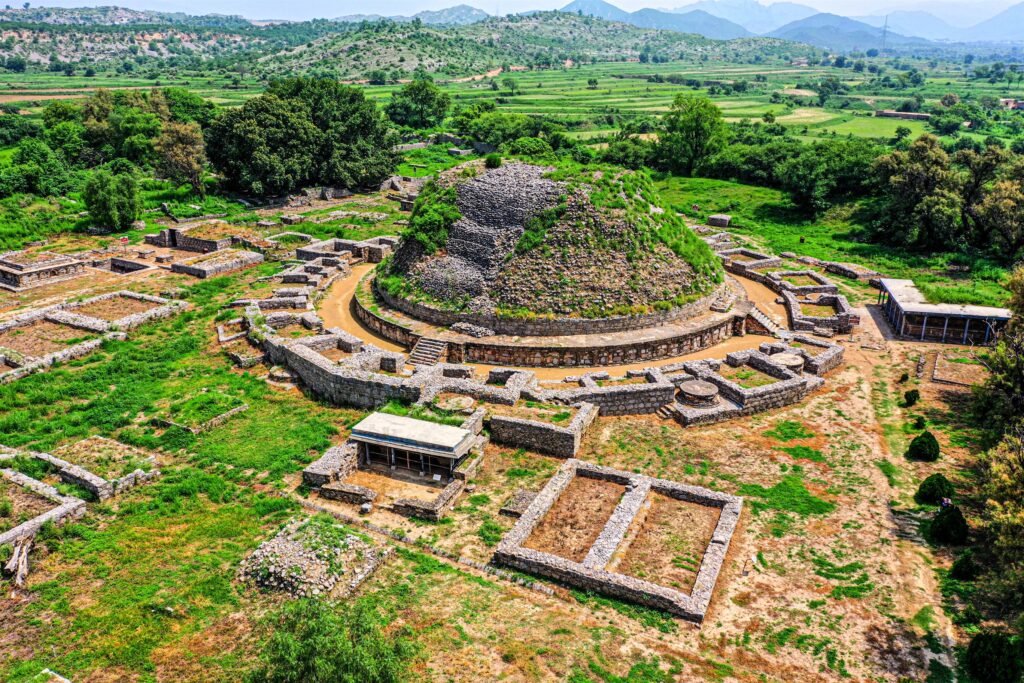
A stupa was a focus of devotion, often associated with relics. Its surrounding path allowed worshippers to move around the monument, while smaller stupas and chapels reflected additional acts of patronage. Nearby residential courts housed monastic communities. This distinction makes the ruins easier to read: one part served public religious activity; another supported everyday monastic life.
Gandhara’s importance also extends beyond sculpture. Surviving birch-bark manuscripts preserve Buddhist texts in the Gandhari language and Kharoshthi script. The University of Sydney’s Gandhari Manuscript Project is studying a collection held at Islamabad Museum. Manuscripts demonstrate a literary heritage that ruined buildings alone cannot communicate; their existence does not mean fragile originals are available for routine public viewing. 3
Gandhara is relevant to Mahayana history, including bodhisattva devotion, but its Buddhism was not uniform. A carved bodhisattva does not establish every resident’s doctrine. Relic devotion continued alongside changing imagery. 2
Nor did Buddhism disappear everywhere on one date. Takht-i-Bahi remained in use into the seventh century, while neighbouring regions followed their own histories. Invasions, political patronage, changing networks and local circumstances need to be considered together. 4
Choosing the right Buddhist heritage sites
The following comparison is intended to help allocate time. Visit lengths are editorial recommendations, including ordinary walking and interpretation, rather than official minimums.
| Place | Main reason to visit | Suggested time | Important practical issue |
|---|---|---|---|
| Taxila Museum | Sculpture and objects from the Taxila region | 1–1.5 hours | Confirm museum opening day before departure |
| Dharmarajika | Large stupa and surrounding religious complex | 45–75 minutes | Broad outdoor site with exposed sections |
| Sirkap | Ancient city plan and Buddhist monuments within an urban setting | 45–75 minutes | Uneven ground and limited shade |
| Jaulian | Decorated stupa courts and hilltop monastic remains | 60–90 minutes | Uphill approach and steps |
| Mohra Moradu | Compact monastery and surviving stucco decoration | 45–60 minutes | Local approach and conservation access |
| Takht-i-Bahi | Substantial hilltop monastery | 1.5–2.5 hours | Stair climbing and heat |
| Peshawar Museum | Gandharan sculpture in a regional museum setting | 1.5–2 hours | City traffic and gallery access |
| Swat Museum and Butkara I | Museum interpretation paired with a stupa site | 2–3 hours together | Identify Butkara I correctly |
| Jahanabad Buddha | Monumental rock-cut seated Buddha | 1–1.5 hours on site | Final uphill pedestrian access |
A traveller with only one spare day in Islamabad should prioritise Taxila. Someone specifically interested in Buddhist archaeology should add Takht-i-Bahi and Peshawar. Swat needs its own overnight allocation; compressing it into the same day as the other regions defeats the purpose of a detailed heritage experience.
Taxila: museum, stupas and monasteries
Understanding the UNESCO property
Taxila is a serial UNESCO World Heritage property, meaning its significance lies in multiple related locations. The inscription includes urban remains, Buddhist monasteries and other cultural layers. It is not one enclosed attraction that can be fully visited with a short walk. The settlements of Bhir Mound, Sirkap and Sirsukh represent different phases of urban development. 5
For first-time visitors, the most useful combination is the museum, a substantial stupa complex and a monastery. Adding Sirkap explains the relationship between religious buildings and the urban community. Trying to visit every minor site often leaves less time to understand the places that matter most to you.
How to get to Taxila from Islamabad
Taxila lies northwest of Islamabad, reached by road toward the Taxila and Wah area. Depending on the hotel and chosen route, plan roughly 35–50 kilometres and around 60–90 minutes each way in ordinary conditions. Traffic at city exits and on connecting roads can extend the journey.
A private vehicle is useful because the individual sites are separated. Public transport may get you to the modern town, but it does not create a convenient door-to-door circuit between the museum, Jaulian and Mohra Moradu. Agree the sequence with your driver before leaving; place names alone can be confused with nearby settlements.
Allow a full day from Islamabad, with lunch arranged outside the archaeological areas. If walking capacity is limited, say so before booking: a museum-centred day with Dharmarajika is different from one that includes the climb to Jaulian.
Taxila Museum: start with the objects
The museum holds sculpture and archaeological objects recovered from the valley’s settlements, stupas and monasteries. Its collections include religious images as well as coins, jewellery, tools and household material, helping visitors understand the communities behind the monuments. 6
Start by distinguishing a narrative relief from a freestanding image. Ask the guide to explain one complete Buddha-life scene rather than naming every fragment rapidly. Then examine a stucco head and a stone sculpture: this comparison becomes particularly relevant at Jaulian and Mohra Moradu.
Before leaving a gallery, note where an object was found. A sculpture from the monastery you will visit later gives the ruins a much clearer context. Photographs of labels can help, where permitted, but museum photography rules must be checked locally. Do not assume flash, tripods or professional equipment are allowed.
Dharmarajika: a major stupa complex
Dharmarajika, also known locally as Chir Tope, lies about three kilometres from the museum. The official museum account associates its origins with Ashoka and the enshrinement of Buddhist relics. The complex subsequently underwent rebuilding and expansion. Its main stupa, surrounding chapels and monastic area therefore represent a long religious history, not a structure surviving unchanged from its earliest foundation. 7
Begin with the outline of the principal stupa. Then follow the relationship between the main monument, surrounding small structures and open circulation space. The site is especially useful for understanding how religious patronage accumulated around a central focus.
Expect exposed ground, low walls and uneven surfaces. Bring water rather than assuming refreshments are available inside. A wide photograph conveys the complex better than a series of close images of unidentified masonry. For quiet reflection, ask the custodian where stopping is appropriate without blocking paths or entering protected areas.
Sirkap: Buddhism within an ancient city
Sirkap is approximately two kilometres from Taxila Museum. Its planned streets, building foundations and monuments make it a different experience from a monastery. The official account connects the city’s grid planning with Hellenistic traditions and identifies structures including the Double-Headed Eagle Stupa. 8
Walk along the main street with a site plan if available. The useful question is how houses, commercial spaces and religious structures occupied the same city. Ask which remains are securely identified and which require interpretation. An informed guide should distinguish an archaeological identification from a story attached to the location.
Choose a shorter route in hot weather. Low foundations can be difficult to interpret without explanations, and seeing the same walls from several angles does not necessarily add understanding. Keep to permitted routes rather than crossing structures for a better camera position.
Jaulian: an instructive hilltop monastery
Jaulian lies around seven kilometres from the museum on a hill raised roughly 92 metres above its surroundings. That figure describes the hill’s relative height, not the site’s elevation above sea level. Its foundation is associated with the second-century CE Kushan period. Surviving remains include a main sacred area, smaller stupas, chapels and monastic courts. 9
The approach requires uphill walking and steps. Allow a slower pace than a flat museum visit, particularly for older guests or anyone with knee problems. Vehicles cannot be assumed to provide access directly to every archaeological terrace.
Inside, compare the devotional court with the living arrangements. Decorated surfaces explain where images belonged before many were transferred to museum care. Ask about the difference between the main stupa, a votive stupa and a chapel. These three terms describe different elements and should not be used as synonyms.
Taxila is famous as an ancient centre of learning. Modern descriptions sometimes call its establishments universities; visitors should understand this as a convenient comparison with historic education and monastic learning, rather than evidence of a modern university organisation with a single campus and degree system.
Mohra Moradu: detail at a smaller scale
Mohra Moradu’s establishment dates to the Kushan period, with substantial later renovation. The complex pairs a stupa area with a residential monastery, and the museum’s account highlights its stucco imagery and a votive stupa associated with the monastic cells. 10
This is a valuable addition for travellers who enjoy looking carefully at architectural detail. Give the custodian or guide time to identify surviving decorated sections. Do not touch reliefs or lean bags against masonry. Conservation shelters and access arrangements can alter how a particular feature is viewed, so older photographs should not be treated as a promise of the current visitor experience.
If time is short, choose Jaulian or Mohra Moradu according to mobility and interest rather than rushing both. A thoughtful visit to one monastery is more useful than two brief stops with no explanation.
Takht-i-Bahi and Sahr-i-Bahlol
What makes Takht-i-Bahi important?
Takht-i-Bahi and the neighbouring remains at Sahr-i-Bahlol form a UNESCO World Heritage property. UNESCO dates the monastery’s foundation to the early first century CE and describes continued use until the seventh century. Its surviving courts, cells, passages and religious buildings make it particularly helpful for understanding the organisation of a Gandharan monastery. 4
Its hilltop position is immediately apparent on arrival. This is an archaeological visit involving a climb, rather than a roadside monument reached by a few level steps. Budget time and energy for the descent as well as the ascent.
Getting there and planning the visit
The site is north of Mardan. From Peshawar, allow approximately 1.5–2 hours by road, depending on the starting point and route. From Islamabad, the motorway approach and onward local roads commonly require around 3–4 hours. These are practical planning ranges; a same-day return from Islamabad is a long excursion.
Peshawar or Mardan provides a more comfortable base if you want an unhurried morning visit. When travelling onward to Swat, consider the monastery as a stop along a broader transfer day, leaving enough daylight for the remaining drive.
Wear footwear with good grip and carry water. In warmer months, climb early. There is limited shade on parts of the approach, and reflective heat from stone can make the effort feel greater than the distance suggests. Guests who cannot manage repeated stairs should discuss alternatives before committing to the visit.
How to read the monastery
Follow the permitted visitor route, asking the guide to establish the basic arrangement before describing individual walls. Compare spaces devoted to stupas with the monastic quadrangle and cells. Notice the stonework and how passages connect different levels.
An especially useful interpretation exercise is to identify three activities: religious devotion, communal gathering and residential life. The ruins do not retain every original roof or image, but the surviving plan lets visitors reconstruct relationships between spaces without pretending every room’s use is equally certain.
Should you also visit Sahr-i-Bahlol?
Sahr-i-Bahlol, roughly five kilometres from the monastery, represents the associated ancient urban setting. It should not be expected to offer the same straightforward monument circuit as Takht-i-Bahi. UNESCO identifies surviving town remains and notes the setting within a fertile plain. 4
For most first visits, prioritise the monastery and discuss the town’s relationship during interpretation. A separate stop is best arranged with local archaeological guidance and respect for the present community. Do not assume unrestricted entry through occupied areas or describe the location as an empty abandoned city.
Peshawar Museum
Peshawar Museum is a logical companion to Takht-i-Bahi. The provincial archaeology directorate includes it among its managed museums, alongside Swat, Mardan and other regional collections. 11
Plan around 1.5–2 hours if Gandharan sculpture is a principal interest. A knowledgeable guide can help select a small group of objects that explain narrative, symbolism and workmanship. Moving quickly through every gallery produces a long list of names but little understanding.
Use the visit to connect sculpture with architectural setting. Was a relief part of a stupa decoration? Is a figure a Buddha or a bodhisattva? What information comes from the inscription or excavation record rather than its appearance? Ask these questions instead of relying only on visual resemblance.
Peshawar’s city traffic needs separate allowance. A programme combining the museum with the old city should include lunch and realistic movement between areas. Do not schedule arrival shortly before closing after a long motorway journey. Check the museum’s current opening day and any gallery restrictions directly with the provincial directorate or your local organiser.
Swat Valley’s Buddhist heritage
Why Swat deserves two nights
Swat’s heritage is spread across the lower valley, the Mingora–Saidu Sharif urban area and side valleys. For a first focused visit, two nights permit a museum session, nearby archaeological sites and a separate outing to Jahanabad. An additional night makes sense for travellers interested in lesser-visited monuments and archaeological interpretation.
Approach from Islamabad using the motorway network and Swat Expressway connections, continuing toward Mingora and Saidu Sharif. Allow roughly 5–6.5 hours with ordinary traffic and a short break. From Peshawar, plan approximately 3.5–5 hours. These ranges can increase with congestion or road disruption; arrive during daylight when possible.
The main heritage circuit lies well below the high mountain trekking areas. Mingora and Saidu Sharif sit broadly around 900–1,000 metres above sea level. A Buddhist-focused visit does not require travelling to Kalam, and adding the upper valley changes both travel time and seasonal considerations.
Swat Museum
Swat Museum belongs near the beginning of the valley visit. Pakistan’s federal heritage directory places it on the Mingora–Saidu road. The Italian Archaeological Mission’s work in the region includes the museum and major Buddhist excavations, making the collection an important interpretive partner to the sites. 12 13
Allow 60–90 minutes, longer if examining sculpture closely. Ask which finds relate to Butkara or Saidu Sharif, then take that information to the archaeological visit. A museum first approach is especially worthwhile when walls and foundations on the ground require explanation.
Butkara I: identify the correct site
Butkara I is one of the principal excavated Buddhist sanctuaries in the Mingora area. It was a major focus of the Italian mission’s archaeological work, along with Panr I and Saidu Sharif I. 13
Use the complete site name when arranging transport because several archaeological locations use the Butkara name. A driver reaching the modern neighbourhood is not the same as reaching the correct monument entrance.
Allocate approximately 45–60 minutes for a guided examination of the stupa complex. Ask how its successive structures relate to each other and which elements represent later additions. The site works well with the museum on the same day, allowing a direct connection between excavated architecture and displayed objects.
Saidu Sharif I
Saidu Sharif I adds another monastic and sacred setting near the urban base. The Italian mission identifies the sanctuary among its major excavations and conservation activities. 13
Confirm access before incorporating it as a guaranteed stop. Excavated archaeological locations can have changing conservation requirements or limited on-site staffing. Allow around 45–60 minutes if the site is open and a guided visit is arranged. Look for an explanation of the original monument’s form through a plan or reconstruction illustration rather than expecting the surviving foundations to explain themselves.
Jahanabad Buddha
Jahanabad, also spelled Jehanabad, is a monumental seated Buddha carved into a rock face in a side valley reached from the Manglawar area. Ca’ Foscari University describes the carving as seventh-century and approximately six metres high. It was damaged during the insurgency and subsequently restored through archaeological conservation work. 14 15
From Mingora or Saidu Sharif, allow approximately 45–75 minutes for the road approach, then additional time for the final walk. The pedestrian section is uphill, with the practical route dependent on local access conditions. Budget around 1–1.5 hours on site for walking, interpretation and photography at a measured pace.
Confirm the actual walking route rather than promising every guest a fixed ten-minute climb. Heat, wet ground and individual mobility affect the effort. A local guide is useful for the final approach and for understanding the conservation history.
Observe the relief from the permitted viewing area. Avoid climbing the rock, touching restored surfaces or treating the monument as a backdrop for stunts. Its importance lies both in Buddhist history and in the care required to preserve damaged cultural heritage.
Shingardar, Amluk-Dara and Barikot
Shingardar Stupa is a useful lower-valley stop when approaching or leaving the Mingora area; the federal archaeology directory records it as an archaeological stupa and monastery site. 16
Amluk-Dara requires a more deliberate local excursion and should not automatically be scheduled as a five-minute roadside stop. Barikot, associated with ancient Bazira, brings an urban archaeological perspective to the valley. The continuing mission work includes both Buddhist sacred areas and the Barikot urban site. 13 17
Choose one or two of these additions according to interest and current access. For Barikot, ask specifically whether archaeological interpretation and entry are available on your date: an active research area does not necessarily operate as a fully staffed visitor attraction.
Buddhist heritage in northern Pakistan
Northern extensions should be presented separately from the core Gandhara circuit. Gilgit and Baltistan have their own Buddhist histories and geographical settings. Travelling there adds major road journeys or weather-dependent flights, so the extension works best when northern landscapes are already part of the programme.
Kargah Buddha lies about ten kilometres outside Gilgit. The Gilgit-Baltistan tourism department identifies the rock carving and gives a broad estimated dating range of the fourth to seventh centuries. 18
Allow roughly 30–45 minutes each way from a central Gilgit hotel, subject to the local approach, and around 30–60 minutes for viewing. Ask about the final pedestrian access before taking someone with limited mobility. A short Gilgit stop can include the carving; a dedicated Islamabad-to-Gilgit drive cannot sensibly be treated as an easy heritage day trip.
Manthal near Skardu and rock-art locations along the wider Indus routes offer further possibilities. The federal archaeology directory records Buddhist remains and rock art in the Shigar area and relates them to carvings near Skardu and Gilgit. 19
Select northern rock-art visits with local expertise. Not every carving is Buddhist: panels can include animals, inscriptions, later marks and other cultural phases. Road works, river conditions and construction can affect access. Avoid stopping on dangerous highway shoulders simply because a rock-art location appears on an old map.
Realistic routes and journey lengths
One day: Taxila from Islamabad
Leave Islamabad early, start with the museum, and continue to Dharmarajika and either Jaulian or Mohra Moradu. Add Sirkap only if the museum schedule, lunch and walking pace allow. This provides a coherent introduction without claiming to cover all of Taxila.
Three days: Taxila, Takht-i-Bahi and Peshawar
Use the first day for Taxila and travel onward to Peshawar with sufficient daylight. Allocate the second day to Takht-i-Bahi, with a slower afternoon. Visit Peshawar Museum on the third day before returning to Islamabad or continuing the journey. Adjust the order for museum closures; an archaeological site and its associated museum may have different schedules.
Six days: a focused Gandhara and Swat journey
| Day | Suggested programme | Overnight base |
|---|---|---|
| 1 | Arrival and a light introduction; avoid demanding climbs after an overnight flight | Islamabad |
| 2 | Taxila Museum, selected stupas and a monastery; continue west if timing permits | Peshawar |
| 3 | Peshawar Museum and a carefully paced city visit | Peshawar |
| 4 | Takht-i-Bahi; onward transfer toward Swat | Saidu Sharif or Mingora |
| 5 | Swat Museum, Butkara I and Jahanabad, subject to site opening and walking pace | Saidu Sharif or Mingora |
| 6 | A selected lower-valley heritage stop; return to Islamabad | Islamabad |
This six-day outline does not include an international departure connection on the same evening as a long road transfer. Add another night if the flight timing leaves little margin, or extend Swat if specialist archaeology is the priority.
Seasons, access and responsible visiting
When to visit
March–April and October–November usually offer a workable balance for the Taxila, Peshawar and lower Swat circuit. Conditions vary by year. In late spring and summer, the plains and exposed hilltop sites can become very hot; organise outdoor walking early and museum visits later.
Winter offers cooler archaeological walks, but mornings can be cold and fog can disrupt motorway travel. Lower Swat is generally more practical for winter heritage visits than high mountain excursions. During rainy periods, steps and local paths can be slippery. Northern extensions have different weather constraints and should be planned separately.
Use a forecast close to departure rather than treating one seasonal temperature as guaranteed. A hat, sun protection, water, a light layer and sturdy shoes cover many core-circuit days; winter and northern travel require warmer clothing.
Opening hours, admission and permissions
Check museums and archaeological sites individually shortly before visiting. Taxila Museum’s official website publishes contact details and opening information, but holiday, seasonal and conservation changes should be confirmed directly. Do not infer that every associated monument follows identical hours. 6
Ask about ticket categories, payments, photography and any special arrangements required for a religious group. Buddhist visitors wishing to conduct prayers, offer flowers or hold a ceremony should arrange permission beforehand. Quiet personal reflection and organised ceremonial activity are different requests.
Foreign travellers should check current official travel advice and local access requirements for the precise districts involved. Carry identification and allow time for checks where applicable. Heritage importance does not establish a blanket assurance about present-day access across an entire province.
Guides, accommodation and mobility
An archaeology-informed guide adds more value than a rapid sequence of monument names. Before booking, ask whether the guide can explain site plans, distinguish historical evidence from tradition, and connect museum objects with excavation locations.
Use Islamabad for Taxila, Peshawar for the western core and Mingora or Saidu Sharif for lower Swat. Confirm accommodation standards and practical meal options individually. Vegetarian requirements should be communicated clearly; vegan meals need a separate explanation concerning dairy and cooking ingredients.
For mobility planning, distinguish level gallery walking from uneven ruins and stair climbs. Jaulian, Takht-i-Bahi and Jahanabad deserve explicit discussion. Ask about toilets and rest opportunities before the day begins, particularly for older travellers. Carry personal medication and do not rely on small sites for visitor facilities.
Protecting the monuments
Stay on authorised paths, avoid standing on ancient walls and never remove fragments. Do not purchase objects presented as excavated antiquities. Ask before photographing people, use drones only with the required permissions, and respect conservation barriers even when an older travel photograph shows a closer viewpoint.
At archaeological sites, preserve the distinction between a documented finding, a devotional tradition and a modern interpretation. Visitors interested in Buddhism deserve accurate explanations as much as visitors interested in archaeology.
Frequently asked questions
Which Buddhist heritage site should I visit first in Pakistan?
Taxila is the most practical starting point from Islamabad because it combines a substantial museum with nearby city remains, stupas and monasteries. Choose two or three archaeological stops according to your available time and mobility.
Are Taxila and Takht-i-Bahi UNESCO World Heritage Sites?
Yes. Taxila and the combined property of Takht-i-Bahi with neighbouring Sahr-i-Bahlol were inscribed in 1980. Swat’s monuments should not be described as individually UNESCO-inscribed merely because they belong to the broader Buddhist heritage landscape. 4 5
Can Buddhist pilgrims visit these places?
Buddhist travellers can plan heritage visits, subject to current access and site rules. If the visit includes an organised ceremony, request the appropriate arrangements in advance. Most locations discussed here are protected ruins or museums rather than continuously operating Buddhist temples.
Is one day enough for Taxila, Peshawar and Swat?
No. These are separate regional clusters. A one-day programme suits selected Taxila sites from Islamabad. A meaningful journey including Peshawar, Takht-i-Bahi and Swat normally needs several days with overnight stays.
Do I need to trek to see Buddhist heritage in Pakistan?
The core circuit requires no multi-day trekking. However, several significant sites involve steps, uphill paths or uneven ground. A vehicle-supported journey still needs honest discussion of walking ability.
Can I combine Buddhist heritage with northern Pakistan?
Yes, provided the itinerary adds the travel time required for Gilgit or Skardu. Kargah and selected Baltistan rock carvings can complement a northern journey. They should be explained within their own regional histories rather than labelled automatically as Taxila-style Gandhara monuments.
How should I choose a private Buddhist heritage journey?
Ask for a day-by-day route with driving estimates, the exact site names, realistic walking requirements, museum-opening checks and a guide with relevant historical knowledge. Confirm transport, accommodation, meals, admission, flights and optional activities in writing. Crossroads Adventure can help shape a private heritage journey around religious interest, archaeology, photography or a gentler walking pace through its website.
Sources and further reading
Historical and heritage references below were consulted on 6 October 2026. Travel durations, recommended visit lengths and sample routes are editorial planning guidance; they are not official timetables.
- Taxila Museum: History of Taxila City
- The Metropolitan Museum of Art: Gandhara, by Kurt Behrendt
- University of Sydney: Gandhari Manuscript Project
- UNESCO: Buddhist Ruins of Takht-i-Bahi and Neighbouring City Remains at Sahr-i-Bahlol
- UNESCO: Taxila
- Taxila Museum: Museum and collection
- Taxila Museum: Dharmarajika Stupa
- Taxila Museum: Sirkap
- Taxila Museum: Jaulian Monastery
- Taxila Museum: Mohra Moradu
- Khyber Pakhtunkhwa Directorate General of Archaeology and Museums: Museums
- Federal Department of Archaeology and Museums: Swat Museum
- ISMEO: Italian Archaeological Mission to Pakistan
- Ca’ Foscari University: Gandhara archaeology and Jahanabad
- Ca’ Foscari University: Luca Maria Olivieri and conservation work
- Federal Department of Archaeology and Museums: Shingardar Stupa
- Ca’ Foscari University: Archaeological excavations
- Gilgit-Baltistan Tourism Department: Kargah Buddha
- Federal Department of Archaeology and Museums: Shigar rock art and Buddhist remains