Crossroads field guides · Heritage & culture
Pakistan’s Sufi shrines are places of worship, remembrance, charitable activity and cultural expression. Some stand beside busy city streets; others anchor small towns whose identity revolves around a saint, a school of thought or a tradition of poetry. A thoughtful journey needs to explain both the history of the person commemorated and the living institution surrounding the tomb.
This guide covers a substantial route through Punjab and Sindh: Data Darbar and Mian Mir in Lahore; Baba Farid in Pakpattan; Bahauddin Zakariya, Shah Rukn-e-Alam and Shah Shams Sabzwari in Multan; the monuments of Uch Sharif; Lal Shahbaz Qalandar in Sehwan; Shah Abdul Latif Bhittai in Bhit Shah; Sachal Sarmast at Daraza Sharif; and Abdullah Shah Ghazi in Karachi. These places represent different centuries, architectural traditions and devotional communities. Visiting one does not explain them all.
The driving times below are planning estimates for private transport under ordinary conditions, rather than measured guarantees. They exclude substantial sightseeing stops and can increase with congestion, road works, weather, security arrangements and festival traffic. Opening arrangements, access to inner chambers, photography and performances must be confirmed locally. A shrine is a functioning religious space, and its routines take precedence over a visitor’s schedule.
By Sultan Uddin · Crossroads Adventure · Editorial review: 6 October 2026
Understanding Sufism and shrine culture
Sufism, often called tasawwuf, concerns spiritual discipline within Islam: cultivating awareness of God, refining conduct and learning through a relationship with a teacher. A tariqa is a spiritual path or order; a silsila is its lineage of transmission. Dhikr means remembrance of God. These terms help distinguish a religious tradition from the narrower experience of visiting an impressive mausoleum. 1
A dargah or darbar commonly refers to a shrine associated with a revered figure. A mazar is a tomb or place of visitation. A khanqah is a lodge connected with spiritual teaching and community life, although local usage can overlap. Langar refers to food distributed through communal or charitable provision. An urs commemorates a saint’s death anniversary, understood devotionally as union with the Divine; its observance may include recitation, preaching, food distribution and music.
Shrine practices vary. Qawwali is a particular tradition of devotional musical performance; it should not be used as a label for every song heard at a shrine. Sindhi poetry sung with a stringed instrument, Qur’anic recitation and the drumming associated with dhamaal have different forms and purposes. Likewise, a gathering of devotees does not automatically mean a scheduled public performance.
Visitors also need historical restraint. Accounts of saints often combine documents, later biographies, family traditions and stories about miracles. The stories are part of the heritage and deserve respectful explanation, but a guide should identify them as traditions where independent historical verification is uncertain. Birth dates, genealogies and journeys can differ between published accounts. A confident claim based on an inconsistent modern webpage is less useful than an honest explanation of what is known.
The region’s shrine culture should not be reduced to the claim that all Muslims share identical practices. Attitudes toward saintly intercession, offerings, music and tomb visitation differ among Muslim communities. Visitors can observe respectfully without adopting a particular theological position or performing devotional acts they do not understand.
Choose the right regional route
| Regional focus | Principal places | Practical base | Time to allow |
|---|---|---|---|
| Lahore’s Sufi heritage | Data Darbar, Mian Mir | Lahore | One full day, preferably spread over two days alongside other heritage |
| Chishti heritage | Baba Farid, Pakpattan | Pakpattan or Sahiwal | One overnight beyond Lahore |
| Multan’s shrine architecture | Bahauddin Zakariya, Shah Rukn-e-Alam, Shah Shams Sabzwari | Multan | Two nights |
| Southern Punjab monuments | Uch Sharif | Bahawalpur | One substantial excursion day |
| Sindh’s poetry and devotional traditions | Bhit Shah, Sehwan, Daraza Sharif | Hyderabad, Sehwan, Sukkur or Khairpur | Four to six days, depending on route |
| Coastal urban shrine heritage | Abdullah Shah Ghazi | Karachi | Two to three hours within a Karachi day |
Lahore, Multan and Karachi are useful arrival or departure cities; actual air and rail services depend on the travel date. For rural shrines, a vehicle and guide familiar with the district usually provide a clearer experience than trying to connect several towns by improvised public transport. Choose a regional focus if time is short. A two-day programme cannot meaningfully cover Lahore, Multan and Sindh.
For mixed interests, combine shrines with appropriate surroundings: Lahore’s Mughal architecture, Multan’s old city and craft traditions, or Sindh’s museums and historical landscapes. Include rest periods. The attention required for a crowded sacred space can be more demanding than the walking distance suggests.
Lahore: Data Darbar and Mian Mir
Data Darbar: Ali Hujwiri and Lahore’s spiritual history
Data Darbar commemorates Ali ibn Usman al-Hujwiri, widely known as Data Ganj Bakhsh. He was an eleventh-century scholar associated with Ghazni and Lahore, and the author of Kashf al-Mahjub, an influential Persian work on Sufism. Punjab’s Auqaf department administers the complex and describes his lasting importance to Lahore’s religious life. His literary contribution gives the visit a specific historical focus beyond the size or popularity of the shrine. 2
The present complex reflects repeated expansion and redevelopment. It should not be presented as an unchanged eleventh-century building. Visitors encounter a contemporary religious institution with prayer spaces, circulation routes, charitable activity and extensive management arrangements. Auqaf reported continuing development works in September 2026, so entrance routes and the visitor experience should be reconfirmed before arrival. 3
Getting there: Data Darbar is in central Lahore near the western side of the old city, beside the Bhati Gate area. Allow roughly 30–75 minutes from many central hotel districts, and more if crossing the city at a busy time. Your driver may need to stop away from the entrance; plan for a pedestrian approach and security screening rather than a door-to-door arrival.
What to do: Allow 60–90 minutes for an introductory visit, with additional time if your purpose includes conversation, reading or an approved devotional gathering. Begin by understanding Hujwiri’s writing and the distinction between the historical saint and the modern complex. Ask the guide to explain charitable food distribution without interrupting it. Avoid entering prayer rows or making worshippers wait while photographs are taken.
Mian Mir: a different Lahore experience
Mian Mir was a Qadiri Sufi associated with Lahore in the late sixteenth and early seventeenth centuries. His connections with the Mughal prince Dara Shikoh place him within a broader history of spiritual enquiry at the Mughal court. His shrine is in the Dharampura area, away from Data Darbar’s old-city setting. Punjab’s Auqaf account identifies the Qadiri affiliation and his significance to Dara Shikoh. 4
A frequently repeated tradition connects Mian Mir with laying the foundation of the Golden Temple at Amritsar. Treat that story as a tradition requiring its own source discussion, rather than an uncontested fact established by the Lahore tomb. A careful guide can explain how later communities remember a figure without turning every remembered event into documented history.
Getting there and planning: Arrange a vehicle between the two shrines; Lahore traffic makes a fixed transfer time unreliable. Allow approximately an hour at Mian Mir and a flexible buffer for access. The setting offers a useful opportunity to discuss Qadiri teaching, Dara Shikoh and Mughal patronage. Ask about present access routes and facilities in advance, especially for visitors who cannot manage steps; reported repair works show why old descriptions of amenities should not be assumed current. 5
Pakpattan: Baba Farid
Baba Farid, also known as Fariduddin Ganjshakar, lived in the late twelfth and thirteenth centuries and is closely associated with the Chishti tradition and with the town formerly known as Ajodhan, now Pakpattan. His place in Punjabi literary memory is as important as his significance to devotees. The shrine connects the visitor with a network of teaching and succession extending beyond a single town. Punjab’s official profile discusses his relationship with Qutbuddin Bakhtiar Kaki and his residence in Pakpattan. 6
The popular explanation of the title Ganjshakar, or “treasure of sugar,” belongs to devotional storytelling. Your guide should introduce it as such. The shrine’s doors and ritual routes also carry particular meanings for pilgrims. The Bahishti Darwaza has special religious significance, but it must not be advertised as an entrance available for ordinary visitors throughout the year.
Getting there: Pakpattan lies southwest of Lahore. A private transfer commonly needs around four to five hours, depending on the road selected and city traffic. Sahiwal is a useful larger-city staging point, with the final road approach to Pakpattan adding further travel. Avoid treating the shrine as a quick detour on an already long Lahore–Multan driving day.
Time and experience: Allow one and a half to two hours for the shrine and surrounding approach, with more time for a specialist literary or religious visit. Streets near the complex may be crowded and the final approach may be on foot. Stay close to your guide and agree a meeting point outside any area where visitors are separated into different queues.
Urs considerations: Festival arrangements can include exceptional crowds and restricted movement. A pilgrim specifically seeking the urs and a first-time cultural visitor seeking quiet explanation have different needs. Accommodation and transfers should be planned accordingly. Confirm the religious-calendar dates and official arrangements for the intended year; a date copied from an earlier itinerary can be wrong.
Multan: three distinct shrine experiences
Bahauddin Zakariya: the Suhrawardi tradition
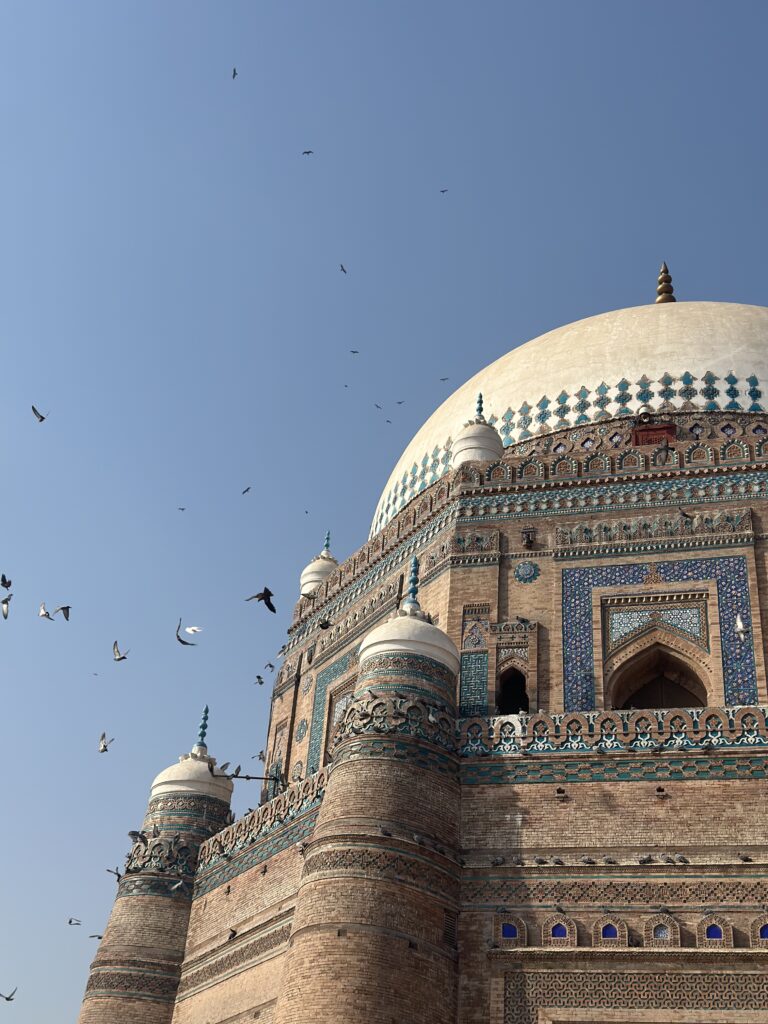
Bahauddin Zakariya was a major Sufi teacher of the late twelfth and thirteenth centuries whose association with the Suhrawardi tradition helped establish Multan as a significant religious centre. His connections with Baghdad and with the political world of the Delhi Sultanate demonstrate that the city’s spiritual history was linked to wider networks of scholarship and power. His tomb stands on the old fort mound, in the Qasim Bagh area. 7
The building is valuable for understanding the transition from a square base to an octagonal upper section and a dome. Look at the composition before focusing only on tile decoration. The stepped changes in shape show how builders moved from the chamber below to the domed roof above. Ask which parts are historic and which reflect restoration; surviving shrines have endured maintenance, political change and damage over many generations.
Practical visit: Set aside approximately 45–60 minutes. The fort mound setting creates changes in level, so confirm the least demanding entrance for anyone with reduced mobility. Combine it with Shah Rukn-e-Alam, but allow a break between them if the weather is warm or crowds are substantial.
Shah Rukn-e-Alam: Multan’s monumental tomb
Shah Rukn-e-Alam, who lived from 1251 to 1335 according to Punjab’s Auqaf profile, was Bahauddin Zakariya’s grandson and a Suhrawardi figure. His enormous mausoleum dominates Multan’s skyline. The individual commemorated, the building’s construction history and its later conservation deserve separate explanation; they are related histories rather than a single date on a signboard. 8
UNESCO’s description dates construction to 1320–1324 under Ghiyas-ud-din Tughluq. It suggests that the building was probably intended for the ruler’s dynasty before being presented to the saint’s family after his death. This makes the mausoleum an instructive example of the relationship between royal patronage and sacred commemoration. UNESCO records the tomb on Pakistan’s Tentative List. That status is not the same as inscription on the World Heritage List. The building’s mass, octagonal form and relationship to the fort mound make it one of the clearest places to study Multan’s distinctive tomb architecture. A visitor should view it from outside as well as entering the permitted areas. 9
Practical visit: Allow about an hour, longer for architectural photography. Morning or later afternoon can be more comfortable for exterior viewing. Do not climb masonry, lean equipment against decorated surfaces or move into worship space to obtain a symmetrical composition. The dome is an architectural subject; the people praying below it are not automatically available as portrait subjects.
Shah Shams Sabzwari: avoid a misleading identity
Shah Shams Sabzwari’s shrine is another important Multan site, associated with the Shah Shams Park and Aam Khas Garden area. Punjab’s Auqaf department identifies him as Shah Shams-ud-Din Sabzwari Multani and describes a square, tiled tomb. Published chronologies can be inconsistent, including on official summaries, so precise life and construction dates should be checked against specialist research before being used in interpretive panels. 10
Some popular descriptions call the shrine Shah Shams Tabriz. Visitors should not infer from that name alone that it is the documented burial place of Rumi’s teacher Shams of Tabriz. The similarity of names and later traditions requires explanation. This is exactly the sort of distinction that turns a shrine visit into a useful historical experience.
Practical visit: Allow 45–60 minutes and a separate vehicle transfer from the fort mound. Do not compress all three major Multan shrines into an hour. A full day permits proper explanation, a meal break and time in the old city. Two nights in Multan are more comfortable than arriving late and leaving immediately after a rushed morning circuit.
Uch Sharif: sacred heritage and fragile monuments
Uch Sharif, in southern Punjab, combines living religious associations with exceptional surviving mausoleum architecture. UNESCO’s Tentative List entry groups the tombs of Bibi Jawindi, Baha’al-Halim and Ustead with the tomb and mosque of Jalaluddin Bukhari. The grouping matters: these are separate monuments, and the whole landscape should not be described as one shrine belonging to one saint. 11
Bibi Jawindi’s mausoleum is generally dated to the late fifteenth century; Punjab’s tourism project gives 1493. Its blue-and-white tilework and partly ruined form are memorable, but the damage is part of its conservation history, not a decorative feature created for photography. The complex is on the UNESCO Tentative List, rather than being an inscribed World Heritage property. 12
Avoid applying “Sufi saint” indiscriminately to every burial in the monument group. Identify the person associated with each tomb and explain where biographical evidence is limited. Active places of devotion and fragile archaeological remains require different visitor behaviour. A local religious visit may focus on a maintained shrine, while an architectural visit may spend more time interpreting damaged mausoleums.
Getting there: Bahawalpur is a practical base. Allow approximately one and a half to two and a half hours each way by private vehicle, depending on the precise departure point and route. Multan can also be used, but increases the driving commitment. An overnight in Bahawalpur creates room for a less hurried excursion and other local heritage.
At the monuments: Allow two hours or more. Ground surfaces can be uneven, shade may be limited and the exposed setting is uncomfortable in severe heat. Bring drinking water and shoes with stable soles. Enter damaged structures only where access is explicitly permitted. Do not climb broken walls or cross a barrier because another visitor has done so. Conservation closures can affect a photographic plan without diminishing the historical value of the visit.
Sehwan: Lal Shahbaz Qalandar
The shrine of Lal Shahbaz Qalandar stands in Sehwan Sharif, Sindh. Lal Shahbaz belongs to the region’s medieval devotional history. Pakistan’s Department of Archaeology and Museums dates his life to 1177–1274 and records an original tomb built in 1356 during the Tughlaq Sultanate. The present shrine should therefore be understood through successive phases of construction rather than treated as a structure built wholly during his lifetime. 13
Sehwan is particularly associated with dhamaal, a form of devotional movement accompanied by drumming. Understanding its religious context is essential. A performance or ritual is not a stage show arranged solely for travellers, and a visitor should not step into its centre to film. Music, movement, prayer and crowd circulation may overlap in ways that require the guide’s close attention.
Getting there: Sehwan lies north of Hyderabad on the west-bank road corridor beside the Indus region. A private journey from Hyderabad usually requires approximately two and a half to three and a half hours; from Karachi, roughly five to seven hours is a reasonable starting allowance. Road conditions and the exact departure point can change these estimates. It is usually more comfortable to approach from Hyderabad or stay overnight rather than make a rushed Karachi return trip.
Planning the experience: Allow at least two hours for an introduction and shrine visit, with an overnight if a locally confirmed evening gathering is central to the journey. Ask specifically whether an event is expected, where observers may stand and whether photography is permitted. Do not promise dhamaal at an exact hour without checking current arrangements.
Sehwan can become extremely busy during the urs. Religious enthusiasm, heat and dense crowds combine to make these dates demanding. Visitors with respiratory problems, limited mobility or anxiety in crowds should explain their needs before the itinerary is confirmed. A quieter ordinary day may offer a better opportunity to understand the shrine’s history.
Bhit Shah: Shah Abdul Latif Bhittai
Bhit Shah’s shrine commemorates Shah Abdul Latif Bhittai (1689–1752), the Sindhi poet and mystic whose collected poetry is known as Shah Jo Risalo. Sindh Tourism Development Corporation identifies the shrine as an eighteenth-century complex and stresses its importance in Sindh’s religious and literary life. 14
The scholarly Encyclopaedia Iranica account places his birth near Hala and explains that he established the settlement of Bhit, meaning “sandhill.” After his death, Ghulam Shah Kalhoro commissioned a mausoleum in his honour. These details connect the poet’s life, the town’s name and the later memorial building rather than treating them as one event. 18
This is a place to listen as well as look. The poetry draws on stories, landscapes and human experience that require interpretation; an English-language summary of “love and peace” leaves most of its meaning unexplained. Ask a guide to describe the narrative behind one poem or character and how the music carries that narrative. The distinctive sung tradition associated with Bhittai is not simply interchangeable with Punjabi qawwali.
Getting there: Bhit Shah is north of Hyderabad, near the Hala area. Allow around one to one and a half hours by private vehicle from Hyderabad, depending on access roads and traffic. It can fit a full excursion day with time for local cultural interpretation, provided additional stops do not crowd out the shrine itself.
Time at the shrine: Allow one and a half to two hours. If hearing the resident musical tradition is a priority, ask for the actual arrangement on the intended date and allow flexibility. Translation can be arranged beforehand rather than improvised while musicians are performing. Wait for an appropriate moment to ask questions and obtain consent before recording identifiable performers.
Bhit Shah works well as a bridge between a spiritual journey and a study of Sindhi literature. Travellers interested in poetry should spend more time here than a standard architectural circuit might suggest. An extra night in Hyderabad can be more valuable than adding another distant monument merely to enlarge the list of places visited.
Daraza Sharif: Sachal Sarmast
Sachal Sarmast’s shrine is at Daraza Sharif, in Khairpur District, near the Ranipur area. Sindh Tourism Development Corporation places it about 40 kilometres southwest of Khairpur, and the Department of Archaeology and Museums lists the shrine within Sindh’s cultural-property inventory. These references establish its location and heritage significance without requiring an invented performance timetable. 1516
Sachal Sarmast, whose personal name was Abdul Wahab, was born in 1739 at Daraza and lived into the early nineteenth century. The Endowment Fund Trust gives 1829 as his death year; other published chronologies differ, so that date should be understood as the account followed here rather than an uncontested universal consensus. 19 Sachal is remembered through poetry and spiritual expression during Sindh’s Talpur period. Sindh Tourism identifies his birthplace as Daraza near Ranipur and records the honorific “poet of seven languages.” 15 A rewarding visit should connect the shrine with the words attributed to him and the languages and musical traditions through which those words circulate. Ask your guide to distinguish a poem’s actual meaning from a modern slogan attached to it. If a detailed literary discussion is important, arrange a knowledgeable interpreter in advance.
Getting there: Khairpur and Sukkur are practical bases. Allow approximately an hour to an hour and a half from Khairpur as a broad planning range, depending on the road approach and stops. From Sukkur, allow additional time. The final local roads and exact drop-off point should be checked with the driver before setting out.
At Daraza: Allow about one and a half hours, and more for a specialist visit. Festival accommodation in small settlements can be limited, so a larger-city overnight may be more comfortable. Combine the shrine with Khairpur’s broader history only if the day still allows time for explanation and rest.
Do not add Daraza to a Karachi day excursion: northern Sindh is a different travel region. A south-to-north Sindh journey can include it naturally; a short stay in Karachi cannot. This geographical distinction is especially useful when comparing proposed programmes that appear similar on a list of names but involve very different driving distances.
Karachi: Abdullah Shah Ghazi
Abdullah Shah Ghazi’s shrine rises above Clifton in Karachi. The coastal hilltop location helps explain its prominence in the city’s sacred geography. The Endowment Fund Trust’s heritage account notes both the landmark setting and the existence of different narratives about the saint’s arrival and background. Treat those narratives as attributed traditions rather than offering one disputed biography as settled fact. 17
The visible complex has changed substantially over time. Visitors should not assume its current form dates from the saint’s lifetime. A good explanation separates the remembered holy figure, the hilltop burial tradition and later construction. This approach is more informative than attaching an early date to every surface in the modern compound.
Getting there: Clifton is part of Karachi’s southern urban area. Transfer time from a hotel depends heavily on district and traffic; allow a generous buffer, especially if combining the shrine with other city appointments. Agree on a driver meeting point because the approach and vehicle circulation can differ from the route shown on a map.
Access and experience: Set aside about an hour, plus transfers and security. The elevated setting means mobility arrangements need checking; never assume a working accessible entrance or lift from an old description. Shoes are removed where required, but hot paving can still be uncomfortable. Visit during a milder part of the day and carry socks if suitable under local rules.
The shrine fits a Karachi heritage day with nearby architectural or museum interests. Allow it its own context rather than presenting it as a brief photo stop between shopping and a restaurant reservation.
When to travel and how to behave
Weather, festivals and daily timing
For most travellers, November through February is the most comfortable broad window for the Punjab and Sindh route described here. October and March can work well, but warm afternoons become a more significant consideration toward the south. Lahore and northern Punjab can experience winter fog and poor air quality; a cool month does not automatically mean clear visibility or smooth morning transport.
April through September brings substantial heat to many of these locations. Exposed approaches, queues and shoe-free surfaces make shrine visits harder than an air-conditioned driving itinerary suggests. Schedule mornings, carry water and include indoor rest periods. Monsoon conditions can affect roads and comfort, particularly when a route includes small-town approaches.
Many urs dates follow the Islamic lunar calendar and therefore move through the Gregorian year. Confirm the exact observance, road arrangements and accommodation for the intended year. Ramadan can change meal availability, energy levels and visiting patterns; Friday prayers and other major religious occasions can affect circulation. Quiet visits and festival visits should be planned as different experiences.
Dress, worship and photography
Wear modest clothing that covers shoulders and legs. Women should carry a scarf; men should also be prepared to follow site-specific head-covering guidance. Remove shoes where directed and use the designated shoe-keeping arrangement. Ask before entering an inner chamber, especially if the entrance is not clearly open to everyone.
Rules for women’s access, separate queues and particular prayer spaces can vary between shrines and within the same complex. Avoid blanket claims that women can enter every tomb chamber, or that they cannot visit shrines at all. Explain the traveller’s needs in advance and have the local guide verify the current arrangement.
Ask permission before photographing worshippers, food distribution, musicians or staff. A person’s presence in a public courtyard does not imply consent to a close portrait. Follow restrictions on cameras and filming. Drones require their own permissions and should never be assumed acceptable over a crowded sacred site.
Donations are voluntary decisions. Ask where the official donation arrangement is located if you wish to contribute. Flowers, cloth offerings and other items can be part of devotional custom, but purchasing them is not necessary for an ordinary respectful heritage visit. Your guide should explain their meaning without pressuring you to participate.
Access, facilities and personal comfort
Ask detailed questions about the actual walking route: steps, surfaces, distance from vehicle, shoe removal and availability of a place to sit. “Accessible” is too broad to be useful without describing these features. Visitors using a wheelchair should have arrangements confirmed directly rather than relying on a general hotel or operator assurance.
Carry essential medication, drinking water and a small supply of tissues. Toilet standards vary and may differ from expectations at a hotel. Plan a reliable comfort stop before a rural transfer. Keep valuables compact and follow screening instructions; leave unnecessary equipment in secure accommodation.
Security measures at major shrines may affect bags, entrances and visitor circulation. Check official advice and local conditions before travel. A guide familiar with the place can help with practical movement and interpretation, but cannot override the management’s restrictions or guarantee uninterrupted access during a special event.
Realistic journey plans
A five-day Punjab introduction
Day 1: Lahore arrival and orientation. Settle into the city and discuss the different traditions represented in the programme. Keep a late arrival day light rather than beginning with a crowded shrine visit while tired.
Day 2: Lahore shrines. Visit Data Darbar and Mian Mir, allowing time between them for traffic, lunch and explanation. Include other heritage only if it complements the day without reducing the shrine visits to brief stops.
Day 3: Lahore to Pakpattan. Make the road journey with a planned comfort stop, then visit Baba Farid at a locally suitable time. Overnight in a property selected for the group’s actual comfort requirements.
Day 4: Pakpattan to Multan. Allow much of the day for the transfer and an initial city introduction. Exact duration depends on the chosen road route. Avoid promising a complete three-shrine circuit after a delayed drive.
Day 5: Multan. Explore the fort mound shrines and Shah Shams Sabzwari with adequate breaks. Depart late only if confirmed transport permits, or add another night. Uch Sharif requires an additional excursion day and preferably a Bahawalpur overnight.
An eight-day Sindh focus
Day 1: Karachi arrival. Settle in and keep the programme light after a flight. Overnight in Karachi.
Day 2: Karachi heritage. Visit Abdullah Shah Ghazi alongside selected city heritage, with time to understand the shrine’s coastal setting. Overnight in Karachi.
Day 3: Karachi to Hyderabad. Allow a substantial transfer window and time to settle into the new base. Additional stops should depend on arrival time rather than be guaranteed. Overnight in Hyderabad.
Day 4: Bhit Shah. Use a full excursion day for the shrine, literary interpretation and any confirmed musical gathering. Return to Hyderabad for the night.
Day 5: Hyderabad to Sehwan. Transfer north and visit Lal Shahbaz Qalandar at a locally appropriate time. Stay in Sehwan if an approved evening gathering is central to the programme. Overnight in Sehwan.
Day 6: Sehwan to Khairpur or Sukkur. Treat this as a travel day with comfort stops, rather than attempting several shrine visits after a long road journey. Overnight in the chosen northern Sindh base.
Day 7: Daraza Sharif. Visit Sachal Sarmast’s shrine with time for a knowledgeable interpreter. Include Khairpur heritage only if the day still allows a comfortable pace. Overnight in Khairpur or Sukkur.
Day 8: Departure or onward travel. Transfer to the confirmed departure point. Available flights or rail services must be checked for the actual date; a route ending in Karachi requires additional return travel rather than an assumed short transfer.
This framework includes seven nights and gives Daraza Sharif its own visiting day. A literary focus, an urs visit or a preference for shorter driving days can justify extra nights. Transfers between central and northern Sindh need genuine space in the programme. Confirm the final departure city before booking transport.
For a combined Punjab–Sindh journey, roughly 10–14 days allows more meaningful interpretation than an accelerated circuit. Build the route around interests: architecture, spiritual traditions, poetry, photography or a combination. The list of shrines should follow that purpose, rather than determine an exhausting schedule by itself.
Frequently asked questions
Can non-Muslims visit Sufi shrines in Pakistan?
Many shrines receive visitors from different backgrounds, but access to particular areas remains subject to the shrine’s current rules. State your purpose clearly, follow local guidance and ask before entering prayer or tomb spaces. A heritage visit does not require performing a religious ritual.
Are qawwali or dhamaal performances guaranteed?
No. Traditions, schedules and restrictions differ. Ask which musical or devotional practice belongs to the site and whether it is expected during your visit. A programme should describe a performance as confirmed only when arrangements have actually been checked.
Which city is best for a first visit?
Lahore suits travellers combining Sufi heritage with Mughal history. Multan offers a concentrated study of shrine architecture and medieval spiritual lineages. Hyderabad is useful for Bhit Shah and an onward Sindh journey, while Karachi provides an accessible introduction through Abdullah Shah Ghazi.
Are these shrines UNESCO World Heritage Sites?
The Shah Rukn-e-Alam tomb and the specified Uch Sharif monument group are on Pakistan’s UNESCO Tentative List. Tentative status is not World Heritage inscription. Do not assume every nationally important shrine has UNESCO status.
How much time is needed at each shrine?
An introductory visit often needs 45–90 minutes, but larger complexes, literary interpretation and ceremonial occasions require more. Add transfer time, screening and the pedestrian approach. One hour inside a shrine does not mean it occupies only one hour of the day.
Can older travellers follow this route comfortably?
A tailored programme can reduce walking and driving pressure, but shrine approaches may still involve steps, uneven ground, crowds and shoe removal. Confirm those details individually. Short regional journeys with comfortable bases are often preferable to a long national circuit.
Should I travel during an urs?
Choose an urs if the gathering itself is your principal interest and you understand the implications for crowds, accommodation and access. Choose ordinary dates if your priority is architecture, quieter conversation or detailed historical explanation. Neither experience should be sold as interchangeable with the other.
For a private Sufi heritage journey with a realistic pace, Crossroads Adventure can shape the route around the places and traditions you most want to understand. Share mobility needs, preferred comfort level and whether music, literature or architecture is your main focus before the daily programme is finalised.
Sources and further reading
- INFLIBNET educational resource: Sufism, spiritual practice and tariqa.
- Punjab Auqaf and Religious Affairs Department: religious attractions and Ali Hujwiri profile.
- Punjab Auqaf: Data Darbar development project update, 12 September 2026.
- Punjab Auqaf: Mian Mir profile within the department’s shrine collection.
- Punjab Auqaf: Mian Mir complex inspection, 9 February 2026.
- Punjab Auqaf: Baba Farid profile within the official shrine collection.
- Punjab Auqaf: Bahauddin Zakariya, Multan.
- Punjab Auqaf: Shah Rukn-e-Alam.
- UNESCO: Tomb of Shah Rukn-e-Alam, Tentative List.
- Punjab Auqaf: Shah Shams Sabzwari, Multan.
- UNESCO: Uch Sharif monument group, Tentative List.
- Punjab Tourism for Economic Growth Project: Uch Sharif.
- Department of Archaeology and Museums: Shrine of Lal Shahbaz Qalandar.
- Sindh Tourism Development Corporation: Shrine of Shah Abdul Latif Bhittai.
- Sindh Tourism Development Corporation: Shrine of Sachal Sarmast.
- Department of Archaeology and Museums: Shrine of Hazrat Sachal Sarmast.
- Endowment Fund Trust, Heritage of Sindh: Abdullah Shah Ghazi, Karachi.
- Encyclopaedia Iranica: Shah Abdul Latif Bhetai.
- Endowment Fund Trust, Heritage of Sindh: Sachal Sarmast, Khairpur.
Historical summaries draw on the linked institutional sources. Driving ranges, suggested durations and sample routes are practical planning estimates rather than official transport schedules. Current admission arrangements, festival dates, permitted areas and facilities require confirmation for the actual travel date.